
Cyclists with one-sided leg pain: when to consider iliac artery endofibrosis
One-sided thigh pain, weakness or lost power only at hard effort can be vascular. Exercise testing can expose iliac artery endofibrosis missed at rest.
Key points
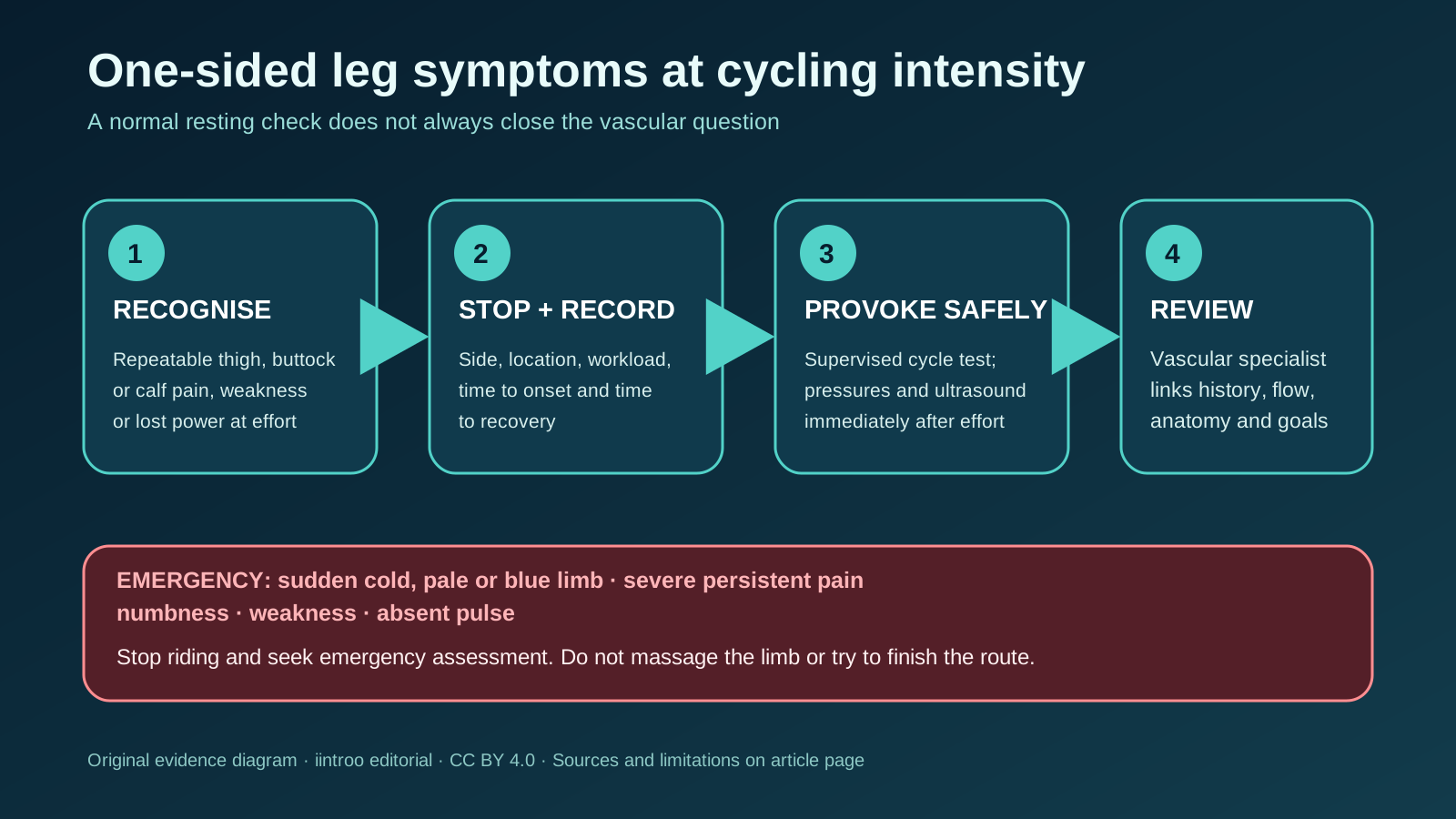
- Iliac artery endofibrosis is uncommon, but it can cause reproducible one-sided buttock, thigh or calf pain, weakness or loss of power during intense cycling while resting tests look normal.
- Diagnosis belongs in a specialist pathway that links the history with exercise-provoked vascular testing; symptoms alone cannot distinguish it from nerve, muscle or bike-fit problems.
- A suddenly cold, pale, numb or pulseless limb, or severe pain that does not settle with rest, needs emergency assessment rather than a training experiment.
The clue is a repeatable ceiling, not ordinary fatigue
This guide is for endurance cyclists and triathletes who develop a repeatable loss of power, cramping, aching, numbness or weakness mainly in one buttock, thigh or calf at high intensity. External iliac artery endofibrosis is an uncommon narrowing problem reported especially in high-volume cycling. The hip-flexed position, repeated vessel motion and very large training exposure are proposed contributors, but the biology is not fully settled and the condition cannot be inferred from mileage alone.
Symptoms often arrive at a similar workload and ease after stopping, which can be mistaken for poor conditioning, back or nerve irritation, a muscle problem, saddle position or a disappointing threshold test. Resting pulses and routine vascular measurements may be normal. That pattern should raise a question, not establish a diagnosis. Many more common conditions can create exercise-related leg pain, and a clinician should assess the whole history, both limbs, the spine and musculoskeletal system as well as circulation.
Make the investigation reproduce the problem safely
The 2016 Delphi consensus describes a diagnosis built from a characteristic history plus vascular testing around exercise. Depending on local expertise, this may include ankle–brachial pressure measurements and duplex ultrasound immediately after a cycle or other provocation test. Later reviews underline why timing matters: a long delay after exercise may allow an abnormal result to disappear. Specialist imaging can be added when it would change management, but no single scan is a screening test for every cyclist with tired legs.
Do not try to prove the diagnosis by repeatedly riding through escalating symptoms on an open road. Record which leg is affected, where the sensation begins, the approximate effort and time to onset, whether cadence or hip position changes it, and how quickly it resolves. Power data can document a repeatable ceiling but cannot identify its cause. A supervised protocol is safer and lets the clinical team connect symptoms, pressures, flow and anatomy rather than interpreting an isolated number.
Treatment decisions depend on goals, anatomy and uncertainty
Evidence for management comes mostly from case series, specialist cohorts and reviews rather than large randomised trials. Reducing provoking exposure or changing cycling position may be discussed for selected people, particularly when competition is not the overriding goal, but conservative management does not guarantee that a fixed narrowing will resolve. Surgery has been used for athletes with confirmed disease and substantial performance limitation, yet procedures and outcomes vary and complications are possible. Endovascular stenting is not a generic shortcut for a young mobile artery.
A vascular surgeon or multidisciplinary sports team should explain diagnostic confidence, disease location, alternatives, procedural risks and what the athlete values. The decision is not simply professional versus recreational: daily symptoms, bilateral disease, competition ambitions, other health conditions and tolerance for uncertainty all matter. Published return-to-sport results are encouraging in selected surgical cohorts, but selection and follow-up differ. They cannot supply a guaranteed operation or a universal date for racing again.
Use a criteria-led return and keep emergencies separate
After any intervention, progression should follow wound healing, vascular status, symptoms, strength, movement and increasing cycling demand. Easy spinning without symptoms is not the same as tolerating prolonged hip flexion, climbing, repeated attacks or a time trial. The treating team may repeat functional vascular testing before unrestricted competition. Sudden recurrence, new rest pain, a marked change in pulses or neurological symptoms warrants reassessment rather than a bike-fit adjustment alone.
A limb that becomes suddenly cold, pale or blue, very painful, numb, weak or pulseless is an emergency. Severe symptoms that do not resolve after stopping also need urgent care. Do not massage the limb, complete the route or wait for the next clinic slot. This article does not diagnose endofibrosis, recommend a procedure or clear return to cycling; it helps athletes recognise when a reproducible exercise problem deserves appropriately timed vascular assessment.