
Hypermobility in dancers: build control without treating flexibility as a diagnosis
Flexible joints do not automatically mean injury or EDS. Understand dancer hypermobility, persistent symptoms, clinical assessment and supportive training.
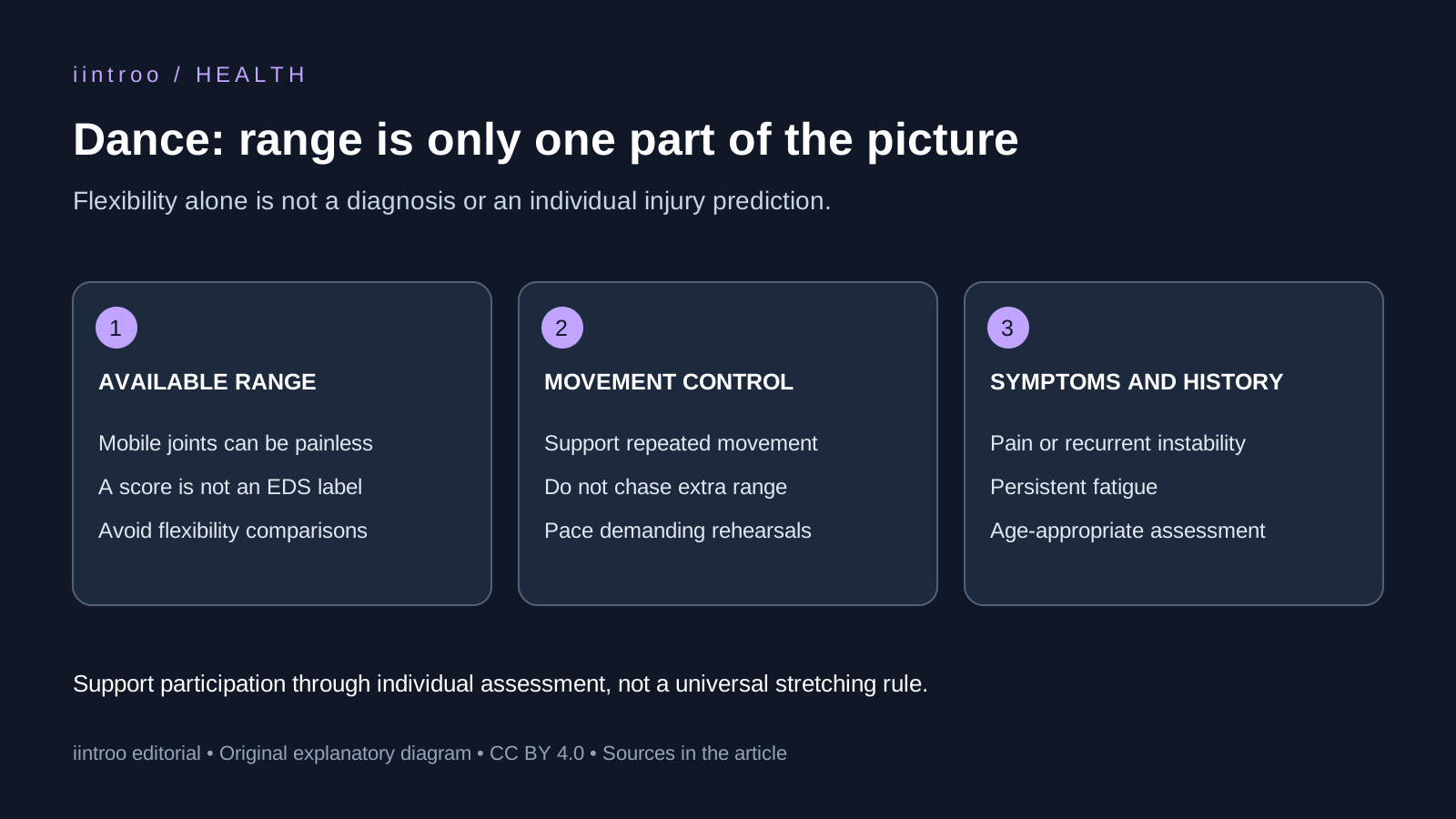
Key points
- A flexible joint or high screening score is not an EDS diagnosis.
- Dance studies do not establish one injury risk for every hypermobile dancer.
- Persistent pain, instability and fatigue warrant individual assessment.
Flexibility is a characteristic, not a verdict
A dancer may have unusually mobile joints without pain or any diagnosed disorder. That range can be useful artistically, but the ability to reach a position does not tell a teacher how comfortably the dancer can repeat, support or leave it. This guide is for dancers, parents and teachers considering what flexibility means for health, not for deciding who has the right body for dance.
Hypermobility alone does not establish Ehlers-Danlos syndrome. Persistent pain, recurrent instability or dislocations, fatigue and other troublesome symptoms deserve an assessment rather than a label based on a photograph or a flexibility challenge. A clinician considers the history and examination together.
What dancer studies actually show
A 2021 prospective study followed 185 pre-professional contemporary dancers through an academic year. Generalized hypermobility, measured using several Beighton-score definitions, was not associated with injury in that cohort. A previous long-lasting injury was associated with subsequent problems. This does not establish that every hypermobile dancer is protected: participants came from one institution, injury reporting was questionnaire-based and a screening score cannot describe every joint.
A separate study of 132 female dancers aged 12–14 found poorer strength and balance measures and more kneecap-related pain in those with both hypermobility and scoliosis. Because measurements were taken cross-sectionally, it cannot show that flexibility caused pain or that a particular exercise programme would prevent it. Different populations and definitions help explain apparently conflicting findings.
Do not turn risk factors into predictions
A systematic review published in May 2026 included 46 articles covering 7,310 classical ballet dancers. It identified overload, hypermobility and psychosocial factors among reported injury associations. Its literature search ended in July 2023, and the available publisher abstract does not provide a single dependable risk estimate for an individual dancer. A recent publication date does not mean every included study is recent.
The practical lesson is to review more than flexibility. Previous injury, current symptoms and the demands of classes and rehearsals belong in the conversation. A high score should not become an automatic exclusion, while a low score should not be used to dismiss pain.
Support capacity rather than chase extra range
For symptomatic hypermobility, NHS guidance emphasizes muscle strength, fitness, posture and balance, with specialist advice where needed. Avoid repeatedly pushing a joint farther simply because the range is available. Regular breaks and pacing can help manage repetitive activity. The aim is to make participation manageable, not to win a comparison of who can stretch furthest.
In a dance setting, discuss which movements provoke symptoms with a suitably qualified clinician and teacher. The aim is an individualized way of supporting participation, not a universal stretching ban or a promise that strengthening eliminates injury. A diagnosed connective-tissue condition may require different advice depending on its type and effects.
Young dancers need age-appropriate assessment
Children are commonly more flexible than adults. The 2023 pediatric framework distinguishes an asymptomatic physical trait from symptomatic hypermobility presentations and recommends assessment appropriate to biological maturity. It includes more than a Beighton score: symptomatic joints, musculoskeletal complications and relevant wider features must be considered, with other diagnoses excluded where appropriate.
Parents can help by recording recurring pain, episodes of giving way, fatigue and changes in participation rather than repeatedly testing extreme positions. Discuss persistent or worsening problems with a healthcare professional. This expert-informed framework guides clinical classification; it is not a self-diagnosis checklist, a dance-selection test or a return-to-performance timetable.
Sources: 5