
Down syndrome and sport: support participation while watching specific health signals
Sport can build fitness and autonomy for people with Down syndrome; inclusive coaching should sit beside individual heart, neck, hearing and vision review.
Key points
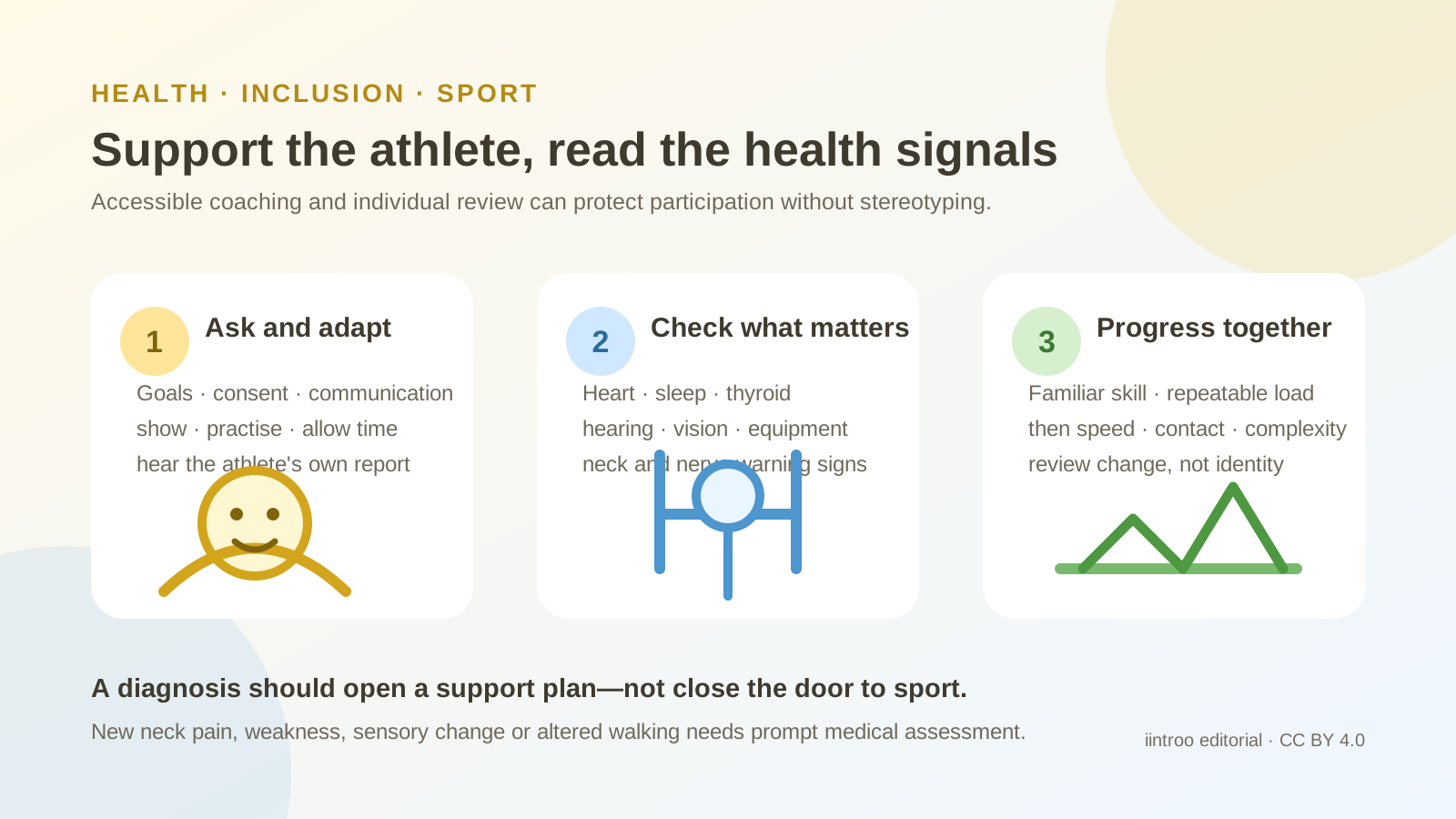
- Down syndrome should not trigger automatic exclusion from sport; health review should be individual and linked to the actual activity.
- New neck pain, weakness, sensory change, altered walking or bowel or bladder control can signal spinal cord compression and requires prompt assessment.
- Hearing, vision, heart, thyroid, sleep and communication needs may affect training, so accessible coaching is part of safety and performance.
Begin with the athlete's goals and actual health, not a stereotype
This guide is for athletes with Down syndrome, families, coaches, clubs and health teams. Down syndrome is associated with intellectual disability and a higher frequency of some health conditions, but people differ widely in communication, fitness, coordination, medical history and sporting goals. Participation decisions should start with the athlete's preferences and current assessment. A diagnosis by itself is not evidence that a person is unsafe, incapable of learning skills or limited to one level of competition.
The American Academy of Pediatrics health-supervision report and Special Olympics processes place physical activity beside ongoing health care. Relevant issues can include congenital or acquired heart disease, thyroid disease, sleep apnoea, hearing and vision changes, coeliac disease, seizures and musculoskeletal concerns. A coach does not need every private detail. With consent, an emergency plan can state what staff should notice, what assistance works, which medicines or devices travel with the athlete and who to contact.
Use exercise evidence to support inclusion, not certainty
A 2024 systematic review found that exercise, physical activity and sport programmes can improve aspects of physical fitness in adults with Down syndrome. A newer systematic review of resistance training reported gains in strength, physical function and balance. Studies were generally small, programmes varied, and many did not represent long-term competitive sport. The evidence supports providing opportunities and skilled instruction; it does not establish one ideal programme or show that every athlete has the same response.
Build from familiar tasks and repeatable success. Use demonstrations, pictures, short phrases or consistent routines according to the athlete's communication preferences. Allow processing time, check understanding without infantilising the person and ask before touching or physically guiding. Progress technique, load, duration and competition complexity separately. Accessible instruction can improve performance and autonomy for the whole team; it is not a substitute for medical review where symptoms or a known condition make that necessary.
Treat neck and neurological warning signs as symptoms, not paperwork
People with Down syndrome have an increased risk of atlantoaxial instability and symptomatic spinal cord compression, although serious neurological injury is uncommon. Warning signs include new neck pain or abnormal head position, weakness, numbness or tingling, a change in walking, loss of hand skill, spasticity or a change in bowel or bladder control. Stop the activity and seek prompt medical assessment. Do not repeatedly test the neck, manipulate it or ask the athlete to play through neurological symptoms.
Screening policy is not uniform. The AAP does not recommend routine cervical-spine radiographs for asymptomatic children because a normal image does not reliably predict later problems, while a 2025 WFNS consensus advocates neurological and radiological screening in high-risk syndromic populations. Special Olympics rules use symptom disclosure, examination and additional neurological evaluation when indicated. Clubs must follow their governing rules and qualified clinical advice rather than inventing a universal x-ray rule from this disagreement.
Make the environment legible and review change over time
Check that hearing aids, glasses, protective eyewear, footwear and communication supports work in the sport environment. Pool acoustics, echoing halls, glare, travel disruption and unfamiliar officials can change how instructions are received. Show the venue and emergency routine in advance where possible, keep cues consistent and provide an accessible way to report pain, breathlessness, dizziness or fatigue. Consent and safeguarding procedures should match the athlete's age and decision-making support needs without removing their voice.
Reassessment is appropriate after a new symptom, injury, surgery, major change in function or updated governing-body requirement. Return should use stable health, comfortable movement, repeatable sport skills and recovery across more than one session before higher speed, contact, inversion or fall consequence. There is no universal x-ray finding, heart-rate target, strength score or waiting period that clears every athlete. This page provides general education, not diagnosis, cervical-spine screening, legal eligibility or personal clearance.