
Duchenne muscular dystrophy and sport: protect movement without overworking fragile muscle
Duchenne exercise should preserve movement, enjoyment and access while avoiding overwork. Stage, heart, breathing, bone and recovery needs make plans individual.
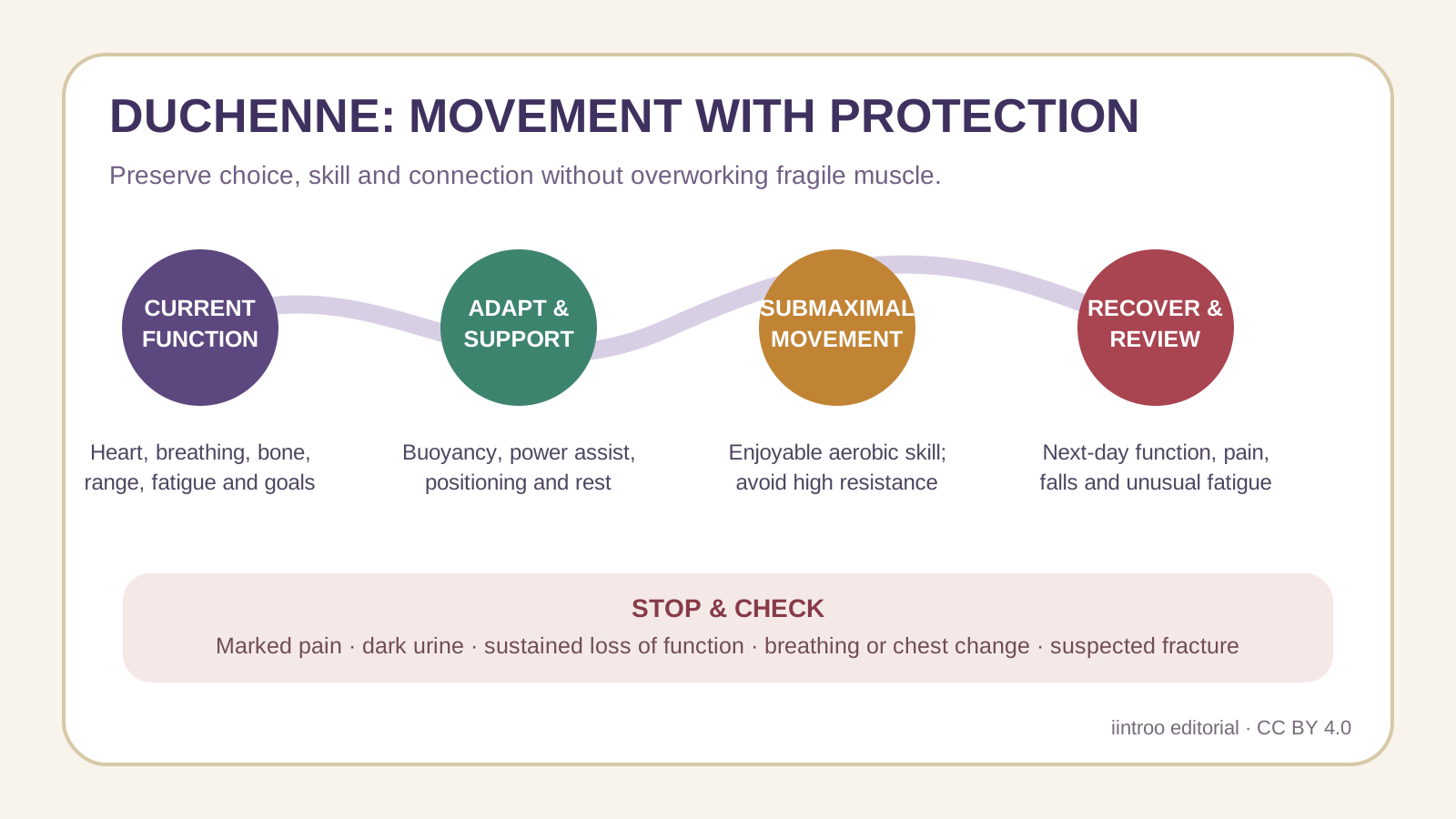
Key points
- Duchenne muscular dystrophy is progressive and multisystem; exercise should be prescribed and monitored by the neuromuscular rehabilitation team across disease stages.
- Current care guidance favours enjoyable submaximal activity while avoiding high-resistance and eccentric loading, but the trial evidence is small and uncertain.
- Marked pain, dark urine, prolonged loss of function, breathing change, chest symptoms or a fall requires assessment rather than encouragement to push through.
Start from the current stage, not a generic fitness target
This guide is for children, adolescents and adults with Duchenne muscular dystrophy, their families, coaches, schools and adaptive-sport teams. DMD is a progressive dystrophinopathy that affects skeletal muscle and can also involve the heart, breathing, bone, endocrine health and learning. Walking status alone does not describe function or risk. The neuromuscular team should connect activity with current strength, range, transfers, seating, equipment, respiratory and cardiac follow-up, medicines, fractures, pain, fatigue and the person's own goals.
International care considerations recommend rehabilitation assessment throughout life and support physical activity that avoids unnecessary immobility and isolation. The objective is not to train around the diagnosis as if it were ordinary deconditioning. Dystrophin-deficient muscle is structurally vulnerable, and capacity changes over time. A physiotherapist or occupational therapist who knows DMD can adapt movement, gravity, leverage, support, duration and rest while preserving choice, play, skill and social participation.
Keep load submaximal and interpret the small evidence base
Care guidance favours submaximal aerobic activity, particularly earlier in the course, with adequate rest. It advises avoiding high-resistance strength work and eccentric loading, where a contracting muscle is forcibly lengthened, because of concern about muscle injury. Swimming, assisted cycling and supported movement can reduce gravitational demands, but they still require individual access, transfer, temperature and fatigue planning. A sport label is not enough: propulsion method, water entry, hills, braking, repeated stairs and competitive pacing can change the real load.
A 2022 systematic review included 12 studies and 282 participants. Selected strength and endurance outcomes favoured exercise, but certainty was very low and quality-of-life evidence was sparse. A 2024 randomized study included 23 ambulant children and found that adding 12 weeks of supervised submaximal cycling helped maintain gait and balance, with an additional change in one balance measure. A 2026 expert meeting report supports conservative individualized exercise but also states that modality and dose remain understudied. These findings justify careful opportunity, not a universal prescription or promise to slow disease.
Build the session around access and recovery
Agree an effort ceiling, frequent rests and a simple way for the participant to report pain, breathlessness and fatigue without selection pressure. Use power assistance, buoyancy, supported positions, reachable targets and adapted rules to preserve skill and autonomy. Monitor how function returns after the session and the next day. Repeated falls, longer recovery, new transfer difficulty or loss of an ordinary daily task matters more than a coach's impression that motivation was low.
Glucocorticoid treatment, bone fragility and contractures can change fall and fracture risk; cardiac and respiratory involvement can change tolerance and emergency planning. Back pain can signal vertebral fracture, and stopping long-term steroids abruptly can risk adrenal crisis. Coaches should know the person's emergency information but must not change steroids, ventilation, cardiac treatment, splints or standing programmes. Heat, infection, travel and inaccessible toilets or changing rooms can also consume limited energy before sport begins.
Stop for injury signals and return without a fixed timetable
Stop the activity and contact the clinical team for marked muscle pain, dark or cola-coloured urine, a sustained drop in function, new swelling, repeated falls, a suspected fracture or unusual recovery. Severe breathing difficulty, chest pain, fainting, blue or grey colour, confusion, major trauma or a very unwell participant requires urgent care. Following a fall, do not pull a person to standing without the agreed transfer method; protect comfort, dignity and possible injury while activating the venue plan.
After illness, injury or equipment change, re-establish comfortable daily movement and positioning before controlled activity and sport skills. Participation may mean changing the goal, assistance or duration rather than returning to a previous benchmark. This page cannot diagnose DMD, prescribe exercise, stretching or equipment, interpret cardiac or respiratory testing, change medicines or clear participation. It supports decisions led by the person, family and neuromuscular rehabilitation team, with evidence limits made explicit rather than filled by overwork or avoidable restriction.