
Restless legs in endurance athletes: sleep, iron and assessment
An urge to move the legs at night is not simply training soreness. Learn the restless-legs pattern, iron-testing context and limits of exercise evidence.
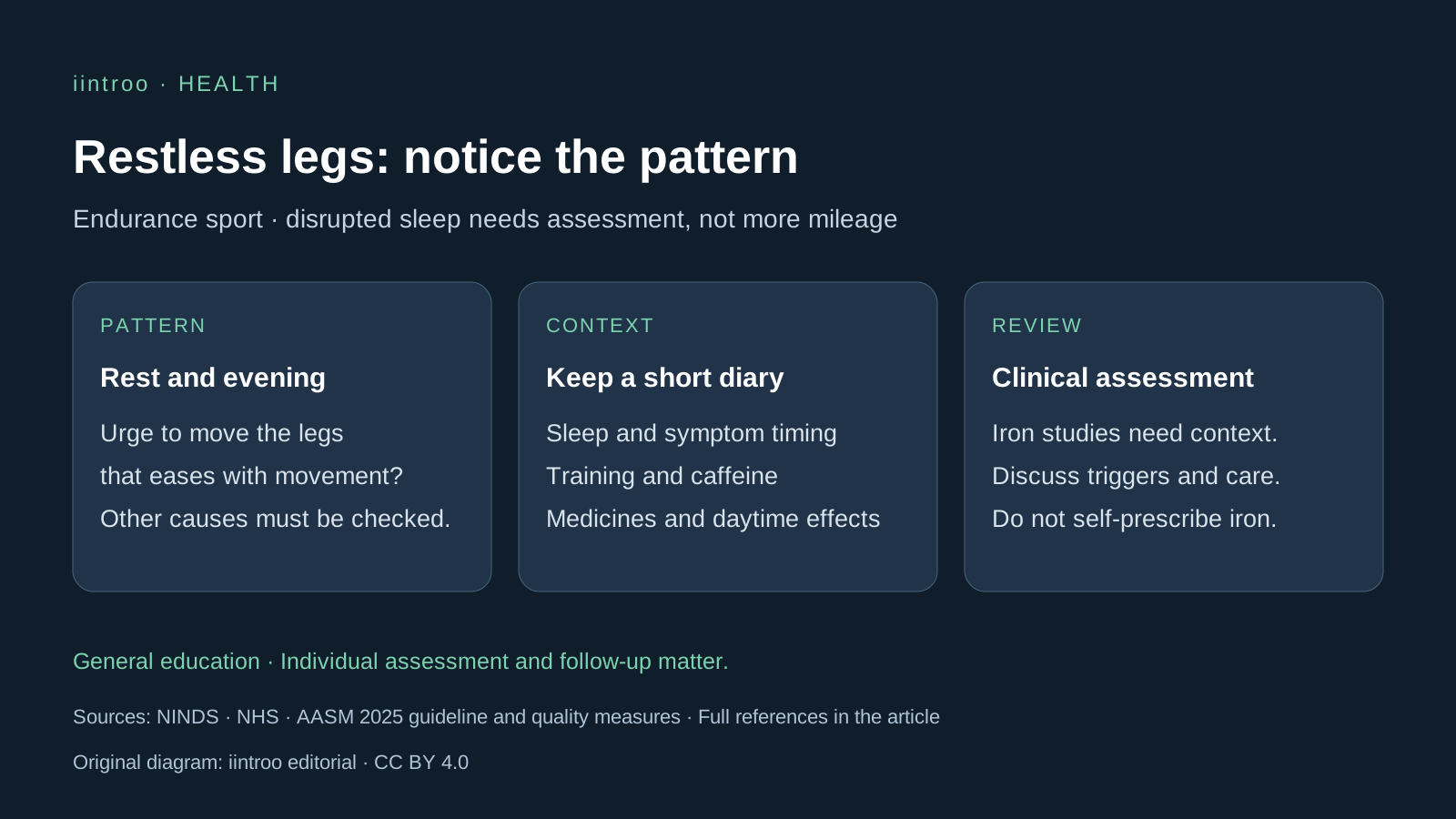
Key points
- An evening urge to move that worsens at rest and temporarily eases with movement deserves a clinical history, not a wearable diagnosis.
- Iron assessment for restless legs is not the same as a generic performance supplement target.
- Small exercise trials in general patients do not show that an endurance athlete should add more training.
The timing and urge matter more than the training label
For a runner, cyclist or cross-country skier, uncomfortable legs at bedtime can easily be blamed on the day's session. Restless legs syndrome has a more specific pattern: an urge to move, often with unpleasant sensations, that appears or worsens during rest, is temporarily relieved by movement, and is worse in the evening or night. Other explanations must be considered before assigning that diagnosis.
This guide concerns adult athletes whose sleep is being disturbed; it does not establish that endurance training causes the condition. NINDS explains that diagnosis rests on the clinical history and examination, not a single definitive test. A watch recording restless sleep cannot distinguish this syndrome from cramps, nerve symptoms or other causes of disrupted sleep.
Bring the pattern to an appointment
Write down when symptoms start, whether sitting or lying still brings them on, what movement changes, and how sleep and daytime functioning are affected. For an athlete, adding training times, travel and caffeine use gives the clinician useful context. This is a practical history aid, not a diagnostic score or proof that the hardest workout caused that night's symptoms.
Seek assessment when symptoms keep you awake, affect mental wellbeing, or persist despite basic changes. Mention medicines, family history and other health conditions. Sleep-apnoea symptoms also deserve attention. The 2025 AASM quality-measures update emphasizes tracking symptom severity and treatment complications rather than judging success only by whether someone has been given a prescription.
Iron needs interpretation, not a performance target
The January 2025 AASM guideline recommends regular ferritin and transferrin-saturation assessment in clinically significant restless legs syndrome. Its iron-treatment thresholds come from consensus and differ from general-population thresholds; they should not be turned into a self-directed supplement target. The decision about whether and how to replace iron belongs with the clinician.
The December 2025 quality-measures update notes that ferritin is an acute-phase reactant and that repeat testing depends on clinical changes, including blood loss, worsening symptoms or iron treatment. A single result detached from its context is not a complete assessment. Bring previous tests and a list of supplements, rather than assuming that a normal haemoglobin result answers every iron-related question.
Exercise evidence does not mean more mileage
A small randomized trial published in 2006 tested combined aerobic and lower-body resistance exercise in people with restless legs syndrome. Forty-one were randomized, 28 began the intervention phase and 23 completed the 12-week trial. Symptoms improved in the exercise group compared with controls. The small sample and substantial attrition limit confidence, and these were not highly trained endurance athletes.
That study cannot tell a marathon runner or skier to add another hard session as treatment. NHS advice supports daytime activity and a regular sleep schedule while discouraging strenuous late-night exercise. Discuss how these ideas fit the existing training week; do not replace planned recovery with extra work simply because exercise helped a different study population.
Review triggers and treatment safely
The AASM guideline identifies caffeine, alcohol, certain medicines and untreated obstructive sleep apnoea as factors to review. For athletes, that conversation can include caffeinated training products and over-the-counter medicines as well as prescriptions. Reviewing a possible trigger is not permission to stop a necessary medicine without advice.
The guideline also cautions against routine long-term use of several dopamine-based treatments because symptoms can worsen over time, a problem called augmentation. Anyone already taking treatment should arrange a review rather than making abrupt changes. NHS ropinirole guidance specifically warns against sudden stopping and explains that reduction needs a doctor's plan.
Persistent sleep disruption is a reason to seek care, not a failure of training discipline. This article provides general education; it does not select medication, prescribe iron, or diagnose a sleep disorder.