
Eosinophilic esophagitis in sport: protect swallowing without improvising a diet
Eosinophilic esophagitis can disrupt swallowing and fuelling. Athletes need specialist treatment, dietitian support and an emergency plan for food impaction.
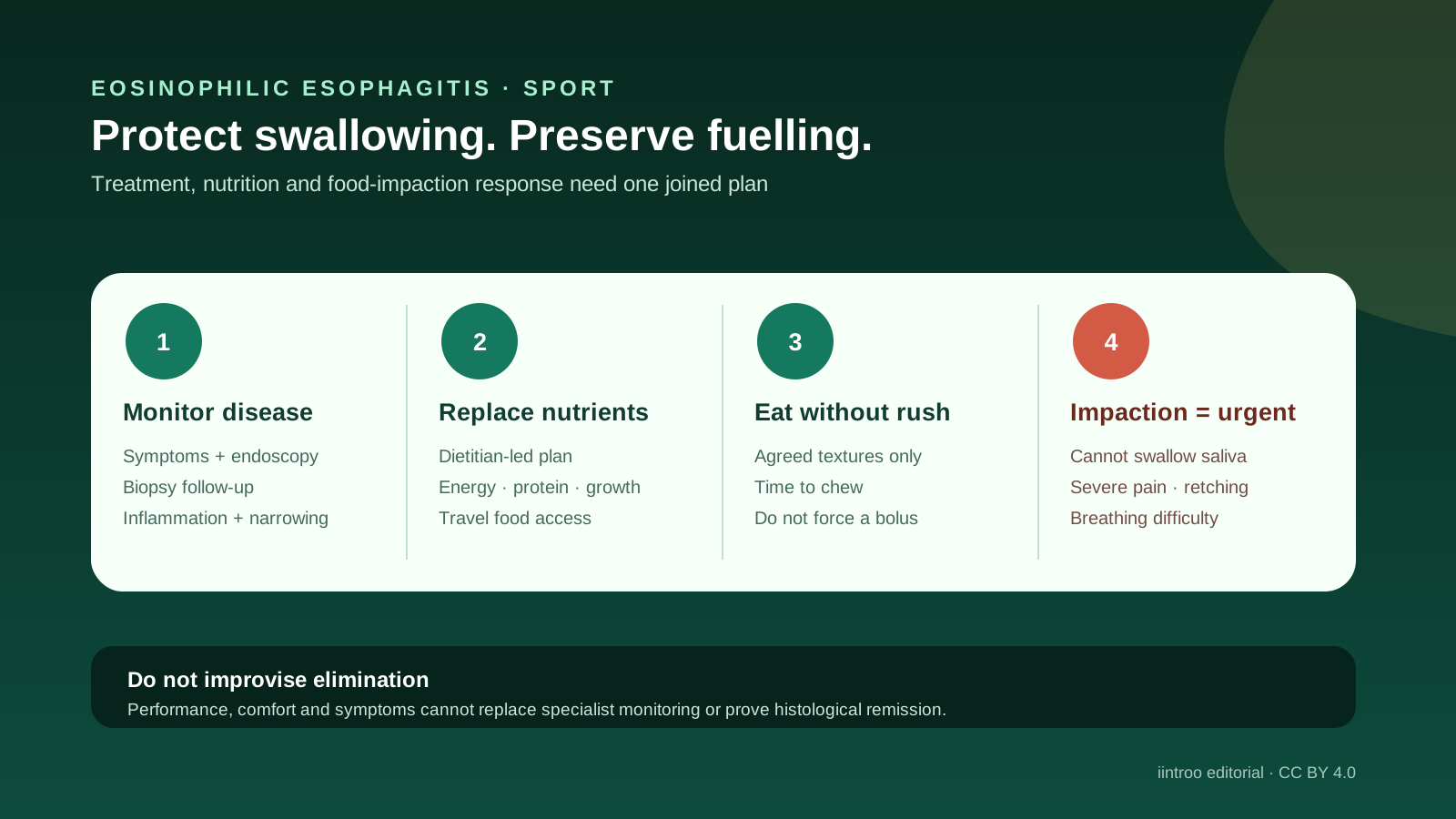
Key points
- Eosinophilic esophagitis is diagnosed from symptoms plus endoscopy and biopsies; swallowing difficulty or food impaction is not explained by exercise alone.
- Symptoms can improve while inflammation persists, so training comfort is not a substitute for the follow-up endoscopy and biopsy plan.
- Food stuck so that it will not pass, inability to swallow saliva, breathing difficulty or severe chest pain requires urgent medical assessment.
Do not normalize swallowing workarounds
This guide is for athletes with diagnosed or suspected eosinophilic esophagitis, families, coaches and travel teams. EoE is a chronic immune-mediated disease of the oesophagus. In adolescents and adults, warning patterns include trouble swallowing, food sticking, eating very slowly, excessive chewing, avoiding dry or dense foods, drinking repeatedly to move food, or previous food impaction. Children may also have feeding difficulty, vomiting, abdominal pain or poor growth. These behaviours can become so familiar that an athlete reports no symptoms while quietly restructuring every meal.
The 2025 American College of Gastroenterology guideline requires symptoms of oesophageal dysfunction, oesophageal biopsies with the relevant eosinophil threshold and evaluation for other causes. Training symptoms cannot make the diagnosis, and a normal-looking oesophagus does not exclude it. Endoscopy and pathology belong to qualified clinicians. A coach can document when swallowing problems occur and whether travel, rushed meals or particular textures expose them, but should not label food allergy, prescribe elimination or tell an athlete to train through chest discomfort.
Keep treatment and fuelling decisions connected
ACG recommends shared decision-making among established pharmacological and dietary options, with monitoring that includes symptoms, endoscopy and histology. Symptoms alone do not reliably show whether inflammation is controlled. Treatment can include proton-pump inhibitors, swallowed topical steroids, empiric elimination diets, dupilumab and dilation for selected strictures. These are clinical decisions. An athlete should not change timing, dose or technique around competition without the prescribing team, and inhaled medication used for asthma is not automatically equivalent to swallowed EoE treatment.
If an elimination diet is chosen, use an EoE-experienced dietitian. The updated guideline favours considering less restrictive starting strategies, while the evidence shows that broader restriction can increase burden. Sport adds energy, protein, travel, recovery and food-access demands. Replacing removed foods matters as much as removing them. A coach or teammate should not invent a six-food exclusion, use allergy testing to dictate the diet, or recommend supplements as nutritional insurance. Growth, weight, iron, bone health and total energy may need individual review.
Design eating and travel routines around swallowing safety
Plan enough time to eat without rushing before training, travel or team meetings. Use only textures and preparation methods the clinical team has said are appropriate, chew carefully and keep prescribed treatment accessible. Pack safe, nutritionally adequate options for unfamiliar venues and confirm ingredient information without assuming that a food labelled allergen-free meets the athlete's EoE plan. Hydration can support sport and comfort, but water should not be used to force a stuck bolus through the oesophagus.
Agree what staff should do if food sticks. An athlete who cannot clear food, cannot swallow saliva, drools, has severe chest pain, repeated retching or breathing difficulty needs urgent assessment. Do not give more food, induce vomiting, perform blind finger sweeps or rely on carbonated drinks or another home remedy. Breathing difficulty or collapse is an emergency. Food impaction may require endoscopic removal and should prompt follow-up for the underlying inflammatory and fibrostenotic disease even if the obstruction eventually passes.
Return when intake and the clinical plan are stable
After an impaction, endoscopy, dilation or treatment change, follow the procedural and clinical team's eating and activity instructions. Re-establish comfortable intake, hydration and everyday function before a hard training session or remote event. Persistent pain, fever, vomiting, inability to eat or drink, black stool, blood, worsening swallowing or unexplained weight loss needs review. Do not use restored performance as proof of histological remission, and do not cancel planned monitoring because the athlete can finish a race.
A useful team plan separates three questions: what the athlete can safely eat now, how energy and nutrients will be replaced, and what triggers urgent escalation. It should travel with the athlete without disclosing more health information than necessary. This article cannot diagnose EoE, prescribe a diet, medication, dilation or food texture, interpret biopsies or clear return. It supports specialist treatment, dietitian-led fuelling and an emergency response that treats food impaction as more than an inconvenient missed session.