
Equestrian concussion: return to riding is not same-day clearance
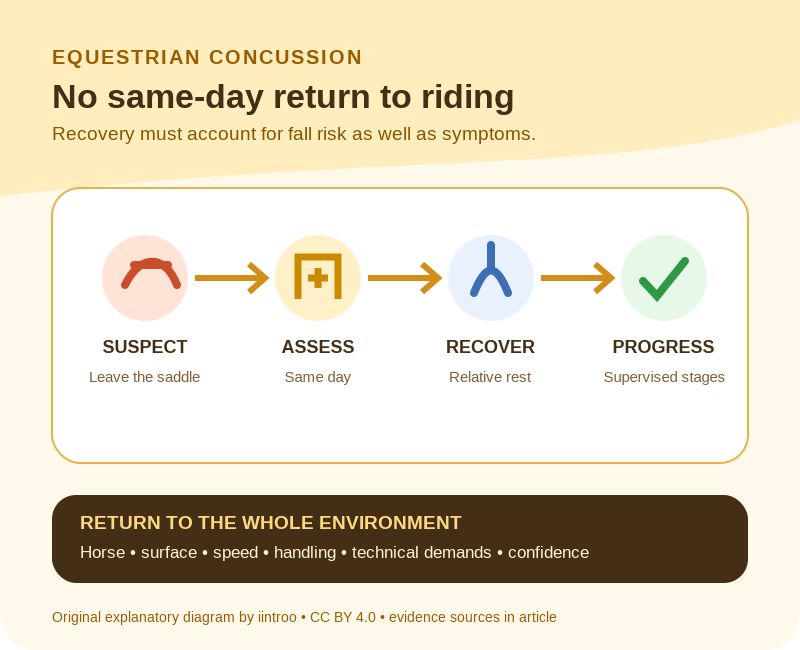
A rider with suspected concussion should leave the saddle and enter a supervised, staged recovery process that accounts for the risk of another fall.
Key points
- Suspected concussion means no same-day return to riding.
- Modern guidance favours brief relative rest, not prolonged isolation.
- Later stages must account for the risk of a fall or another head impact.
Who this guide is for
This guide is for riders, coaches, parents, officials and stable teams after a fall, kick or blow that raises concern for concussion. Loss of consciousness is not required. New confusion, memory difficulty, headache, dizziness, balance problems, vision change or unusual behaviour should trigger removal from riding and same-day assessment by an appropriate healthcare professional.
FEI guidance states that a rider with suspected concussion must not return to the horse that day. The risk is not limited to competition: handling, leading, mounting and riding at home can expose an impaired athlete to another fall. Activate emergency services for deteriorating consciousness, repeated vomiting, seizure, severe worsening headache, neck pain, weakness or other urgent danger signs.
Recovery guidance has moved beyond strict rest
The FEI document provides a staged riding framework, but its opening stage uses older language about complete rest. The 2023 Amsterdam consensus recommends relative—not strict—rest for the first 24 to 48 hours, with ordinary daily activity and light physical activity as tolerated while avoiding contact, collision and fall risk.
That distinction matters: recovery should not mean prolonged isolation in a dark room, but it also does not permit an early return to the saddle. A clinician can adapt school, work, screen use and exercise to the rider’s symptoms and circumstances. Online stages cannot replace individual instructions or local federation rules.
Build the horse-specific demand gradually
A return plan can begin away from the horse with symptom-limited activity, then progress through aerobic work and more demanding exercise under clinical guidance. Equestrian-specific resources add low-risk riding and gradually increasing technical demands before unrestricted training and competition. The setting, horse, surface, discipline, speed and supervision change the consequences of an error.
Each stage should be completed without more than the symptom response allowed by the treating professional. Later stages require healthcare oversight and psychological readiness as well as physical tolerance. A quiet horse or helmet does not create medical clearance, and one balance test cannot represent an entire riding session.
Helmets reduce risk but do not diagnose concussion
The clinical review describes traumatic brain injury as more common than spinal injury in equestrian sport, with falls from a horse a leading mechanism. Certified, correctly fitted protective headgear is an essential control, but no helmet can prevent every concussion. Replace or inspect equipment according to the manufacturer and applicable federation rules after an impact.
Do not use visible helmet damage, or the absence of it, to decide whether the brain was injured. Event officials and coaches should document the incident, who observed it and how the rider left the venue. Medical assessment remains necessary even when the rider wants to continue or reports feeling normal.
Clearance is shared, documented and individual
FEI’s framework ends with unrestricted competition after completion of its medical return process. The Amsterdam consensus emphasises shared decision-making and individual factors that can change recovery, including previous migraine, anxiety, aggravation of injury and psychological stress. A typical group average is not a personal deadline.
Teams can make the process easier by identifying a concussion lead, keeping horses under safe care while the rider is assessed, and requiring written clearance where the rules do. Persistent, worsening or non-resolving symptoms need reassessment and potentially targeted rehabilitation. The goal is safe return to the whole equestrian environment—not simply sitting on a horse once.