
Breathing symptoms around horses: assess the rider and the stable air
Cough, wheeze or chest tightness in a stable can reflect several exposures. Map the task and setting, improve air controls and seek objective assessment.
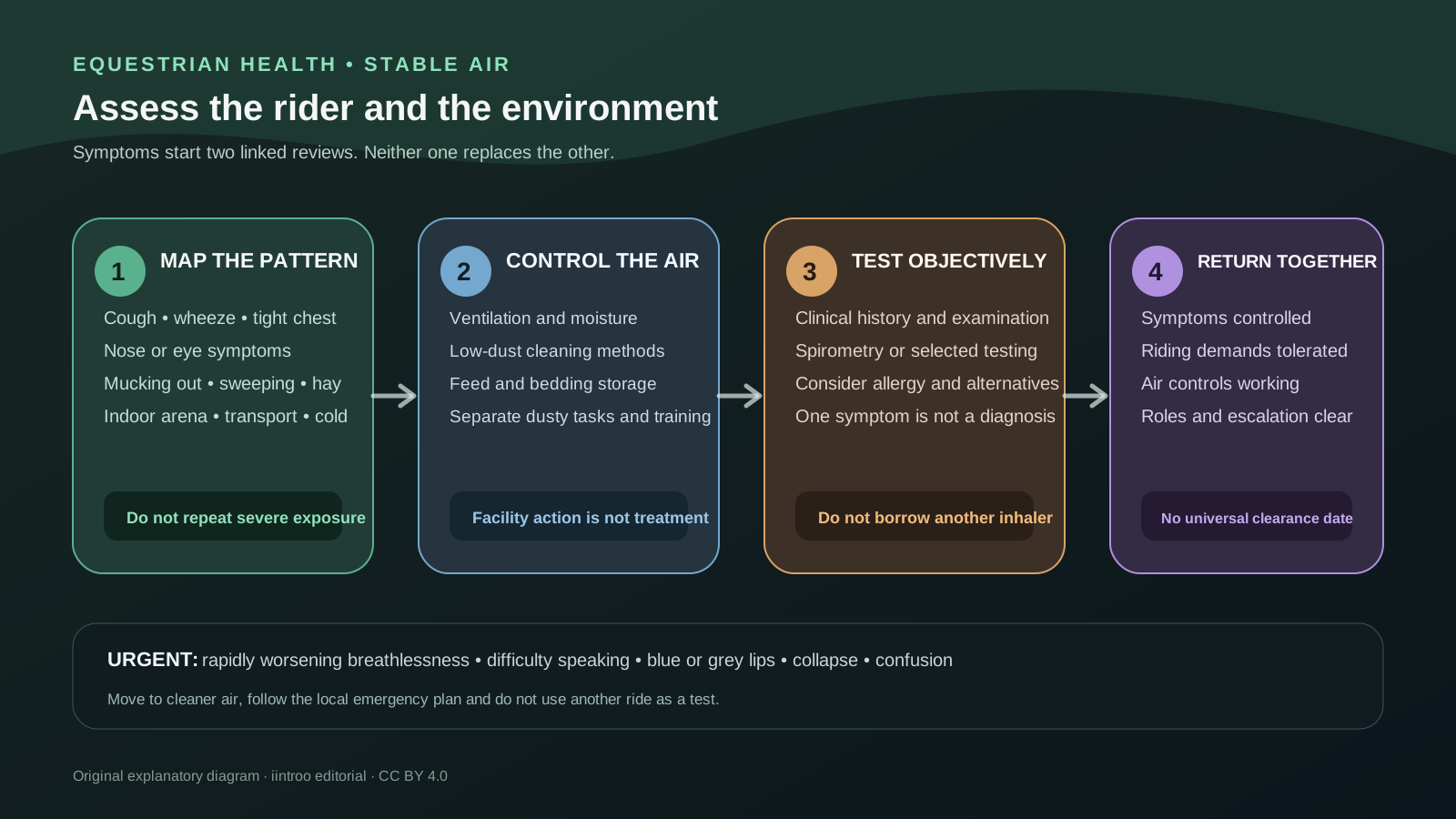
Key points
- A stable can contain horse allergen, dust, microorganisms, endotoxin, fungal components and irritant gases; one symptom cannot identify which exposure matters.
- Asthma requires a characteristic history plus evidence of variable expiratory airflow; symptoms or an allergy result alone are not the diagnosis.
- Ventilation, low-dust work methods and task planning address the environment, while clinical testing addresses the rider—neither substitutes for the other.
Map the exposure instead of naming a disease from the doorway
This guide is for riders, grooms, coaches, parents and venue teams when cough, wheeze, chest tightness, nasal symptoms or unusual breathlessness appears around horses. Stable air is a mixture rather than a single allergen. Hay and bedding can release organic dust and microorganisms; cleaning can disturb settled material; horses produce potent airborne allergen; moisture and ventilation affect fungi and particles; and urine breakdown can add ammonia. Cold outdoor exercise, pollen, infection and exercise-related airway narrowing may overlap with the indoor exposure.
Write down where and when the problem occurs: grooming, mucking out, sweeping, feeding, an indoor arena, transport, a particular stable or only hard riding. Note whether symptoms improve away from the setting and whether eye, nose or skin symptoms accompany them. That pattern can guide an environmental review and a clinical history, but it cannot establish asthma, allergy or a safe return by itself. Do not deliberately repeat a severe exposure as a personal challenge test.
Read small stable studies as signals, not rider-risk calculators
A Swedish study followed 13 workers in one stable on three occasions and measured dust, horse allergen, microorganisms, endotoxin, glucan and gases. Three workers showed signs of bronchial obstruction that might have been worsened by the environment, while winter conditions changed several air measurements. The sample was tiny, the setting was specific and diary completion was poor. It supports looking at stable climate and exposure, not a prevalence estimate for equestrian athletes worldwide.
A cross-sectional Turkish study compared 80 horse-farm workers with 30 healthy controls and also reviewed 1,376 respiratory-clinic records. Eight workers were sensitised to horse allergen, but respiratory symptoms within the worker group were not significantly associated with that sensitisation. An intervention in one riding-school stable reduced carbon dioxide and airborne horse allergen after mechanical ventilation, while several other measures changed differently. Together these studies show multiple exposures and plausible controls; they do not prove that ventilation alone treats a symptomatic person.
Separate objective diagnosis from facility action
GINA defines asthma by variable respiratory symptoms together with evidence of variable expiratory airflow. Spirometry with bronchodilator response is commonly used, and more than one test may be needed; peak-flow monitoring or selected challenge testing can support assessment when clinically appropriate. EAACI similarly recommends a structured evaluation for athletes because exertional breathlessness can arise from asthma, exercise-induced bronchoconstriction, allergy, inducible laryngeal obstruction, breathing-pattern disorder or another cause. A normal-looking rider or a single normal reading does not settle every case.
The facility can act before a diagnosis is complete: inspect ventilation and moisture, avoid dry sweeping or compressed-air cleaning, separate people from dusty tasks where possible, maintain bedding and feed storage, and schedule high-dust work away from training. These are general exposure controls, not a prescription for a particular building. A competent occupational-hygiene or ventilation assessment may be needed. A rider should not borrow another person's inhaler, antihistamine or mask as a substitute for medical review and a site plan.
Build a safe route back to the horse environment
Stop riding and move to cleaner air when breathing or alertness is deteriorating. Severe breathlessness, difficulty speaking, blue or grey lips, collapse, confusion or symptoms that are rapidly worsening needs emergency care under the local response plan. Recurrent cough, wheeze, chest tightness, night waking, falling performance or symptoms that require repeated reliever use deserves prompt qualified assessment. Nasal and eye symptoms also matter because upper-airway allergy can affect comfort and may coexist with lower-airway disease.
Return decisions should combine symptom control, the clinician's plan, ability to complete the relevant riding demands and confidence that the stable controls are working. Begin in a lower-exposure setting when appropriate and reintroduce tasks separately so a problem can be identified without recreating the highest exposure. Coaches control participation and work allocation; clinicians diagnose and treat; facility managers control the air and tasks. This page does not diagnose asthma or horse allergy, select respiratory protection, prescribe medicine or clear a rider to compete.