
EILO in athletes: noisy breathing is not always asthma
Breathing difficulty at peak exercise can come from the larynx, the lower airway or both. Symptoms alone cannot decide which treatment is appropriate.
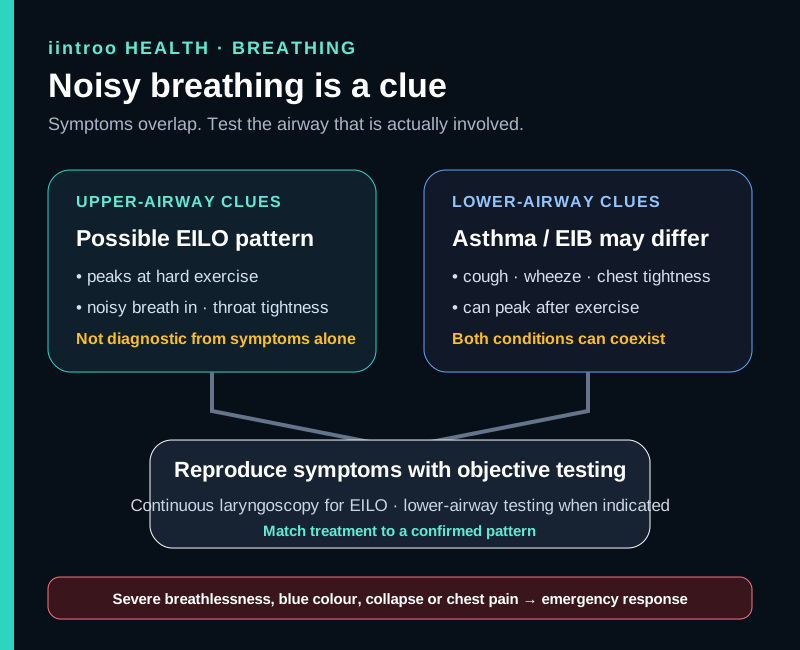
Key points
- Exercise-induced laryngeal obstruction, or EILO, is a temporary narrowing of the upper airway during exercise and can resemble asthma or exercise-induced bronchoconstriction.
- Noisy inhalation, throat tightness or symptoms at peak effort can suggest EILO, but symptom descriptions and questionnaires do not confirm the diagnosis.
- Continuous laryngoscopy during exercise is the preferred test for EILO; asthma testing may also be needed because the conditions can coexist.
Treat the sound as a clue, not a diagnosis
This guide is for athletes, coaches and health teams responding to breathing difficulty during hard exercise. EILO describes transient narrowing at the glottic, supraglottic or both levels of the larynx. It often develops as ventilation rises, may produce a harsh or high-pitched inspiratory sound and can settle quickly when exercise stops.
Those features differ from the classic pattern of exercise-induced bronchoconstriction, which often peaks after exercise, but real presentations overlap. Athletes may struggle to identify whether a sound comes from breathing in or out. EILO and asthma can also coexist, so neither a sideline description nor an audio recording should be used to rule one condition in and the other out.
Reproduce the problem and look at the right airway
The preferred test for suspected EILO is continuous laryngoscopy during exercise. A flexible scope records the larynx while exercise intensity is high enough to reproduce the athlete's usual symptoms. Resting examination can be normal, and spirometry or symptom questionnaires alone have limited diagnostic accuracy for this problem.
A respiratory assessment may also include objective lower-airway testing, because an inhaler response guessed from symptoms is unreliable. The exercise mode should resemble the athlete's provoking activity when practical. Test access, protocols and interpretation vary, and the evidence does not support self-testing by deliberately pushing through severe symptoms.
Do not escalate asthma medicine by trial and error
Repeatedly adding or increasing inhaled medicine without confirming lower-airway dysfunction can expose an athlete to side effects while leaving the actual problem untreated. An athlete with prescribed asthma treatment should continue to follow the clinician's action plan and seek review if it is not working; this article is not an instruction to stop medicine.
Document when symptoms begin, whether breathing in or out is harder, what others hear, how quickly the episode resolves and whether cough, wheeze, chest pain, faintness or allergy symptoms occur. This record can guide a qualified assessment, but it cannot replace examination and testing.
Match treatment to the confirmed pattern
For confirmed EILO, specialist breathing retraining or laryngeal-control work is commonly used. A 2025 intervention study reported improvements after a standardised speech-therapy protocol, but it was not randomised and does not prove one programme works for every subtype. The IOC review found no randomised trials available for a robust universal treatment algorithm at the time of its search.
Severe supraglottic cases may be considered for specialist surgical assessment, but that is not a general sport-performance intervention. Care should also address relevant coexisting asthma, nasal disease, reflux or other contributors. Return decisions should reflect symptom control, the athlete's sport and the plan agreed with the treating team.
Keep an emergency pathway separate
Call local emergency services for severe breathlessness at rest, blue or grey colour, collapse, chest pain, confusion, signs of anaphylaxis or any rapidly worsening episode. A suspected laryngeal problem should not delay the event emergency action plan or the athlete's prescribed rescue treatment.
For recurring non-emergency episodes, stop the session safely and arrange assessment rather than asking the athlete to prove toughness. This article offers general education, not an individual diagnosis, breathing programme, medicine change or clearance to compete.