
Familial hypercholesterolaemia in sport: exercise supports care but does not replace it
Familial hypercholesterolaemia raises lifelong LDL exposure. Exercise supports health but does not replace diagnosis, family screening or lipid-lowering care.
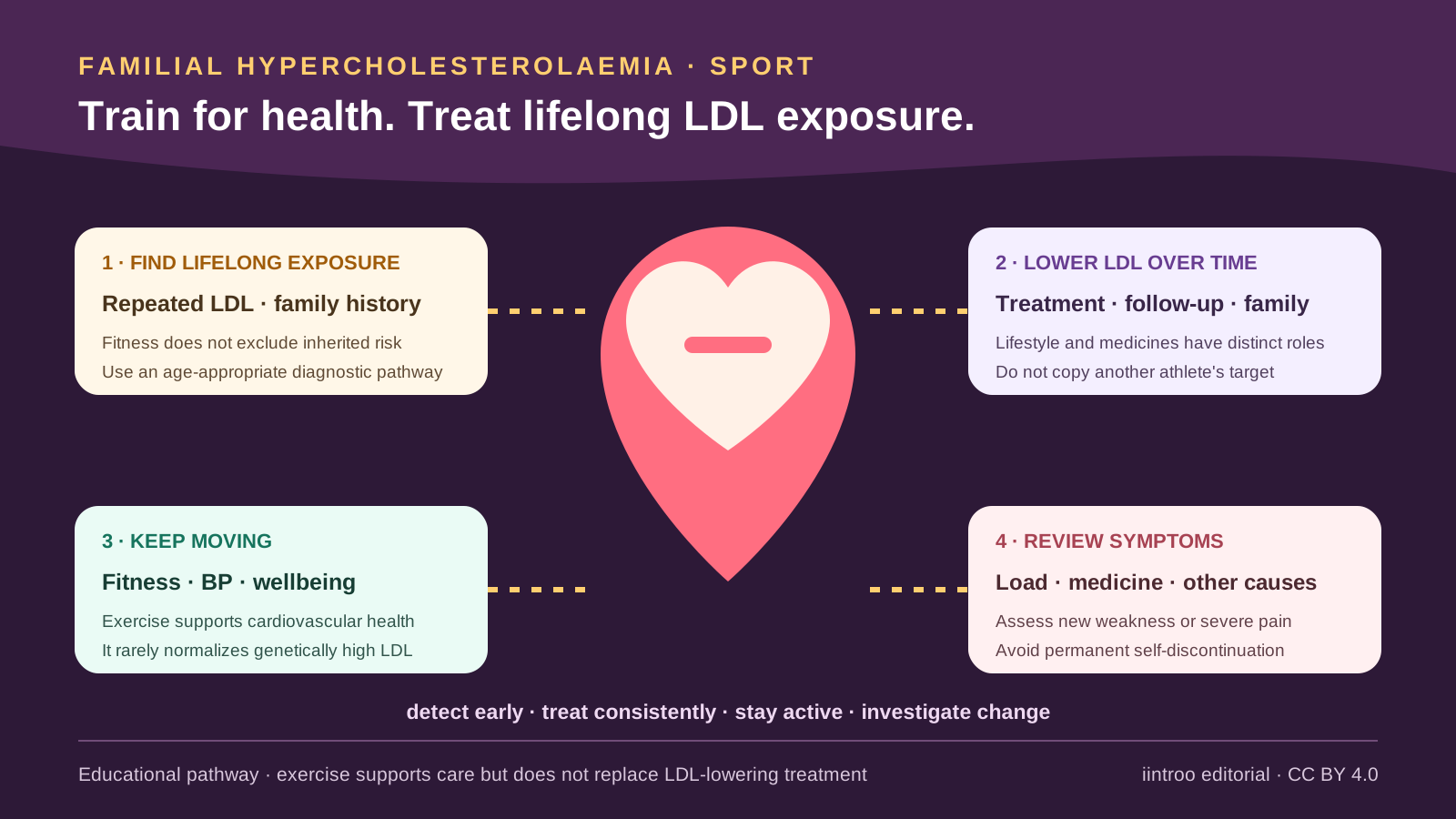
Key points
- Familial hypercholesterolaemia causes high LDL exposure from early life and can be missed in fit athletes who have no symptoms.
- Regular activity improves cardiovascular health, but exercise and diet usually cannot replace evidence-based LDL-lowering treatment in FH.
- New muscle symptoms during lipid-lowering treatment need structured assessment that considers training load and other causes rather than abrupt permanent self-discontinuation.
Do not let fitness hide lifelong LDL exposure
This guide is for athletes with diagnosed or suspected familial hypercholesterolaemia, their families and support teams. FH is an inherited condition that causes high low-density lipoprotein cholesterol from early life and increases the risk of premature atherosclerotic cardiovascular disease. A lean body, high aerobic fitness, plant-rich diet or strong race result cannot exclude it. Many affected people feel well, and the first clue may be a blood test, tendon xanthoma, premature coronary disease in a relative or an identified familial genetic variant.
Diagnosis uses repeated lipids, personal and family history, examination and sometimes genetic testing within a validated clinical pathway. Secondary causes of high LDL also need consideration. The 2026 EAS paediatric consensus emphasizes cascade testing when a parent carries a pathogenic variant and earlier specialist assessment of children with high LDL or a family history of premature disease. Testing a family is not blame: it creates an opportunity for early prevention while growth, privacy and age-appropriate communication remain central.
Keep exercise beside, not instead of, lipid-lowering care
Regular activity supports fitness, blood pressure, metabolic health and wellbeing and should be encouraged in most people with FH. Yet sports-cardiology guidance notes that exercise rarely brings genetically high LDL close to a usual range. A 2024 meta-analysis across 148 exercise trials found modest average lipid changes in broader dyslipidaemia populations, while a 2026 FH-specific scoping review found only four eligible studies with heterogeneous and inconsistent results. Neither body of evidence supports replacing prescribed treatment with harder training.
The 2025 ESC/EAS update and 2026 ACC/AHA guideline place LDL reduction inside overall cardiovascular-risk management, using statins and evidence-based nonstatin options according to the person and response. Homozygous and heterozygous FH are not the same clinical situation. Coronary disease, aortic disease in severe homozygous FH, diabetes, kidney disease, smoking, blood pressure and lipoprotein(a) can change risk. Coaches and athletes should not select a drug, dose, supplement or target from a teammate's result.
Assess muscle symptoms without ignoring either treatment or training
Athletes may notice muscle soreness while taking a statin, but high training load, a new strength block, viral illness, thyroid disease, vitamin deficiency, another medicine, a primary muscle condition and expectation effects can produce overlapping symptoms. The 2026 ACC/AHA guideline recommends a structured assessment of timing, distribution, weakness, interactions and other causes, with clinical examination and creatine kinase testing when symptoms are severe. New bilateral proximal weakness is different from familiar local soreness after a specific session.
Do not permanently stop lipid-lowering treatment, restart at random, borrow a teammate's medicine or add a supplement without the prescribing team. Many people can find a tolerated regimen through dose or medicine adjustment and evidence-based combinations. Severe muscle pain or weakness, dark urine, reduced urine, fever, collapse, chest pain or major breathlessness requires prompt assessment; dark urine after hard exercise can indicate rhabdomyolysis or another serious problem and is not safely explained by a statin label alone.
Match sport review to symptoms and established disease
An asymptomatic athlete with FH and no known cardiovascular disease does not automatically need exclusion from training. The clinical team considers age, cumulative LDL exposure, treatment, family history, other risk factors and whether symptoms or known disease require ECG, imaging or exercise testing. Exertional chest pressure, fainting, unexplained breathlessness, marked loss of exercise capacity or sustained palpitations needs medical assessment rather than a self-directed threshold test on the road or in the gym.
Continue routine follow-up even when performance is excellent and laboratory results improve. Camps and travel should preserve medication access and the athlete's established eating pattern without turning cardiovascular prevention into a restrictive weight-loss plan. This article cannot diagnose FH, interpret genetics, set LDL targets, choose treatment or clear an athlete with cardiovascular disease. It supports family-aware detection, sustained evidence-based care, regular activity and careful review of symptoms without presenting exercise as a substitute for lowering lifelong LDL exposure.