
Turf burns and skin infections: clean the wound and stop locker-room spread
Abrasions are more than cosmetic. Clean and cover broken skin, avoid shared personal items, report suspicious lesions early and manage facilities deliberately.
Key points
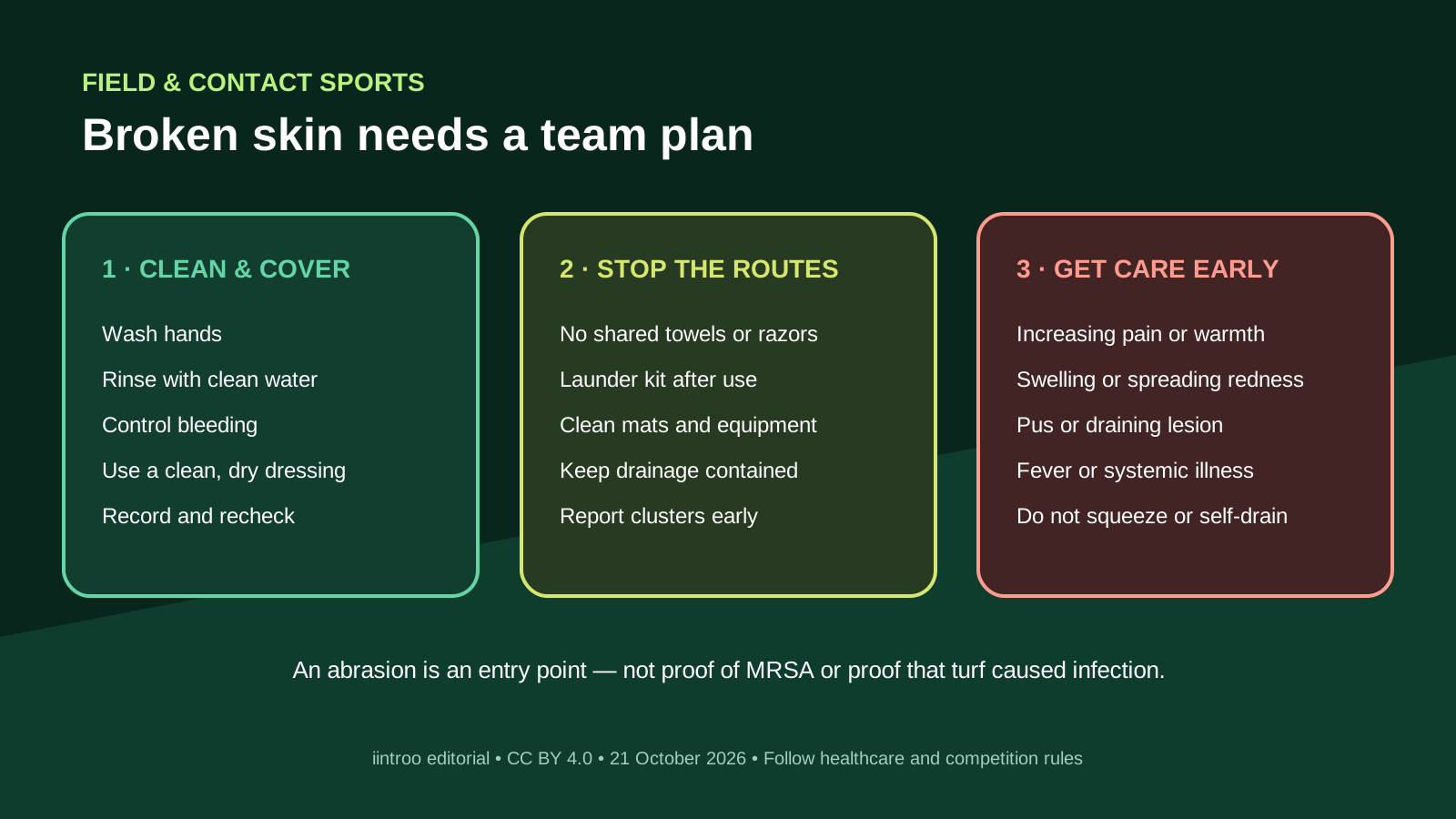
- Broken skin can provide an entry point for infection, but a turf abrasion does not prove MRSA.
- Clean, dry coverage and no sharing of towels, razors or open ointment containers reduce transmission opportunities.
- Painful, warm, swollen or draining lesions need early assessment and must not be squeezed on the sideline.
Treat every abrasion as a break in the barrier
This guide is for athletes, coaches, parents, athletic trainers and facility managers in rugby, American football, hockey, wrestling and other close-contact sports. A turf burn is a friction abrasion: the surface layer of skin has been damaged. It may contain dirt or fibres, sting and weep, but appearance alone cannot identify an organism or predict infection.
Move to a clean area, wash hands, control bleeding with gentle pressure and rinse the wound with clean running water or saline. Remove visible loose debris with clean technique when safe. Do not pour harsh disinfectant into deep tissue, scrub aggressively, share an open ointment pot or return with a wet, leaking dressing. Deep, gaping, heavily contaminated or embedded wounds need professional assessment.
Understand why MRSA prevention is a team system
MRSA is a strain of Staphylococcus aureus resistant to several antibiotics. CDC notes that athletic settings can amplify spread through skin-to-skin contact, uncovered wounds, shared items and contaminated surfaces. Cuts and abrasions can be entry points, but not every red mark is MRSA and a playing surface should not be blamed without outbreak investigation.
Historical CDC investigations documented clusters, hospitalisations and delayed reporting. Some studies found sharing towels or personal items associated with infection, while turf abrasions were common but not consistently an independent risk factor. These observational outbreaks show plausible routes; they do not calculate one athlete’s risk or justify preventive antibiotics.
Cover, separate and report
Keep cuts and wounds covered with a clean, dry bandage until healed, following healthcare advice. Wash hands after care and dispose of dressings safely. Do not share towels, razors, clothing, uniforms, washcloths or products from open containers. Launder clothing according to its label and dry it fully; do not leave damp kit sealed for days.
Report a lesion that is painful, warm, swollen, rapidly enlarging, draining pus or accompanied by fever. Do not pick, pop or drain it in a changing room. A clinician may need to examine or culture it before treatment. Rapidly spreading redness, severe pain, systemic illness, confusion, breathing difficulty or concern for sepsis requires urgent assessment.
Make facility hygiene specific and auditable
Facilities should provide handwashing, covered waste bins, wound-care supplies and a private reporting route. Clean shared equipment and high-touch surfaces on a documented schedule using products suitable for the material and risk, following label dilution and contact time. Never mix disinfectants. Mats, pads and benches need a system that can actually be completed.
Assign medical and cleaning roles before an outbreak. Multiple linked infections require public-health or infection-control advice under local rules. Screening or decolonisation of an entire team is not a do-it-yourself response. If wound drainage cannot be contained by a secure dressing, participation exposing others or shared surfaces is unsafe.
Return depends on containment, healing and sport rules
An athlete with an open or infected wound should follow healthcare and governing-body advice. CDC advises avoiding water facilities while an open wound heals. Contact-sport rules may be stricter than general wound guidance and can require clearance. Pain-free movement does not prove a wound is non-infectious, and antibiotics do not automatically mean immediate return.
Protect confidentiality while informing those responsible for exposure control. This article does not diagnose MRSA, prescribe an antimicrobial, specify a universal exclusion period or replace an event, school or federation rule. It explains immediate care and the team systems that make early reporting easier.