
Floorball eye injuries: certified protective eyewear belongs in the kit
A light ball and fast stick can still cause serious eye trauma. Use certified, well-fitted goggles, replace damaged equipment and treat every vision change after impact as a medical concern.
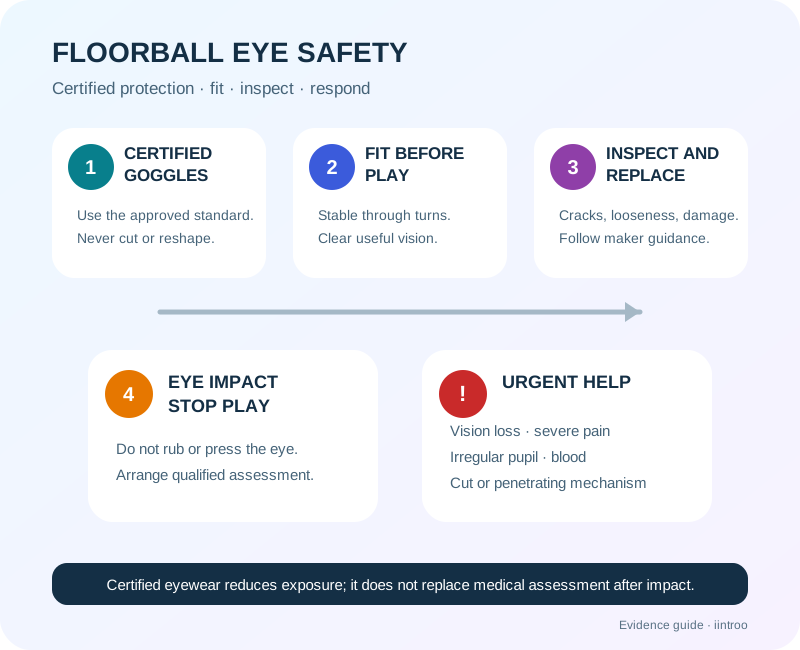
Key points
- The IFF's 2026 rules require any protective goggles worn in play to comply with IFF Material Regulations and prohibit tampering with them.
- Regional observational studies consistently identify the eye as a common floorball injury site, but their designs cannot calculate one universal injury rate for every league or prove the exact effect size of goggles.
- Blurred or lost vision, severe pain, an irregular pupil, blood in the eye, a penetrating injury or worsening symptoms after impact require urgent medical assessment; do not press on the eye.
Treat the ball, stick and close-range deflection as eye hazards
This guide is for field players, parents, coaches, equipment staff and officials. Floorball is non-contact by rule, yet a fast plastic ball, stick blade, collision or deflection can still strike an unprotected eye. A Swedish county study identified 167 floorball eye injuries from 2008 to 2011, while a Swiss emergency-department series found that the eyes accounted for 43.7% of its 263 floorball injuries. Those figures describe specific healthcare systems and periods, not every competition.
The IOC ophthalmology consensus classifies suitable protective eyewear as a major prevention measure across sports and highlights floorball experience in Nordic and central European countries. The practical lesson is not that every impact can be prevented. It is that the eye is exposed, consequences can persist and protection should be designed into routine kit policy rather than offered only after a teammate is injured.
Choose certified goggles and preserve their protective design
Under the IFF's 2026 rules, a player who wears protective goggles must use a model that complies with the IFF Material Regulations and must not tamper with it. National associations and competitions may impose additional age or equipment requirements, so teams should check the rules that actually govern their players. Ordinary fashion glasses, open frames or an unverified product are not automatically equivalent to sport protection.
Fit the frame to the athlete rather than sharing one nominal size across a squad. The goggles should remain stable during sprinting, turning and looking down without obstructing useful vision or creating painful pressure. Prescription needs should be handled with an eye-care professional and approved sport equipment. Do not drill, cut, heat or reshape a certified frame in ways that could weaken it.
Make inspection and replacement part of match preparation
Before play, check the lens, frame, strap and attachment points for cracks, deep scratches, looseness or previous impact damage. Confirm that the player can see clearly in the lighting and that sweat or fogging does not prompt repeated removal. Use manufacturer-approved cleaning and anti-fog instructions; harsh chemicals or abrasive wiping can damage a lens or coating.
Replace equipment that no longer fits, has been materially damaged or falls outside the manufacturer's service guidance. Officials inspect whether equipment is dangerous and whether goggles meet the applicable rules, but that is not a substitute for the club's own equipment process. Record which standard and model are being used so a recall or rule change can be acted on efficiently.
After an impact, stop play and protect the eye
Remove the player from play after a direct eye impact when there is pain, altered vision, marked redness, light sensitivity, swelling, headache, nausea or uncertainty about the mechanism. Do not ask the athlete to prove readiness by tracking a ball or returning for one shift. A normal-looking eyelid does not rule out injury inside the eye.
Do not rub or press the eye, do not attempt to remove an embedded object and do not apply medication or a tight patch without qualified direction. Activate the venue's medical plan. A clinician should decide what examination is needed and when sport can resume; a generic article cannot clear an eye injury or set a universal return time.
Escalate vision loss and open-globe warning signs urgently
Sudden blurred or lost vision, double vision, severe or increasing pain, an irregular pupil, blood visible in the eye, a cut or penetrating mechanism, fluid leaking from the eye, flashes or a new curtain-like shadow are urgent warning signs. Shield the area without pressure if trained to do so and arrange emergency assessment through local services. Do not give food or drink when urgent surgery may be possible unless emergency clinicians advise otherwise.
Persistent symptoms after a seemingly minor impact also need review. Teams should document the incident, inspect the protective equipment and correct any failure in fit, availability or policy. Prevention evidence is largely observational, but the combination of plausible mechanism, frequent eye involvement in case series and the low burden of certified protection supports a precautionary equipment approach.