
Goalball injury prevention: prepare for dives, throws and contact with the floor
Goalball combines dives, throws and collisions. Track wrist, hand, shoulder and skin problems, improve court preparation and return by task.
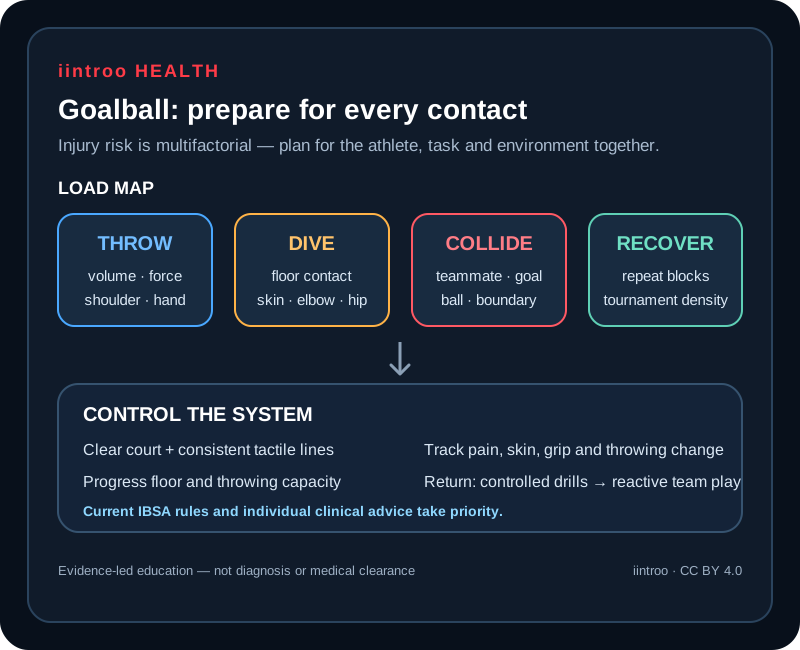
Key points
- Goalball injuries arise through several mechanisms, including floor contact, player collisions, repeated throwing and physical preparation.
- Small and retrospective studies frequently report upper-limb injuries, but their percentages should not be treated as a prediction for every player.
- Prevention combines a controlled environment, sport-specific capacity, clear communication and access to impairment-informed medical care.
Start with goalball's real movement demands
This guide is for goalball athletes, coaches, families, officials and health teams. Players repeatedly orient to sound, throw a weighted ball, dive to block, recover from the floor and coordinate with teammates while wearing eyeshades. A health plan should reflect those sport-specific tasks rather than describe visual impairment itself as the injury.
A mixed-method study combined London 2012 and Rio 2016 surveillance with participant interviews. Acute traumatic injuries were common, but the reported incidence differed greatly between Games. Interviewees described collisions, overuse, conditioning, equipment, environment and preparation as interacting mechanisms. Those findings support a systems approach, not one isolated cause.
Read the injury numbers with their limitations
A questionnaire study of 43 European Championship players reported that most recorded injuries involved the upper limbs, while a 2024 cross-sectional study of 163 male athletes in Turkish national competitions reported wrists and hands frequently. Both relied on athletes recalling previous injuries, and neither provides a universal incidence rate for women, youth or every level of play.
The broader para-athlete systematic review rated prevalence evidence very low quality and incidence evidence low quality because studies differed in samples and surveillance methods. Use these reports to decide what to monitor and study; do not turn a percentage from one tournament or country into an individual risk forecast.
Count throws, dives, floor contacts and collisions
Record training duration, throws by intensity and direction, repeated dives, defensive blocks, strength work, matches and tournament density. Add recent illness, travel, sleep, new flooring or equipment and any other sport or mobility demand. A session total can hide a sudden increase in high-force throws or floor contacts.
Track pain, swelling, grip or throwing change, reduced confidence, skin abrasions and symptoms after contact. Communication systems should let athletes report privately and orient safely when a drill changes. Sudden pain or altered technique is information to act on, not proof that an athlete lacks resilience.
Prepare the court and the athlete together
Use the current IBSA rules for court layout, lines, ball and eyeshades. Before training, keep the run-off area clear, confirm consistent tactile markings and explain the position of staff, goals and equipment. Introduce unfamiliar courts and drills progressively rather than assuming competition experience removes environmental risk.
Physical preparation may build throwing capacity, trunk control, comfortable diving and recovery from the floor. Knee, elbow or hip protection must comply with current rules and fit the individual without creating new pressure or movement problems. No single warm-up, pad or strength test has been proven to prevent all goalball injuries.
Return by task, communication and repeated tolerance
Return can rebuild comfortable daily function, controlled floor movement, easy rolling and throwing, planned blocks, faster dives, reactive drills and full team play. The sequence depends on diagnosis, body area, athlete history and response. A brief pain-free drill or a fixed rest period does not establish readiness for match collisions and repeated throws.
Suspected fracture or dislocation, deformity, loss of circulation, new numbness or weakness, severe swelling, head or neck symptoms, or a deep or infected wound requires prompt assessment; severe or rapidly worsening symptoms need urgent care. This guide does not diagnose an injury, prescribe protective equipment or provide clearance.