
After Guillain–Barré syndrome: rebuild sport around function, fatigue and safety
Recovery after Guillain–Barré syndrome can include weakness, fatigue and autonomic symptoms. Rehabilitation and sport return should progress by function.
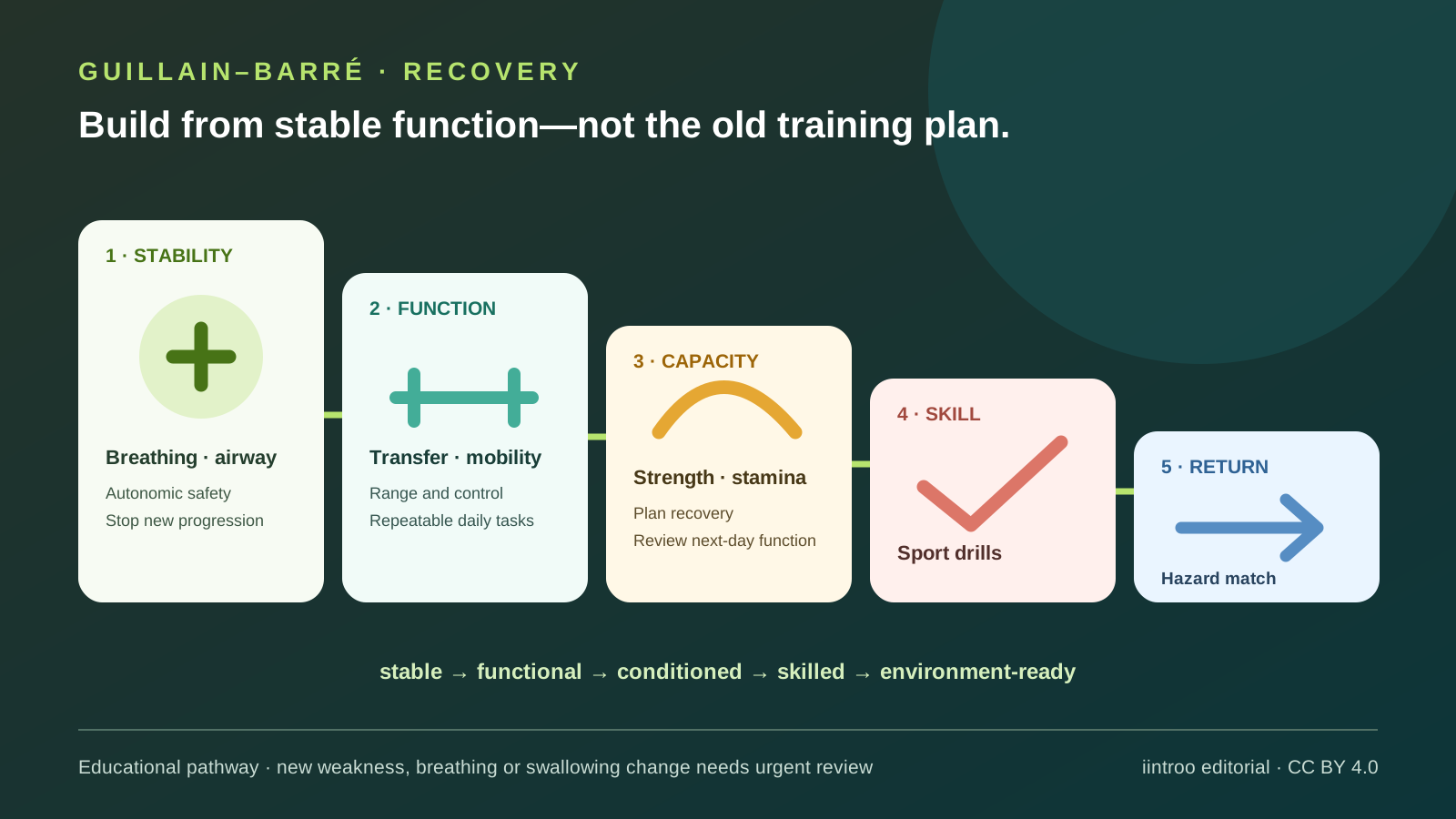
Key points
- Guillain–Barré syndrome is an acute peripheral-nerve disorder that can affect strength, sensation, breathing, swallowing, pain and autonomic control; new progression is urgent.
- Recovery can continue for months, but residual weakness and fatigue vary widely and competitive-sport exercise evidence remains limited.
- Return should rebuild daily function, endurance, strength, balance and sport hazards with the rehabilitation team rather than using a fixed date or training through neurological fatigue.
Separate expected training fatigue from neurological change
This guide is for people returning to physical activity or sport after Guillain–Barré syndrome, and for families, coaches and rehabilitation teams supporting them. GBS is an acute immune-mediated disorder of peripheral nerves. Weakness often begins in the legs and can progress, while altered sensation, pain, facial or swallowing difficulty, breathing muscle weakness and autonomic disturbance may occur. The pattern and severity vary. A previous athletic baseline does not protect against respiratory or autonomic complications and should not be used to dismiss new weakness.
New or rapidly increasing weakness, difficulty breathing, choking, inability to manage secretions, fainting, marked heart-rate or blood-pressure instability, or inability to walk requires urgent medical assessment. During recovery, a sudden decline, new cranial symptoms or worsening after an initial stable period also needs review because relapse, treatment-related fluctuation, another neuropathy or an unrelated illness may need consideration. A coach should record the changed function and activate the agreed plan, not test whether the athlete can push through another interval.
Build rehabilitation from medical stability and real function
The EAN/PNS guideline supports physiotherapy, occupational therapy and speech, swallowing or respiratory therapy when indicated, beginning during the acute phase and continuing beyond six months when limitations persist. It does not identify a universally superior high- or low-intensity programme. Early goals can include positioning, respiratory care, transfers, joint range and safe mobility; later goals may include gait, wheelchair skills, strength, endurance, balance, hand function, work and community access. The sequence follows medical stability and current capacity, not the athlete's former training plan.
Overwork concerns should be handled without imposing permanent inactivity. A 2025 scoping review and a 2026 systematic review reported possible improvement in strength, functional capacity and fatigue with structured exercise, particularly supervised multicomponent programmes. Included studies were few, small and mixed GBS with CIDP in parts of the evidence, so they cannot define an ideal sport dose or guarantee benefit for every survivor. Individual symptom response, neurological examination, respiratory and autonomic status and recovery across the following day remain essential.
Progress load while respecting fatigue, pain and autonomic symptoms
Progress from repeatable daily activity to low-complexity aerobic and strength work, then increase duration, resistance and coordination one variable at a time. Allow planned recovery and track unusual heaviness, loss of movement quality, neuropathic pain, tremor, dizziness, palpitations and next-day function. Heart-rate targets can be misleading when autonomic function or medicines alter the response. Pool work, cycling or supported resistance may reduce some balance demands, but water rescue, transfers, temperature and equipment access create their own hazards.
Persistent fatigue after GBS is common and can be disabling even when strength has improved. Sleep, mood, pain, deconditioning, respiratory issues and another medical condition can contribute; exercise should not be marketed as a cure. The guideline does not recommend a specific medicine for GBS fatigue and does not advise for or against exercise training solely as fatigue treatment because evidence is limited. A useful programme pursues valued function while creating a route to reassessment when capacity falls rather than blaming the athlete for insufficient effort.
Return by consequence, not by diagnosis label or date
Before ordinary training, confirm stable walking or mobility, transfers, breathing, swallowing, blood-pressure tolerance and recovery from daily tasks. Then rebuild sport skills in a controlled setting before height, open water, traffic, speed, collision, remote routes or solo exercise. Para-sport classification and equipment decisions are separate from medical clearance. Teammates may need an agreed emergency plan and only the health information the athlete chooses to share. Confidence and fear after critical illness deserve attention alongside physical measures.
Return can be nonlinear, and residual foot drop, sensory loss, pain or fatigue may require orthoses, equipment adaptation or role changes selected by qualified clinicians. This article cannot diagnose GBS, interpret nerve tests, prescribe intensity, change medication or provide a personal return date. It supports urgent recognition of deterioration, sustained multidisciplinary rehabilitation and progressive exposure based on repeatable function and the consequences of failure in the chosen discipline.