
Sport with haemophilia: match the activity to the bleeding plan
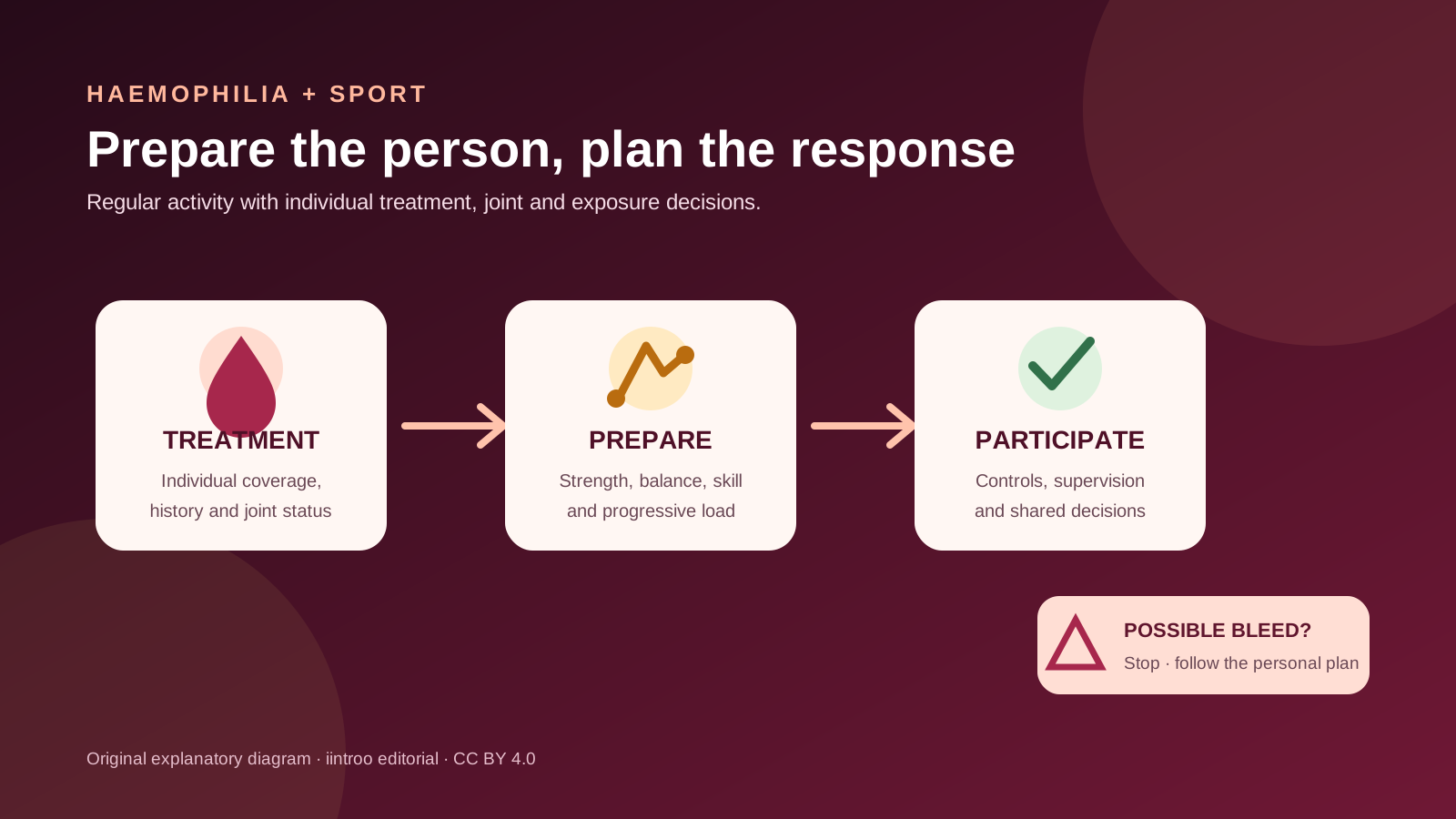
Haemophilia does not mean avoiding all exercise. Safe participation links joint preparation, an individual treatment plan and a rehearsed bleed response.
Key points
- Regular physical activity can support strength, balance, fitness and joint health in people with haemophilia; blanket inactivity is not the goal.
- Bleeding phenotype, joint status, treatment coverage, inhibitors, age, skill and the consequences of trauma all affect sport choice and preparation.
- Suspected head, neck, eye, throat or abdominal bleeding and serious trauma require urgent action under the person's haemophilia emergency plan.
Replace blanket restriction with individual risk assessment
This guide is for people with haemophilia A or B, families, coaches, teachers and sport medical teams. The World Federation of Hemophilia recommends regular physical activity to promote fitness and healthy neuromuscular development, with exercise selected to the person's condition and ability. That is not permission to copy another athlete's plan. Factor level or diagnosis label alone cannot describe joint health, bleeding history, inhibitors, treatment access, skill, age or the consequence of a fall in a particular environment.
Start with the haemophilia treatment centre. Discuss the proposed sport, position, surface, contact, speed, remoteness, supervision and competition schedule. The team can consider treatment coverage, target joints, previous bleeding and whether physiotherapy assessment is needed. Activities with direct collision, high fall consequence or limited rescue may need modification or may not be appropriate for a particular person. Shared decision-making means explaining trade-offs and alternatives, not transferring clinical responsibility to a coach.
Build capacity before adding unpredictable exposure
Strength, balance, coordination and sport skill can reduce avoidable falls and improve control. Introduce training progressively, use suitable footwear and certified protective equipment where indicated, and teach technique before fatigue or contact is added. A warm-up and recovery routine should support participation, not be presented as a guarantee against bleeding. An existing painful or swollen joint deserves review rather than repeated loading to see whether it settles.
Reviews of aerobic and resistance exercise generally report improvements in strength, function or joint-related outcomes with few serious adverse events in studied programmes. However, trials are small, interventions and treatments vary, and people at greater risk may be excluded. A 2026 scoping review likewise found wide variation in programme design and reporting. The evidence supports appropriately supervised exercise; it does not identify one universal programme or prove that every high-impact sport is safe.
Coordinate treatment without publishing a dosing recipe
The treatment centre may coordinate prophylaxis timing and targets with training or competition. Those decisions depend on the prescribed product, pharmacokinetics, adherence, inhibitor status, bleeding phenotype and activity. Newer factor and non-factor therapies can expand opportunity but do not make traumatic bleeding impossible. Coaches should know the plan's operational parts—who carries treatment, who calls the centre and what activity stops—without advising dose changes or borrowing another person's medicine.
A 2024 prospective study of moderate-to-vigorous activity during pharmacokinetic-guided prophylaxis involved a selected haemophilia A group with an individual exercise protocol and clinical follow-up. Its results cannot be converted into a general factor threshold or session target. Competition travel needs advance planning for medicine storage, documentation, supply, insurance and access to haemophilia expertise. Anti-doping checks remain separate; prescribed treatment should be documented through the applicable process.
Recognise a possible bleed and use the emergency plan
Stop activity for a new joint sensation, increasing pain, warmth, swelling, reduced movement, unexplained weakness or altered technique, and follow the individual bleed plan. Symptoms can be subtle, and muscle bleeding may create tightness, pain, nerve symptoms or loss of function. Do not massage or repeatedly test a suspected bleed. The treatment centre should define when treatment is given and when assessment or imaging is required; this article cannot distinguish bleeding from sprain, fracture or ordinary soreness.
A significant blow to the head, neck, eye, throat, chest or abdomen, severe trauma, neurological change, breathing difficulty, collapse, persistent vomiting or rapidly increasing pain is urgent. Activate emergency care and the haemophilia plan, tell responders about the bleeding disorder and prescribed therapy, and contact the treatment centre. Return follows control of the episode, recovery of function and professional review, not a fixed rest period. This guide does not prescribe factor, non-factor therapy, pain medicine or clearance.