
Hereditary angioedema in sport: bring specific treatment and an airway plan
Hereditary angioedema attacks can be unpredictable. Planning should preserve participation while keeping prescribed on-demand treatment and airway response close.
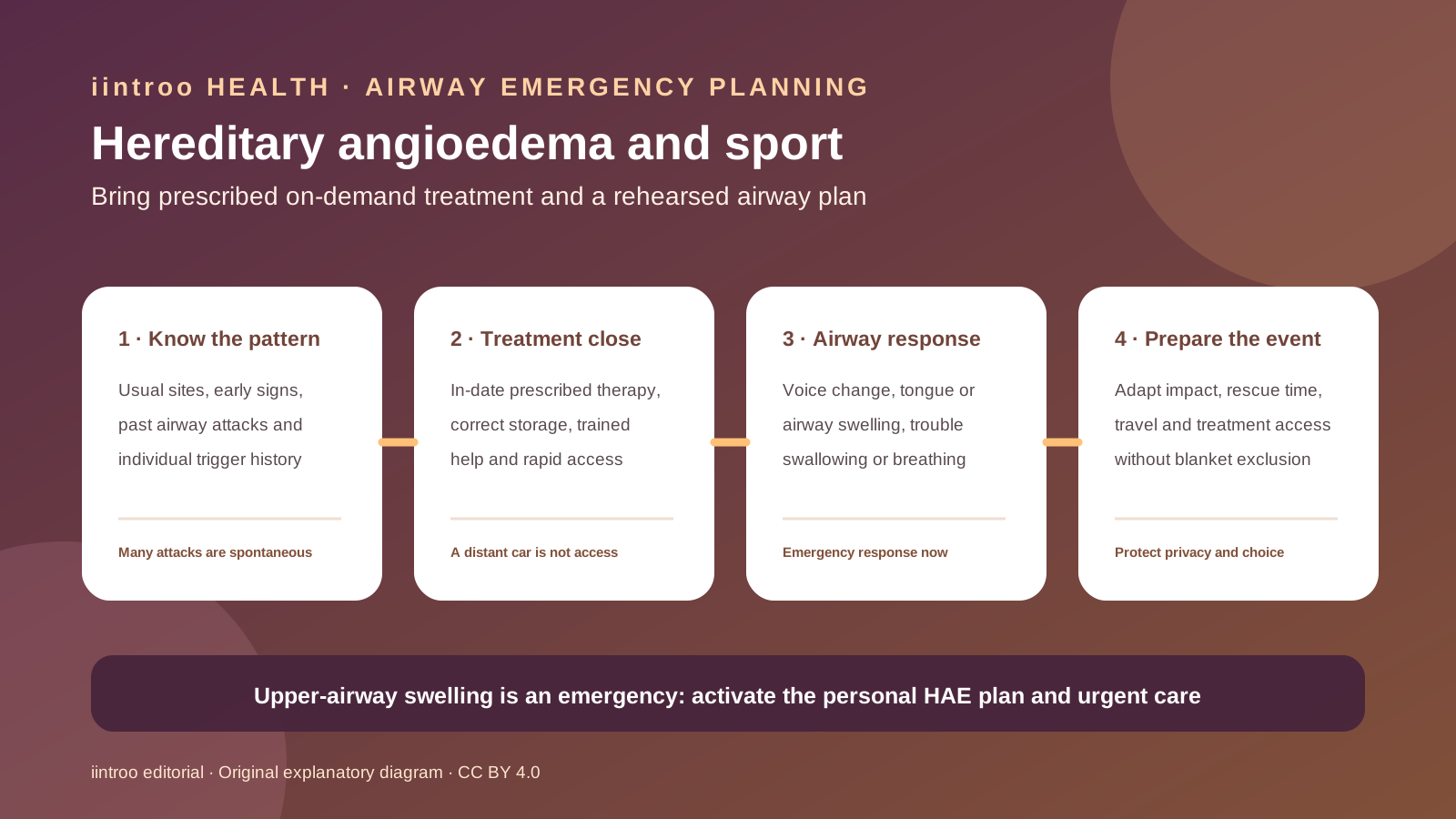
Key points
- Physical trauma, stress and infection can trigger attacks for some people, but many attacks are spontaneous and individual patterns vary.
- Every athlete with confirmed hereditary angioedema needs rapid access to the prescribed on-demand treatment and a rehearsed plan; upper-airway swelling is an emergency.
- Hereditary angioedema is not the same as allergic angioedema or exercise-induced anaphylaxis, so diagnosis and emergency treatment must follow the person's specialist plan.
Confirm the diagnosis and learn the athlete's own attack pattern
This guide is for athletes with specialist-confirmed hereditary angioedema, families, coaches and event teams. HAE is a group of bradykinin-mediated disorders and is not interchangeable with hives, allergic swelling or exercise-induced anaphylaxis. Recurrent skin or abdominal swelling, family history and laboratory or genetic assessment may contribute to diagnosis. A coach, photograph or response to an antihistamine cannot determine the mechanism or safely label a first episode.
Record the athlete's usual sites, early signs, previous airway or abdominal attacks, known triggers, prescribed on-demand treatment, prophylaxis, who can administer it and the emergency route. Trauma, dental work, stress and infection are recognized triggers, yet many attacks are spontaneous. A 2024 study of a small, selected group found that participants reported varied exercise associations; it cannot predict one athlete's response or justify avoiding all exercise.
Keep prescribed on-demand treatment available at the activity
The 2025 WAO guideline and international guidance recommend that people with confirmed HAE have access to prescribed on-demand treatment because serious attacks are unpredictable. The plan should specify where it is stored, temperature and expiry requirements, whether the athlete self-administers, who is trained to help and when emergency services are called. Leaving treatment in a distant car, hotel or locked medical room is not rapid access for a pool, trail or large venue.
Upper-airway or tongue swelling, voice change, difficulty swallowing, noisy breathing, severe breathing difficulty, faintness or collapse requires immediate activation of the athlete's HAE plan and emergency care. Do not wait to see whether the session ends first. Confirmed bradykinin-mediated HAE uses HAE-specific treatment; ordinary allergy medicines do not replace that plan. If the cause is uncertain or anaphylaxis is possible, emergency professionals must manage the differential rather than a coach withholding treatment.
Modify exposure without making sport the enemy
The paediatric international guideline says physical activity, including sport, need not be routinely restricted when rapid acute treatment is available; prophylaxis may be considered individually. For contact, combat, climbing, open water or remote events, discuss impact, rescue time and treatment access with the HAE specialist. Padding, rule or position changes, a trained companion and a nearer medical point may reduce consequence without excluding the athlete.
Do not promise that avoiding a particular food, stress or training intensity will prevent every attack. The athlete may decide that a repeatable personal trigger warrants adjustment, but unnecessary restriction can damage fitness, confidence and quality of life. Review changes in contraception, pregnancy planning, blood-pressure medicines, dental work, surgery or airway procedures with the treating team because these can affect HAE management. Coaches should not prescribe short- or long-term prophylaxis.
Prepare travel and return through a written, private plan
For camps and competition, carry sufficient in-date treatment in hand luggage as permitted, the specialist's letter, translated emergency information when useful and contacts for local care. Check storage, border and airline rules before departure and keep a backup plan for lost or delayed equipment. The emergency plan should be shared only with people who need it and with the athlete's agreement. Teammates need to know how to summon help, not the person's full medical history.
After an attack, return depends on site and severity, treatment response, residual symptoms and specialist advice. A mild peripheral episode and an airway emergency are not equivalent. Escalating abdominal pain, dehydration, breathing symptoms or recurrent swelling needs review. There is no universal symptom-free interval, trigger threshold or medication timing that clears every athlete. This page provides education, not diagnosis, drug selection, prophylaxis, device training or personal return-to-sport clearance.