
Huntington disease and adaptive sport: train function while planning for falls and swallowing
Huntington disease can change movement, judgement, balance and swallowing. Adaptive activity should be supervised, progressive and linked to daily function.
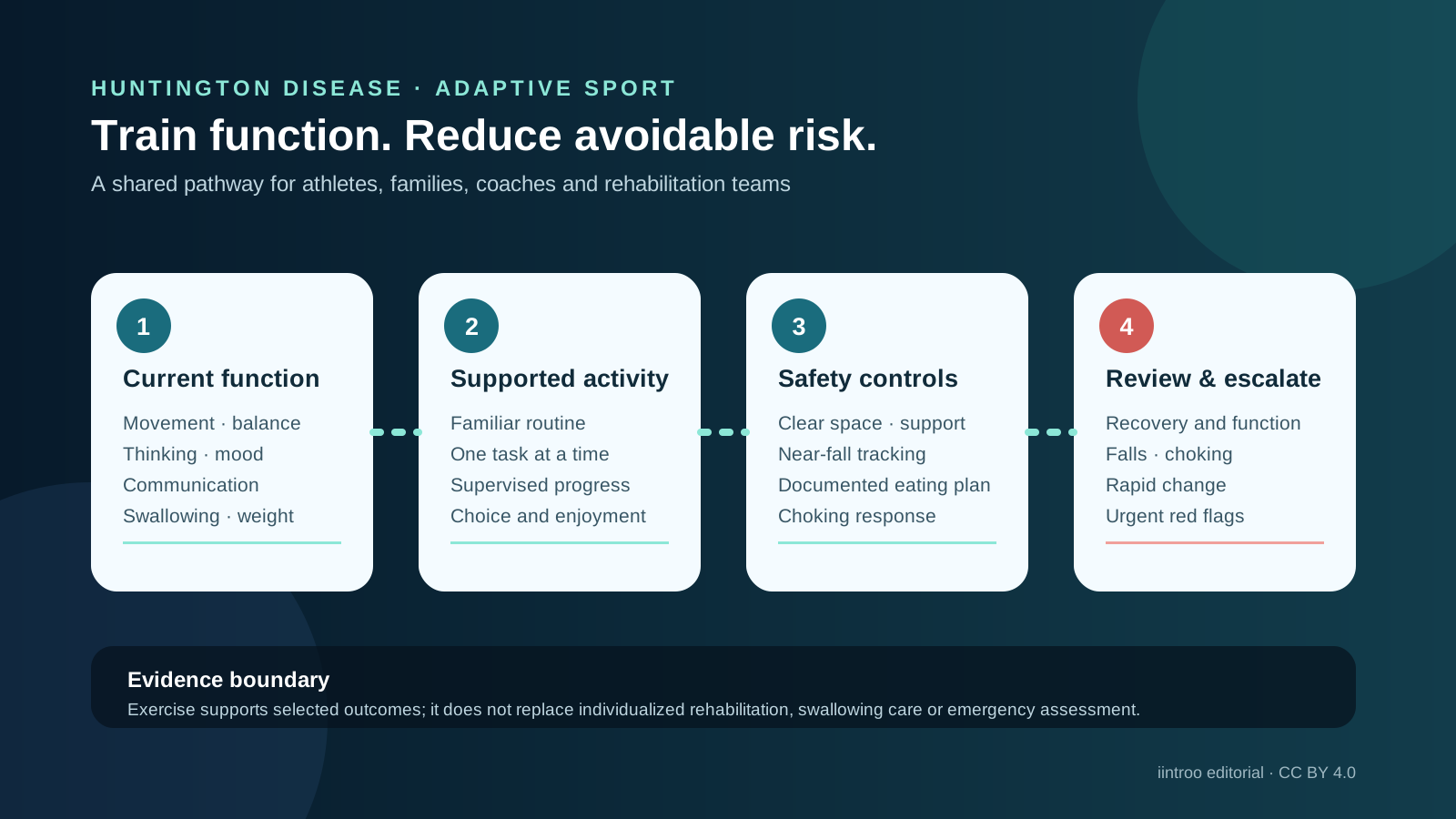
Key points
- Exercise can improve selected fitness and walking outcomes in Huntington disease, but trials are small and do not show that activity changes the disease course.
- Balance, insight, impulsivity, swallowing, weight loss and communication can alter sport safety even when aerobic capacity appears adequate.
- A new fall, head injury, choking episode, chest symptoms, fainting or a rapid functional change needs assessment rather than a harder training session.
Plan from current function, not the diagnosis label
This guide is for people with Huntington disease, families, coaches, activity leaders and rehabilitation teams. Huntington disease can affect movement, balance, thinking, mood, communication, swallowing and weight. The combination and rate of change differ between people and across stages. A person may have enough strength for an activity while still needing support with route choice, divided attention, judgement, transfers or reporting symptoms. Participation decisions should therefore begin with the person's goals and a current multidisciplinary assessment, not a stage name or a generic fitness test.
The European Huntington's Disease Network recommends early physiotherapy involvement and individualized review of walking, strength, posture, transfers and everyday function. Coaches can contribute observations about stumbles, cueing, fatigue, recovery and enjoyment, but should not diagnose progression. Agree how instructions will be given, who can pause the session and how the athlete communicates discomfort or wants to stop. Familiar settings, consistent routines and one task at a time may be more useful than adding speed, noise or complex choices to make an activity feel demanding.
Use the exercise evidence without promising disease modification
The 2020 clinical practice guideline supports aerobic exercise combined with strengthening and supervised gait training for selected people with Huntington disease. The underlying evidence includes short, often supervised trials. A 2022 meta-analysis of eight randomized trials and 231 participants found signals for walking endurance, lower-limb function and cognition, but not for motor function, gait speed, daily activities, balance or mobility. A separate home-exercise review found possible motor and quality-of-life benefits while warning that evidence was limited and protocols varied.
Longer-term evidence remains incomplete. The PACE-HD feasibility study enrolled 116 people and showed that a physiotherapist-led intervention could be delivered across specialist centres, with differences favouring the intervention for fitness, walking endurance and reported activity; it was not a fully powered effectiveness trial. A 2026 inpatient randomized trial included only 32 people and found no significant between-group change in its primary motor score after four weeks, despite selected secondary signals. These studies support access to tailored activity, not a universal frequency, intensity or claim that exercise slows neurodegeneration.
Make falls, swallowing and weight part of sport safety
Choose an environment that reduces avoidable collision and fall consequences. Stable cycling equipment, hand support, clear floor space, appropriate footwear, flotation and direct supervision can help, but controls must match the actual activity and the person's abilities. Record near-falls as well as injuries. If balance, turning, freezing, impulsive starts or dual-tasking changes, reduce complexity and seek physiotherapy review rather than relying on repeated verbal warnings. Water, roads, heights, heat and remote routes require a specific rescue and communication plan.
Weight loss and swallowing difficulty can occur in Huntington disease and may be hidden by eating slowly, avoiding textures or skipping food around sessions. A speech and language therapist and dietitian can assess swallowing and nutrition. Coaches should not prescribe texture changes, supplements or high-calorie targets. Use only the person's documented eating and drinking plan, allow unhurried breaks and know the response to choking. Coughing with food, a wet voice, recurrent chest infections, marked weight change or difficulty taking medicines deserves clinical review; inability to breathe or speak is an emergency.
Escalate change and return by function
Stop and assess after a fall with possible head, neck or limb injury, a choking episode, new weakness, unusual confusion, collapse, fainting, chest pain, severe breathlessness or a rapid change in behaviour or coordination. Activate emergency services for serious injury, breathing difficulty, unresponsiveness or other urgent danger signs. New agitation, depression, suicidal thoughts or unsafe behaviour needs prompt professional support through the person's clinical and crisis plan; sport staff should not try to manage a mental-health emergency through exercise or discipline.
After illness or injury, rebuild from safe transfers and familiar daily activity to supervised conditioning and then the skills and environment of the chosen sport. The goal may change as function changes, and successful participation can include more assistance, shorter sessions or a different role. This article cannot diagnose Huntington disease, prescribe exercise, swallowing or nutrition care, assess capacity, change medicines or clear participation. It offers a structure for shared decisions led by the person and their clinical team, with evidence limitations made visible.