
Hypermobile Ehlers–Danlos syndrome in sport: build stability without chasing range
Athletes with hEDS or hypermobility spectrum disorder need task-specific strength and control, not forced flexibility, diagnosis by social media or permanent rest.
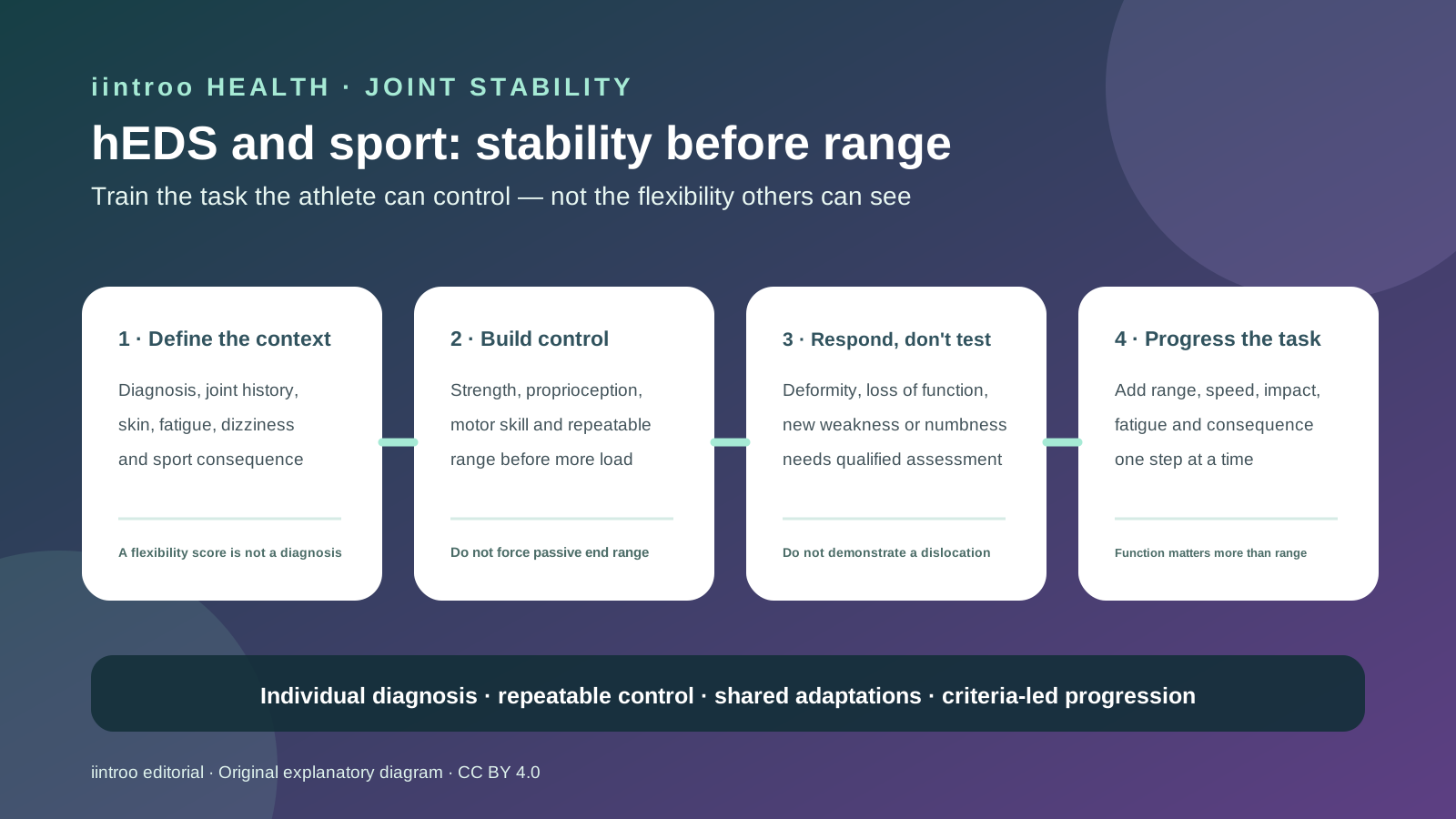
Key points
- Generalised joint hypermobility, hypermobility spectrum disorder and hypermobile EDS are related but not interchangeable labels; diagnosis should exclude other connective-tissue disorders.
- Exercise evidence supports tailored strength, motor-control and proprioceptive work, but studies are small and do not define one ideal programme or dose.
- A suspected dislocation, new neurological change, severe chest or abdominal pain, fainting or an unusual vascular symptom needs clinical assessment rather than more stretching.
Name the condition carefully and map the sport task
This guide is for athletes diagnosed with hypermobile Ehlers–Danlos syndrome or hypermobility spectrum disorder and for teams supporting them. Generalised joint hypermobility is a physical finding, while hEDS and HSD are clinical diagnoses with broader criteria. Other EDS subtypes and connective-tissue disorders can carry different skin, vascular or organ risks. A flexibility score, family resemblance or social-media checklist cannot establish the diagnosis or safely exclude another condition.
Start with the athlete's actual pattern: joints that sublux or dislocate, pain, instability, skin or scar issues, fatigue, dizziness, gastrointestinal symptoms, current supports and previous rehabilitation. Then map the discipline's end-range positions, landings, hangs, partner contact, speed, repetition and fall consequence. Dance, gymnastics, climbing and strength sport reward different skills; visible range alone does not show control, tissue tolerance or readiness for repeated load.
Train strength, control and proprioception without forcing range
GeneReviews and rehabilitation reviews support tailored exercise to improve core and limb strength, tone, proprioception, motor control and joint stability. Begin with positions the athlete can control and progress resistance, range, speed, complexity and fatigue separately. Isometrics, slow resistance, closed-chain work, balance tasks and technique practice may each have a role. The exercise choice should reflect symptoms and goals rather than a rule that every hypermobile joint must be protected from loading.
Evidence remains limited: trials are small, programmes vary and many participants are not competitive athletes. Reviews report possible improvements in pain, strength or function but cannot identify a universal dose. Avoid aggressive stretching, repeated passive end-range testing or coaching that treats greater range as the only marker of progress. Soreness, instability and next-day function should guide adjustment; a temporary reduction is not the same as prescribing permanent inactivity.
Respond to joint events, orthostatic symptoms and equipment pressure
A joint that appears deformed, cannot bear load, has new numbness or weakness, or follows significant trauma needs qualified assessment. Do not repeatedly manipulate a suspected dislocation or ask the athlete to demonstrate it. Recurrent subluxation, bruising or skin injury should trigger a review of technique, fatigue, supports and diagnosis. Braces, tape, footwear, grips and adaptive equipment can improve feedback or control, but poor fit can create pressure and dependence without addressing capacity.
Some people with hEDS also have orthostatic intolerance, but dizziness has many causes. Build transitions gradually, allow seated or supported alternatives and use the athlete's clinician-developed plan. Fainting during exercise, severe chest or abdominal pain, sudden breathlessness, a new neurological deficit or an unusual vascular symptom requires medical assessment. Coaches should not prescribe salt, compression, fluids or medicine as treatment simply because another athlete uses them.
Return by repeatable function and preserve athlete autonomy
Progress from controlled drills to sport range, speed, impact, fatigue and competition consequence. Useful criteria may include repeatable joint control, task-specific strength, confidence, recovery and the ability to use agreed strategies independently. A dancer may need end-range control, a climber repeated grip and shoulder tolerance, and a gymnast progressive landing exposure. Travel, sleep, venue access and recovery facilities can also change what is repeatable. Make adaptations with the athlete, not as a public test of whether their condition is real.
Pain does not always equal damage, but escalating pain, repeated instability or loss of function deserves review. Training records can help distinguish a repeatable response from a changing clinical problem. There is no universal Beighton score, pain threshold, brace, weekly load or symptom-free interval that clears every athlete. This page provides general education, not diagnosis, manual reduction, brace prescription, autonomic treatment, pain management or personal rehabilitation and return-to-sport clearance.