
Immune thrombocytopenia in sport: protect participation without reducing risk to one platelet count
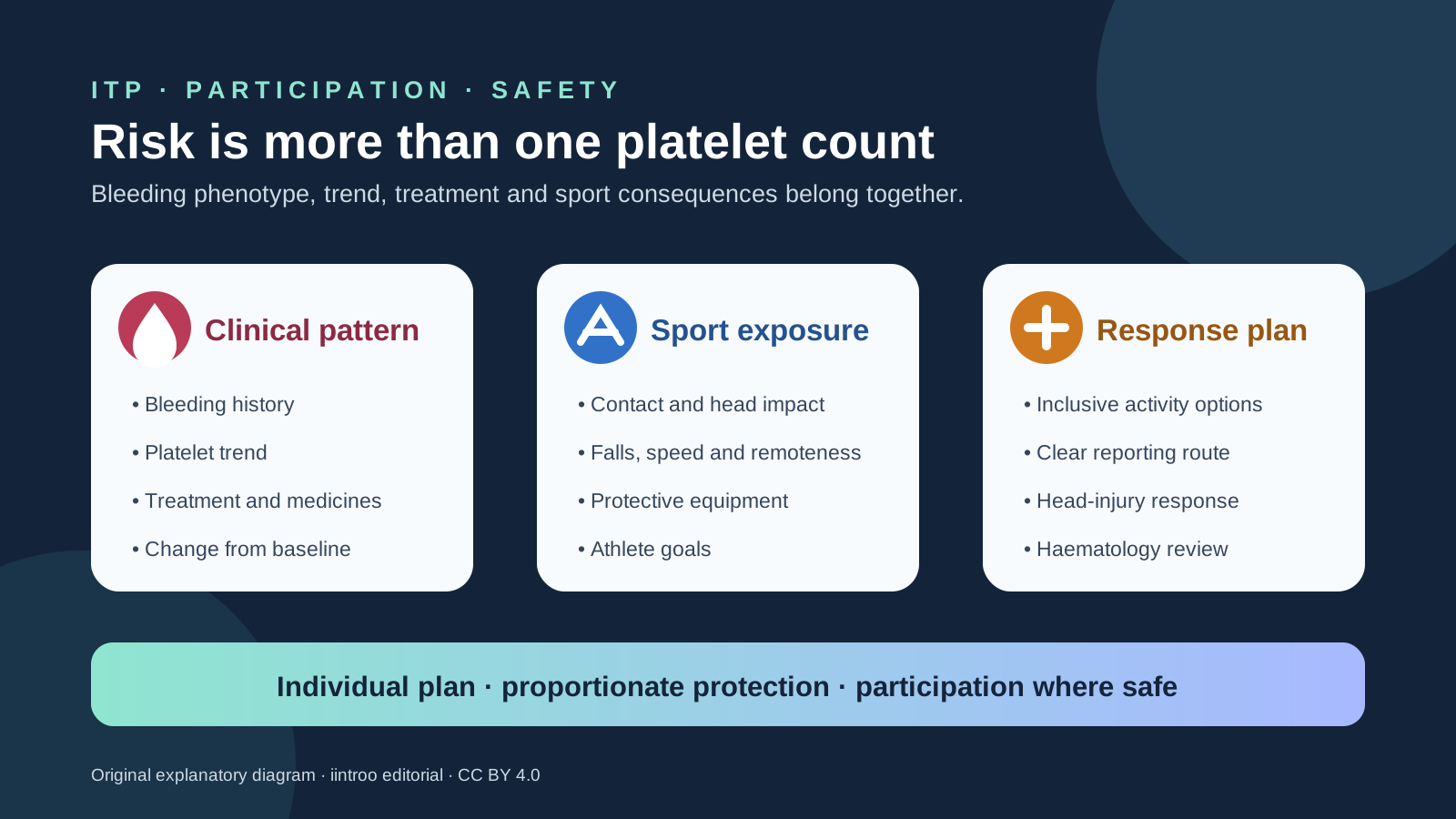
ITP sport decisions should combine bleeding history, platelet trend, treatment and impact exposure. Low-risk activity can support health and belonging.
Key points
- ITP lowers platelet counts through immune-mediated platelet destruction and impaired production, but bleeding risk is not explained by one count alone.
- International consensus supports low-risk activity and inclusive school participation while higher-consequence sports require an individualized haematology plan.
- Head trauma, neurological symptoms, uncontrolled mucosal bleeding or other major bleeding needs urgent assessment under the athlete's emergency plan.
Understand ITP without turning a number into a diagnosis
This guide is for athletes with immune thrombocytopenia, families, coaches and health teams. ITP is an acquired immune disorder in which platelet destruction and impaired platelet production can lower the circulating count. It may be newly diagnosed, persistent or chronic. Bruising, petechiae, nose or gum bleeding, heavy menstrual bleeding and prolonged bleeding can occur, while some people have few symptoms. Platelet count matters, but current guidelines also consider actual bleeding, age, comorbidities, medicines, activities, access to care and the person's priorities.
A coach should not diagnose ITP from bruises, request private laboratory results or decide that a single count makes an athlete safe. Counts can change, laboratory values require clinical interpretation and treatment has benefits and harms. The 2026 ASH update focuses on adult initial and second-line therapy; it does not create a sport-clearance threshold. The 2019 ASH guideline and international consensus likewise emphasize shared decisions and quality of life because strong evidence is missing for many management questions.
Separate routine bruising from an emergency
The athlete's plan should state their usual symptoms, who to contact and what changes need same-day review. New persistent mucosal bleeding, blood in urine or stool, unusually heavy menstrual bleeding, rapidly spreading bruising or petechiae, or symptoms that differ from baseline deserve medical advice. Head impact must be taken seriously even if the athlete initially feels well. Severe headache, repeated vomiting, confusion, drowsiness, seizure, weakness, speech or vision change, collapse or uncontrolled bleeding requires emergency services and the local emergency protocol.
Do not give aspirin or another medicine that may affect platelets unless the treating clinician has said it is appropriate. Do not use repeated contact drills, falls or maximal lifting as a test of safety. First aid should follow the athlete's written plan and trained responder protocols. The team should know enough to respond without broadcasting the diagnosis. In youth sport, school and club communication should facilitate inclusion, not isolate a child from classmates because staff are uncertain.
Support activity while acknowledging uncertain evidence
The international consensus recommends maintaining low-risk activity for children and discussing nonlow-risk sport using age, platelet count, bleeding history and the physical nature of the activity. It discourages high-risk activities unless counts are consistently near normal or treatment is used after an individualized risk-benefit discussion. These are Grade C recommendations, meaning the evidence is limited. They should guide a structured conversation, not be converted into a universal list that ignores the athlete's disease and the exact version of a sport.
A retrospective single-centre cohort followed 102 young people with chronic ITP; 60% played organized sport, most reported injuries were mild and only one injury prompted acute ITP treatment. High-risk sport was associated with injury. The study is reassuring but cannot establish safety for rare intracranial bleeding or define a platelet cutoff. A survey of 278 pediatric haematologists found wide variation in restrictions, showing how uncertainty can itself reduce participation and quality of life.
Build an activity-specific participation plan
A useful plan combines bleeding phenotype and recent history, platelet trend rather than an isolated value, current treatment and side effects, protective equipment, sport contact and fall exposure, remoteness, medical access and the athlete's goals. Swimming, golf or controlled conditioning differs from boxing, rugby, ice hockey, motocross or outdoor climbing. Coaches can adjust roles, practise technique without contact and ensure rapid reporting where clinically appropriate, while the haematology team decides whether monitoring or treatment changes are justified.
Review is needed when bleeding pattern, treatment, platelet stability or sport demand changes. A menstrual-health plan and iron assessment may be relevant for some athletes, but neither belongs to a coach-led protocol. This page cannot set a safe count, recommend medication, predict bleeding or clear collision sport. Current evidence supports patient-centred participation and careful risk reduction; it does not prove that treatment removes injury risk or that every person with a low count should be excluded from exercise.