
Impetigo in contact sport: treat the infection and stop team spread
Impetigo spreads through contact and contaminated items. Contact athletes need prompt diagnosis, treatment, hygiene controls and competition-specific clearance.
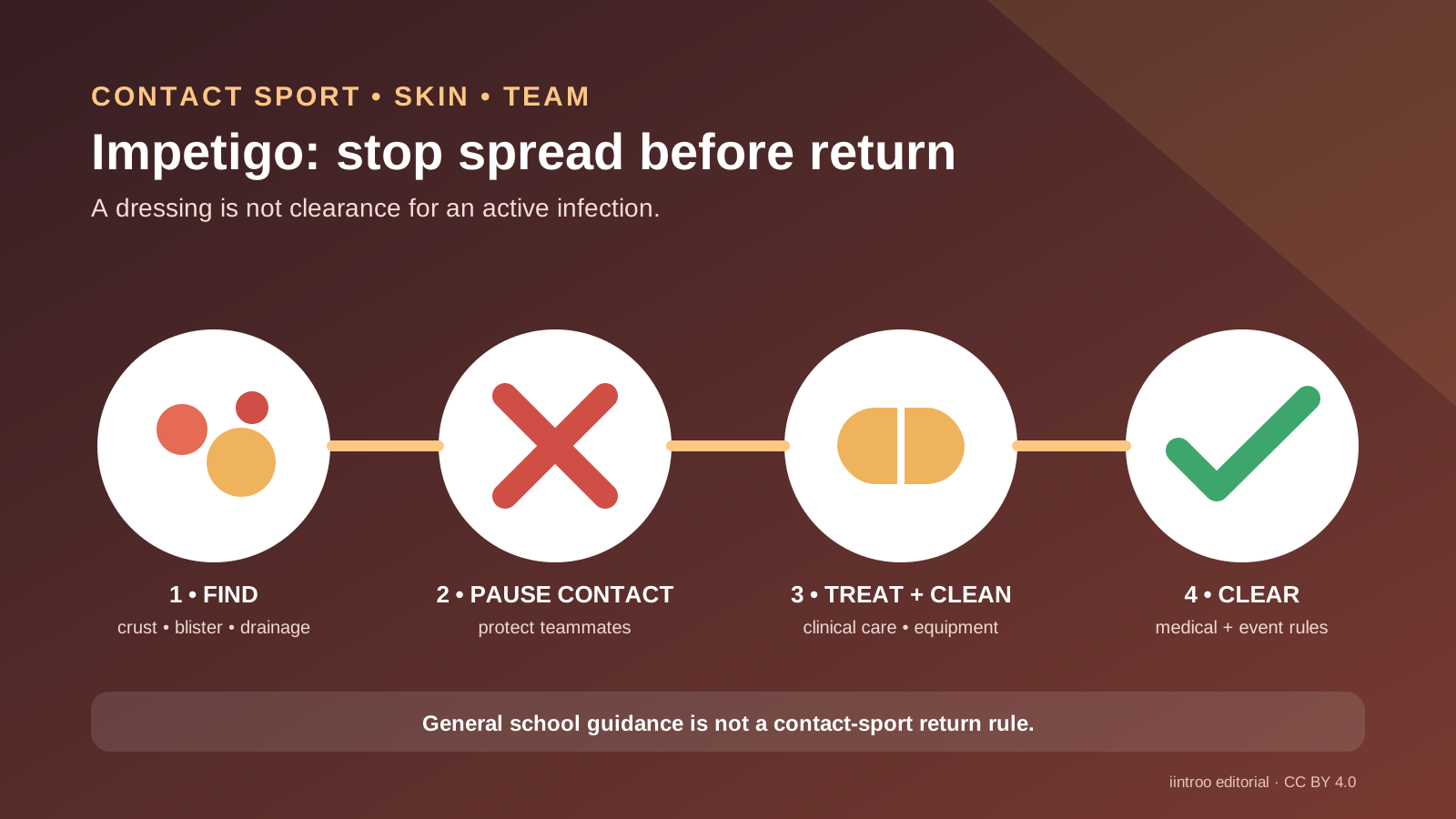
Key points
- Impetigo is a contagious bacterial skin infection commonly caused by Staphylococcus aureus or group A Streptococcus; similar-looking lesions can need different treatment.
- General public-health return advice is not the same as contact-sport clearance: wrestling rules commonly require at least 72 hours of effective antibiotics and no new or draining lesions.
- Active infectious lesions cannot simply be covered for participation; rapid reporting, treatment and environmental cleaning protect teammates and opponents.
Recognize a contagious lesion without diagnosing by photo
This guide is for contact athletes, coaches, parents and event staff. Impetigo is a superficial bacterial skin infection, usually caused by Staphylococcus aureus or group A Streptococcus. Non-bullous disease often begins as papules or pustules that break and form characteristic crusts; bullous disease forms larger fluid-filled lesions. Herpes, fungal infection, eczema, abrasions, folliculitis and resistant bacterial infection can look similar. A photograph, coach inspection or internet checklist cannot reliably identify the organism or select treatment.
An athlete with a new spreading, crusted, blistering, moist or draining lesion should stop skin-to-skin contact and obtain clinical assessment. Fever, rapidly spreading redness, severe pain, swelling, red streaking, facial or eye involvement, immune suppression or systemic illness needs prompt care. Culture is not required for every typical case but may be useful where the diagnosis is uncertain, disease is recurrent, an outbreak is occurring or resistant infection is suspected. Team privacy matters, but concealing a lesion can expose opponents and prolong an outbreak.
Do not confuse school guidance with contact-sport clearance
CDC guidance notes that people with group A streptococcal impetigo may return to school or work after at least 12 hours of appropriate antibiotics when lesions are covered. That is general public-health advice, not a wrestling clearance rule. The NCAA wrestling rulebook is stricter for bacterial infections: no new lesions for 48 hours, at least 72 hours of antibiotic treatment and no moist, exudative or draining lesion at the meet. Active infection cannot be made eligible simply by applying a dressing.
Rules differ across federations, ages, countries and events, and a clinician must confirm that treatment is effective and the lesion is no longer contagious. A signed form does not override visible progression or the event physician's decision. Return should therefore satisfy both medical recovery and the applicable competition rule. The athlete should complete prescribed treatment and avoid sharing leftover antibiotics. A universal number of days cannot be promised when the diagnosis, organism, response and rule set differ.
Break transmission chains in the team environment
Impetigo can spread through skin contact and contaminated towels, clothing, bedding or equipment. Athletes should report lesions early, wash hands, shower after activity, keep personal items personal and launder clothing and towels after use. Coaches and facility staff should follow manufacturer-compatible cleaning and disinfection procedures for mats, pads and shared equipment, paying attention to required product contact time. Cleaning a visibly dirty surface and disinfecting it are separate tasks; spraying and immediately wiping may not meet the label instructions.
CDC guidance for athletic facilities emphasizes routine equipment cleaning, wound care and hand hygiene. The AAP statement on organized sports also supports prompt identification, exclusion while contagious and outbreak coordination. Teams should not single out one athlete as the source without evidence. Multiple linked cases, treatment failure or suspected resistant infection warrants medical and public-health input. Routine whole-team antibiotics or decolonization is not a default solution because benefits, harms and resistance must be judged clinically.
Return with intact skin and a rule-specific decision
Before contact resumes, check that there are no new lesions, drainage, moisture or systemic symptoms and that the required effective treatment interval has been completed. Noninfectious residual marks may sometimes be covered under the rule set, but the medical examiner decides whether the lesion is truly noncontagious. The return check should also look for other teammates with lesions and for equipment or hygiene practices that could restart transmission. Pain-free training capacity alone is irrelevant if the skin remains infectious.
This page cannot diagnose impetigo, choose topical or oral antibiotics, interpret a culture, authorize contact or replace event rules. Seek reassessment if lesions spread, recur, fail to improve as expected or appear with fever or deeper pain. A sound team plan is simple: find suspicious lesions early, pause contact, obtain treatment, clean the environment, document the applicable rule and return only after both clinical and competition criteria are met.