
Indoor climbing chalk dust: measure exposure before calling the air harmless
Climbing chalk can raise indoor particle levels when dust is resuspended. Ventilation and low-dust practice matter, but recurring symptoms need assessment.
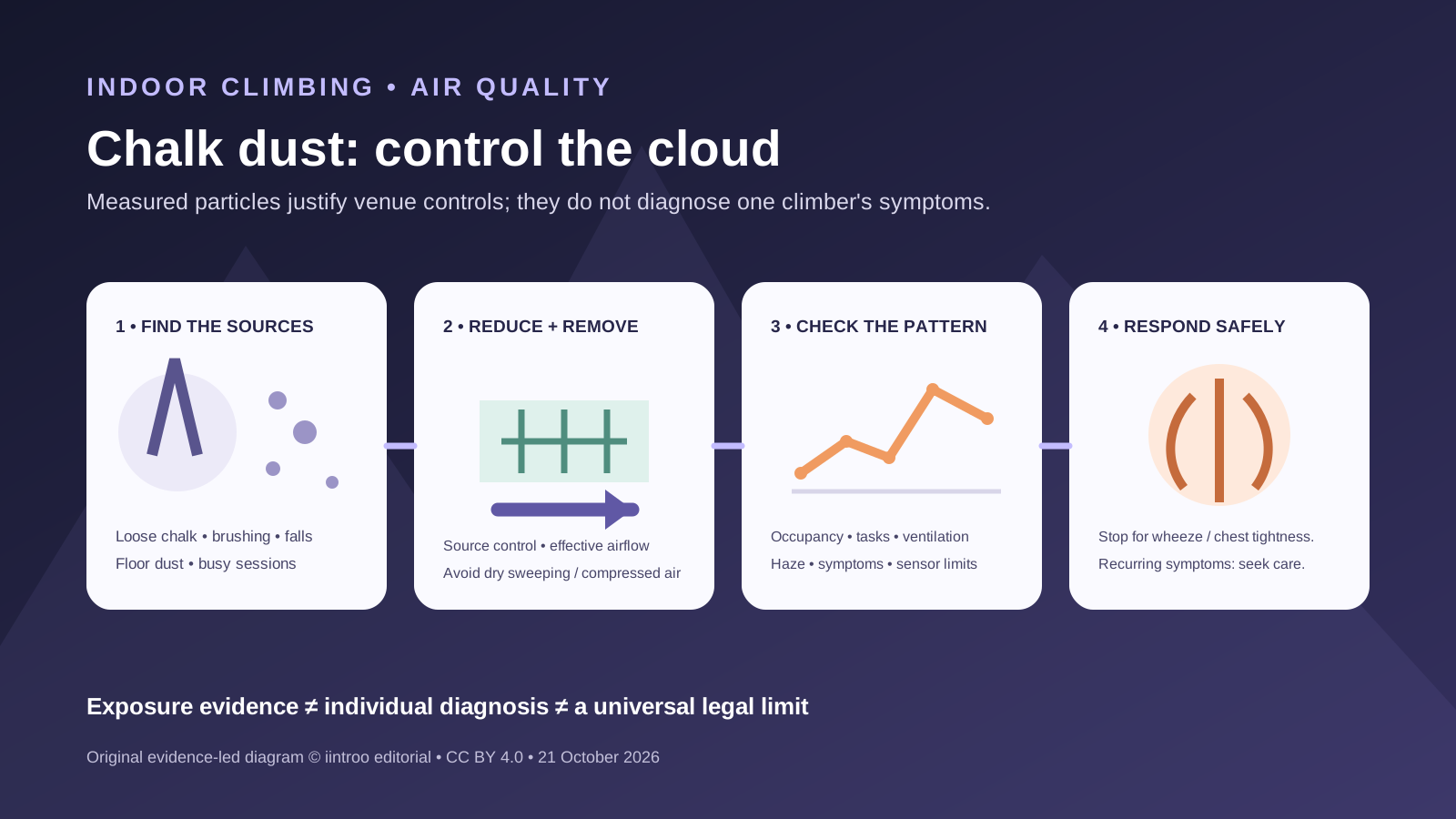
Key points
- Measurements show that climbing chalk can create high airborne particulate concentrations indoors.
- Particle measurements do not prove that chalk caused one athlete's cough or long-term disease.
- Source control, ventilation, cleaning and symptom reporting belong in the same venue plan.
Separate measured dust from an individual diagnosis
This guide is for climbers, coaches, parents, route setters, cleaners and gym operators. Magnesium carbonate climbing chalk improves grip by drying the hands, but loose powder and deposited dust can become airborne during use, falls, brushing, movement and cleaning. Exercise increases breathing rate, so the air in a busy indoor hall deserves the same deliberate attention as holds, mats and belay systems.
Several field studies measured high particle concentrations in climbing facilities, with much of the dust in the coarse PM2.5-to-PM10 range. These measurements establish exposure under the sampled conditions. They do not prove that chalk caused a particular cough, asthma attack or chronic illness, and older studies may not represent a modern hall with different products, occupancy, ventilation or cleaning.
What the intervention evidence can and cannot support
A German field study compared climbing-chalk forms and reported that liquid chalk produced substantially less airborne dust than loose powder. Chalk balls did not eliminate exposure. This supports source-reduction choices, but product composition varies and liquid formulations can contain alcohol or additives that irritate skin or create other handling issues. One product category should not be marketed as medically safe for everyone.
A pilot investigation of 109 climbers did not find a clear relationship between measured dust and lung-function changes, although reported symptoms were more common with higher exposure. Small samples, short observation and healthy-worker selection limit reassurance. An in-vitro study showing oxidative responses in rat lung cells describes a possible biological mechanism, not clinical disease in human climbers.
Use a hierarchy of controls in the hall
Gyms should first reduce dust at its source: limit open communal chalk clouds, encourage controlled application, consider lower-dust options after product review and avoid unnecessary hold brushing while people are directly below. Local exhaust near known high-release tasks may complement effective building ventilation. A general fan that merely stirs settled powder can increase resuspension rather than remove it.
Monitor ventilation performance and occupancy, and investigate visible haze, settled dust and repeated symptom reports. A low-cost particle sensor can help identify patterns but is not automatically calibrated for compliance or medical interpretation. Applicable indoor-air, workplace and building rules vary by country. Venue managers should involve competent ventilation and occupational-health professionals rather than inventing a universal PM limit from one research paper.
Cleaning is an exposure task, not cosmetic housekeeping
Dry sweeping, compressed air and aggressive dusting can launch settled particles back into the breathing zone. Plan cleaning when occupancy is low, use methods and vacuums appropriate to fine and coarse dust, maintain equipment and protect workers according to the exposure assessment. Do not assume a disposable face covering replaces source control, ventilation or suitable respiratory protection selected under local occupational rules.
Route setters and cleaners may accumulate more exposure than an occasional climber because they spend long periods near dust-generating tasks. Include them in training, symptom reporting and control evaluation. Store chalk to prevent spills, clean changing areas and shared surfaces without creating clouds, and review whether floor and mat materials trap powder in ways that make later resuspension more likely.
Respond to symptoms without blaming chalk by default
Stop activity and move to cleaner air for wheeze, chest tightness, unusual breathlessness, persistent cough, dizziness or eye irritation. Severe breathing difficulty, blue or grey lips, inability to speak normally, collapse or rapidly worsening symptoms requires emergency help. A person with a prescribed asthma action plan should follow it; coaches should not share inhalers or diagnose asthma from a dusty session.
Record timing, location, occupancy, tasks, products and whether symptoms improve away from the venue. Persistent or recurrent symptoms deserve clinical assessment because asthma, exercise-induced bronchoconstriction, infection, allergy, laryngeal obstruction and other conditions can overlap. A gym should investigate clusters rather than treating them as poor fitness. This guide explains exposure control; it does not diagnose disease, prescribe a respirator or certify indoor air.