
Indoor ice-rink air: carbon monoxide can look like fatigue until several people are ill
Headache, dizziness or nausea at an indoor rink may be more than exertion. Leave the area, seek urgent advice and activate the venue air-safety plan.
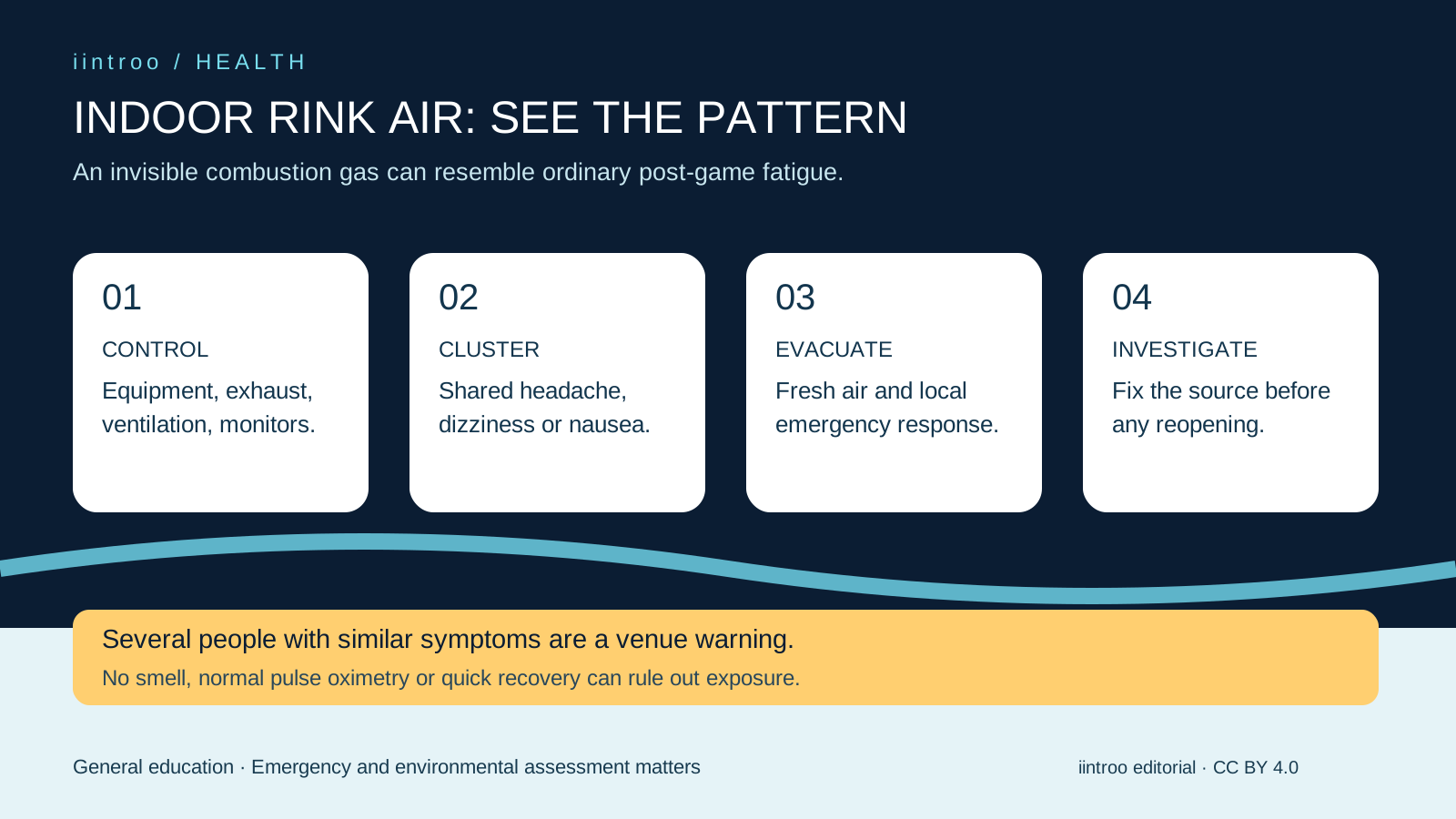
Key points
- Carbon monoxide has no colour or smell, and early symptoms can resemble fatigue or viral illness.
- Fuel-burning resurfacing or maintenance equipment and inadequate ventilation have caused ice-arena outbreaks.
- Multiple people with similar rink symptoms are an environmental warning, not a conditioning problem.
Recognise the venue pattern
This guide is for ice hockey players, figure skaters, curlers, coaches, officials, families and arena operators. Carbon monoxide is a colourless, odourless gas produced by incomplete combustion. In an indoor rink, fuel-burning resurfacing machines, maintenance equipment, heaters or other sources can raise exposure when equipment is faulty or ventilation is inadequate. An electric machine lowers one source but does not prove the building is risk-free.
Early carbon-monoxide symptoms can include headache, dizziness, weakness, nausea, vomiting, chest discomfort or confusion. These are nonspecific and can be mistaken for exertion, dehydration, migraine or infection. A cluster matters: two players, spectators or workers developing similar symptoms in the same venue should trigger an environmental response even if one person's symptoms seem mild. Children, pregnant people and those with heart or lung disease may be especially vulnerable.
Historical outbreaks still teach a current lesson
CDC investigations have documented ice-arena outbreaks involving players, spectators and staff. In Wisconsin in 2014, a hockey player lost consciousness and elevated carbon monoxide was found at the venue; dozens of people were evaluated. Earlier investigations linked both carbon monoxide and nitrogen dioxide to combustion-powered resurfacing equipment. Case investigations show what can happen, but they do not estimate the risk in every modern arena.
A study of adult hockey players measured rink carbon monoxide and carboxyhaemoglobin before and after games, supporting biological uptake during exercise. It was small and conducted decades ago, so it cannot define a present-day safe playing duration or clearance threshold. The useful conclusion is operational: facilities need source control, maintenance, ventilation and monitoring rather than relying on athletes to notice an invisible gas.
Leave first; do not finish the session
If carbon monoxide exposure is suspected, stop activity, move people to fresh air without entering a dangerous area to rescue others, and call local emergency services or the appropriate poison service. Do not send a symptomatic player back onto the ice after water, food or a short rest. A coach's portable consumer monitor can add a warning, but a normal reading after doors open does not reconstruct the earlier exposure or medically clear anyone.
Loss of consciousness, confusion, chest pain, severe breathlessness, seizure, marked weakness or symptoms during pregnancy require urgent medical evaluation. Clinicians interpret the exposure history, examination and testing; pulse oximetry can appear normal in carbon-monoxide poisoning and should not be used by a team as a rule-out test. Oxygen and hyperbaric decisions belong to emergency clinicians, not a venue checklist.
Build controls into rink operations
Arena management should maintain combustion equipment to manufacturer and regulatory requirements, verify exhaust and ventilation performance, monitor relevant gases under the applicable local rules, keep records, and train staff to stop operations and evacuate. Testing should reflect when sources are running and people are present. A detector mounted in the wrong place, past inspection sticker or absence of odour is not proof of safe air.
The plan should name who calls emergency services, who stops equipment, who clears the ice and stands, and who prevents re-entry. Include visiting teams, officials, cleaners and spectators rather than treating this as an athlete-only problem. Carbon monoxide and nitrogen dioxide require different attention; one monitor may not cover both. Local occupational, building and public-health requirements vary, so the venue must follow the rules that apply to it.
Reopening is a facility decision, not a symptom test
An arena should not reopen because symptoms faded outdoors. The source must be identified and controlled, affected equipment assessed, ventilation verified and the space cleared under the relevant authority or competent professional. Teams should document who was present, where they were, symptom timing and emergency referrals. That information supports public-health investigation without asking individuals to prove the exposure themselves.
A medically assessed athlete also needs advice based on the severity of poisoning, symptoms and other health factors; there is no universal same-day return rule. Clubs can reduce delay by telling families that a shared headache pattern will be taken seriously and reported without blame. This guide explains recognition and venue planning. It does not certify an arena, set a legal exposure limit or provide medical clearance.