
Juvenile idiopathic arthritis in youth sport: keep movement, adapt the day
Young athletes with JIA can stay active, but pain, stiffness, fatigue, eye disease and treatment need an individual plan rather than a blanket sport ban.
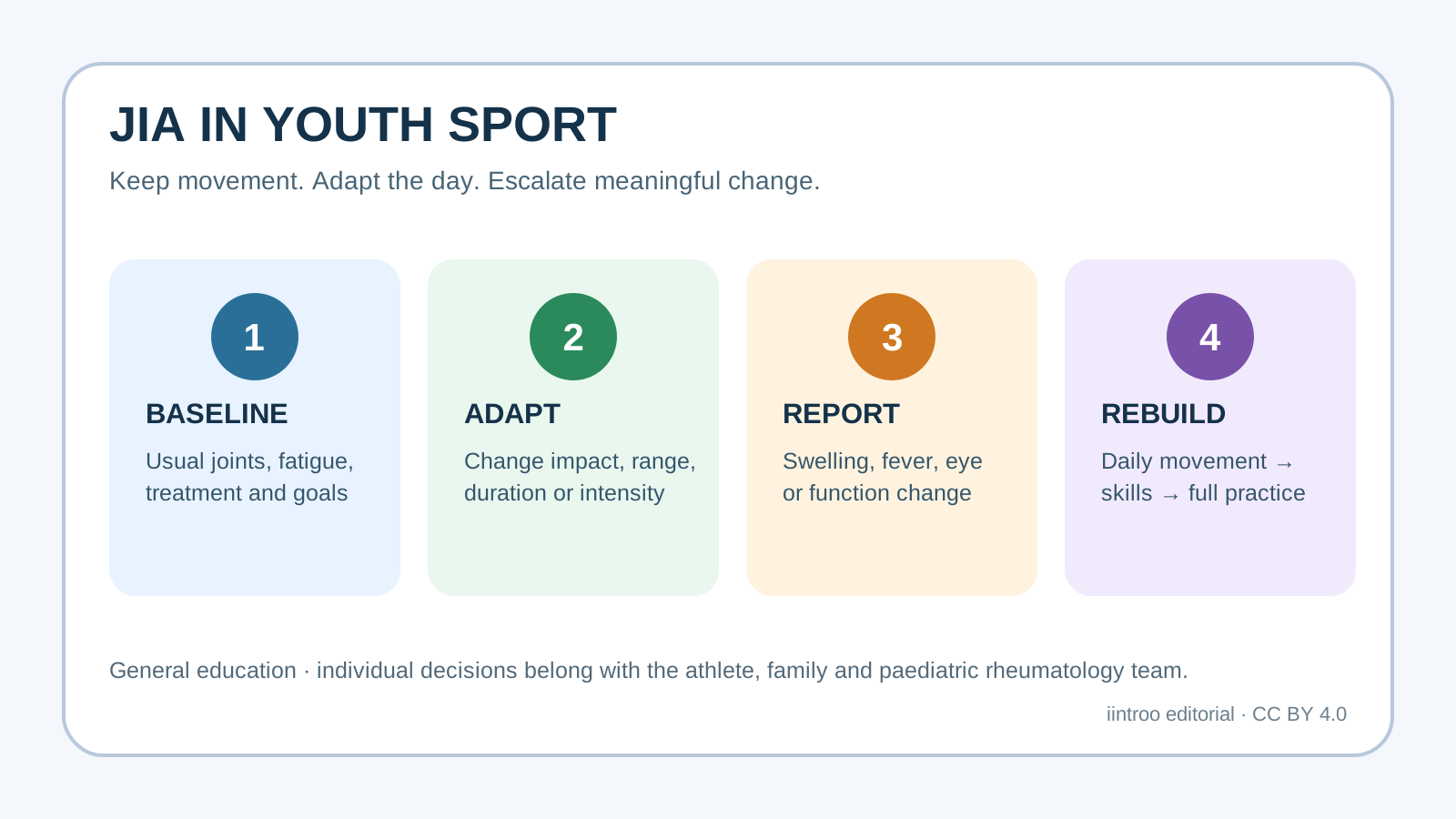
Key points
- JIA is a group of inflammatory conditions diagnosed by clinicians; one painful joint or difficult training week does not establish the diagnosis.
- Current rheumatology guidance supports physical activity alongside treatment, but small exercise trials do not identify one best sport or universal programme.
- A hot swollen joint, fever, new eye symptoms or a major change in function needs clinical review rather than repeated testing in training.
Treat the diagnosis and the athlete as individual
This guide is for young athletes with diagnosed or suspected juvenile idiopathic arthritis, families, coaches, schools and health teams. JIA is an umbrella term for arthritis beginning before age 16 and lasting at least six weeks after other explanations are excluded. Patterns differ: a few or many joints, entheses, skin, fever or eye inflammation may be involved. Morning stiffness, limp, swelling, fatigue and pain can change over time, so the sport plan cannot be inferred from the label alone.
A paediatric rheumatology team should direct diagnosis and treatment. The 2026 American College of Rheumatology update supports physical activity, physiotherapy and occupational therapy alongside medication, and its patient guidance says young people can lead active lives. That does not mean every session should be completed unchanged. Start with normal function, current disease control, joint range, strength, fatigue, treatment effects, school load and goals, then decide what can continue and what needs temporary adaptation.
Use exercise evidence without turning it into a prescription
A 2026 meta-analysis included eight randomised trials and 405 children and adolescents. Programmes varied in mode, supervision, duration and outcome. Earlier reviews also found a small and heterogeneous evidence base, with mixed results for fitness, function and quality of life. These studies support access to appropriately designed activity and do not show that exercise generally worsens disease, but they cannot name one optimal dose or promise remission, pain relief or competitive performance.
Choose aerobic, strength, balance, mobility and sport-skill work around current function and clinical advice. Swimming or cycling may reduce impact on a painful day, while weight-bearing and resistance work can still matter for bone, muscle and sport capacity when tolerated. Change one demand at a time—duration, intensity, impact, range or technical complexity—and record the response during the session and following day. A coach adapts the task; they do not diagnose inflammation or change medication.
Separate ordinary variation from a health change
Agree a private reporting plan for stiffness, swelling, fatigue, pain and reduced confidence. A flare is not defined by one wearable score or one poor performance. New warmth or swelling, persistent night pain, loss of movement, repeated limp, fever, rash, marked fatigue or a clear decline from baseline deserves contact with the clinical team. Sudden severe symptoms, breathing difficulty, collapse or a very unwell child requires urgent care through local services.
JIA-associated uveitis can be silent, which is why scheduled eye screening matters even when vision feels normal. New eye pain, redness, light sensitivity or vision change needs prompt professional assessment. Immunosuppressive treatment can also change infection and vaccination planning. Teams should support hygiene and early reporting without isolating the athlete, and families should ask the treating team how illness, travel or tournament exposure affects the individual plan rather than stopping medicines independently.
Return by function, not by a fixed calendar
After a flare, injury or treatment change, rebuild from comfortable daily movement to controlled conditioning, sport drills and full practice. Review joint response, fatigue, technique, confidence and recovery before adding impact, contact, long duration or competition pressure. School accommodations, warm-up time, access to medication and a place to rest can preserve participation. A modified session is still training; hiding symptoms to protect selection is not a safe return strategy.
This page cannot diagnose JIA, define a flare, prescribe exercise, alter medication or clear a young person for contact or competition. It supports shared decisions among the athlete, family, paediatric rheumatology and rehabilitation team, with coaches working from agreed boundaries. The goal is neither forced rest nor forced participation: it is enough treatment to control disease and enough adaptable movement to protect health, confidence and sporting development.