
Kabaddi knee and ankle health: prepare for cuts, low stances and contact
Kabaddi exposes raiders and defenders to different cutting, grappling and contact demands; preparation and return should follow the athlete's actual tasks, not one timetable.
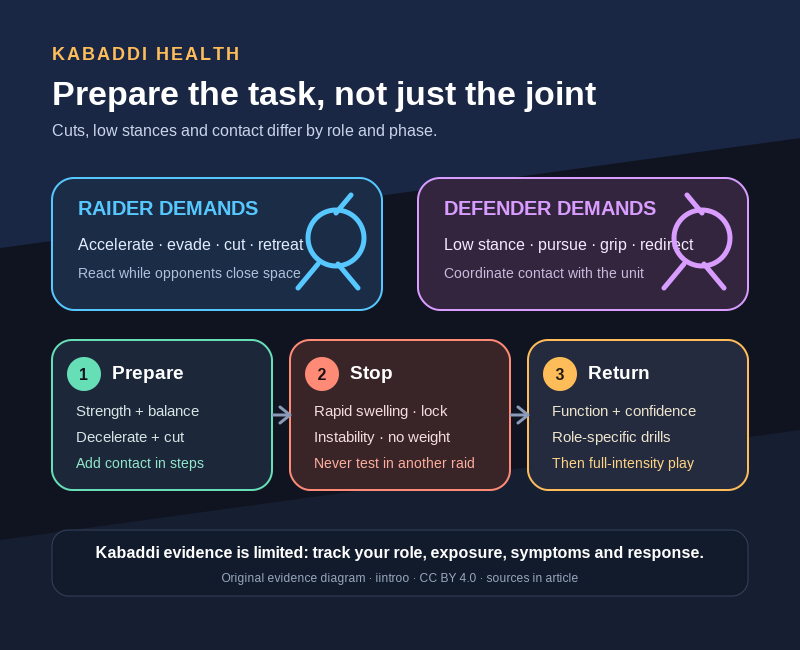
Key points
- Kabaddi combines rapid direction changes, low positions and direct contact, but sport-specific injury evidence remains sparse and mostly observational.
- Raiding and defending do not create identical demands, so preparation and rehabilitation should include the athlete's real role and contact tasks.
- A swollen or unstable knee or ankle, inability to bear weight, locking or neurovascular symptoms needs assessment rather than a return test during play.
Start with kabaddi's real movement and contact demands
This guide is for kabaddi players, coaches, families and medical teams. Under International Kabaddi Federation rules, a raider enters the opposing half to score and return, while defenders coordinate holds and stops. Repeated acceleration, deceleration, lateral cuts, low stances, reaching and player-to-player contact load the knee and ankle in combinations that ordinary straight-line running does not reproduce.
Role matters. A raider may need evasive footwork and a rapid retreat under contact; a corner or cover defender may absorb, grip and redirect an opponent from a low position. Match level, surface, sex, age, training history and playing style can all change exposure. A list of common injuries cannot predict what will happen to one player.
Treat the evidence as a map with blank areas
Recent kabaddi reviews identify lower-limb injuries, including knee and ankle problems, as important concerns, but the underlying studies vary widely in setting, methods and definitions. One elite Korean report involved only 24 athletes, and surgical cohorts answer questions about selected injured players rather than all participants. These designs describe patterns; they do not prove a single movement caused an injury or establish one prevention programme.
The prospective study of elite players after ACL reconstruction offers sport-specific follow-up, but surgery type, selection and specialist care prevent the results from becoming a universal return schedule. Research gaps are especially important for women, youth, community players and para or modified forms. Teams should document training and match exposure, role, surface, mechanism and time loss consistently.
Prepare cutting, low stance and contact progressively
General preparation can develop lower-limb strength, balance, landing and deceleration control before adding faster cuts, pursuit, low defensive positions and live tackles. Increase the speed, unpredictability, contact intensity and work-to-rest density in planned steps. A warm-up may support readiness, but kabaddi-specific trials have not shown that one routine prevents every knee or ankle injury.
Monitor response across practices and tournaments, not only during the drill. Pain that changes stance, repeated ankle giving-way, knee swelling or a loss of confidence in cutting deserves an early load review. Sudden spikes after travel, selection camps or return from illness should not be hidden by adding more tape, pain medicine or unsupervised conditioning.
Know when the raid must end
Stop play after a knee or ankle injury if the athlete cannot bear weight, develops rapid swelling, hears or feels a pop with instability, has a locked knee, visible deformity, severe focal bone pain or cannot actively move the joint. Numbness, a cold or pale foot, worsening pain or loss of pulse needs urgent emergency assessment. Do not send the player into another raid to test the joint.
Head, neck and facial contact require their own response. Confusion, memory disturbance, worsening headache, repeated vomiting, seizure, weakness, neck pain or breathing difficulty means immediate removal and appropriate urgent care. A mouthguard or protective practice can reduce selected risks but cannot clear a player after symptoms.
Return through raider or defender tasks
Return should combine clinical assessment with strength, movement quality, repeated-effort capacity and the role's actual skills. A progression may move from running and controlled changes of direction to planned footwork, reactive cuts, low positions, partner drills, controlled holds and full-intensity play. The order and criteria depend on the injury and athlete; a pain-free jog is not proof of readiness for a chain tackle.
Track pain, swelling, instability and the response later that day and the next morning. A specialist may also consider psychological readiness and the consequences of reinjury. This article does not diagnose a ligament injury, recommend surgery, prescribe rehabilitation or promise a return date.