
Netball knee and ankle prevention: make landing practice part of the warm-up
Netball injuries often occur around landings, cutting and contact. A structured warm-up can rehearse strength, balance, deceleration and change of direction, but technique and consistency matter more than a token checklist.
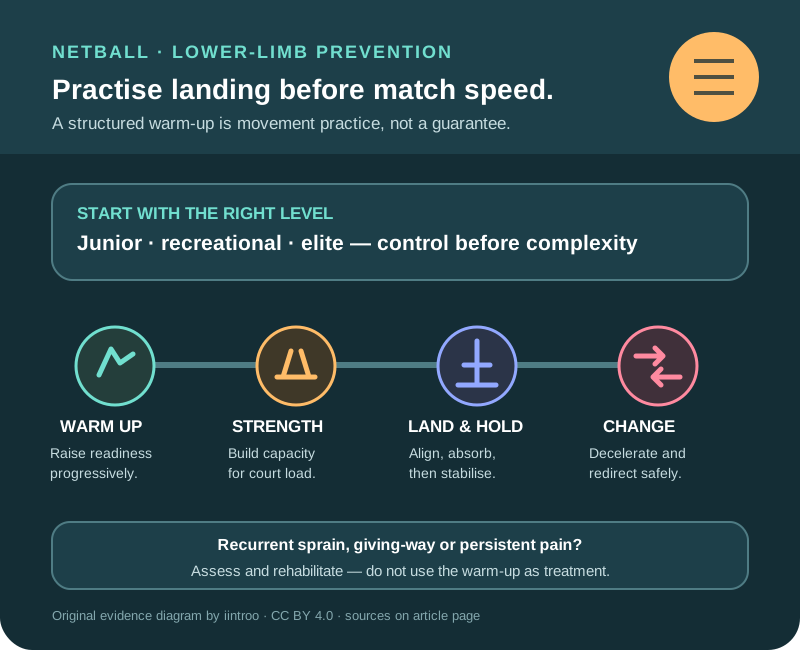
Key points
- Knee and ankle injuries are prominent in netball, and landings, falls, collisions and rapid direction changes are recurring injury situations.
- Netball Australia's KNEE programme combines warm-up, strength, balance and landing, and agility work rather than relying on stretching alone.
- Programme-specific injury reduction is not yet certain, so persistent pain, instability or recurrent sprains still require individual assessment and rehabilitation.
Start with the movements netball repeatedly demands
This guide is for netball players, coaches, families and community clubs. Netball repeatedly asks athletes to jump, catch with the arms overhead, land within the footwork rules, decelerate and cut in a crowded space. A systematic review found that ankles and knees were the most commonly reported injury sites, while landings, collisions and falls were frequent circumstances. The wide range of reported rates also showed how much definitions, competition level and surveillance methods differ.
Those findings identify priorities, not a prediction for one player. Age, previous injury, playing level, training exposure, strength, balance, court conditions and contact can interact. A 2025 review and expert consensus found that risk is multi-factorial, so one screening score or visible knee position should not be treated as a diagnosis or a guarantee of future injury.
Use a programme, not a few decorative stretches
Netball Australia's KNEE programme is an on-court framework with warm-up, strength, balance and landing, and agility components. It is adapted for junior, recreational and elite groups and emphasises take-off, landing, deceleration and change-of-direction technique. The official guidance recommends regular use before court work or matches, with at least twice-weekly exposure for maximum effect and continued practice to maintain it.
That frequency is programme guidance, not a personal exercise prescription. Coaches should choose the version that matches the team's age and capacity, learn the manual, demonstrate each task clearly and progress only when control is adequate. A rushed routine performed with fatigue or poor understanding may rehearse the very movement pattern it is meant to improve.
Coach the landing and the next action
Useful cues include arriving with control, keeping the hip, knee and foot aligned, absorbing force through a comfortable bend and stabilising before the next pass or cut. Practice both single- and double-leg landings, planned deceleration and direction changes in a progressive setting. Add the ball and decision-making only after the movement can be performed safely at lower complexity.
No single ideal shape fits every body, position or match situation. Feedback should be specific and respectful, not framed as blame. Court space, footwear condition, training density and contact drills also deserve attention because injury risk does not sit solely inside the athlete's technique.
Treat previous ankle sprain as a rehabilitation question
The 2021 scoping review found gaps between best-practice ankle management and what netball athletes reported doing. Prevention programmes, external ankle support and adequate rehabilitation may help reduce recurrent sprain risk, but adherence was a major limitation, and evidence did not show that netball-specific shoes alone prevent sprains.
An athlete with recurrent giving-way, swelling, pain, reduced confidence or difficulty changing direction should not rely on a warm-up as treatment. A qualified clinician can assess the injury, function, sport demands and whether taping or bracing is appropriate. Return to court should be based on individual recovery and progressive netball tasks rather than an automatic date.
Make consistency measurable without promising zero injuries
A club can record whether the programme was delivered, which version was used, how long it took and whether players could perform the key movements. Periodically observe quality and ask athletes about pain, instability and barriers to participation. These process checks are more informative than claiming success because a poster is on the wall.
Current evidence supports prioritising lower-limb prevention, but the injury effect of netball-specific programmes remains incompletely established. A structured warm-up can improve preparation and movement practice; it cannot eliminate contact, unpredictable play or every injury. Sudden severe pain, inability to bear weight, major swelling, deformity or neurovascular symptoms need prompt medical assessment.