
Kiteboarding safety: test the release before launching
Kiteboarding combines wind, water, lines, a board and high pulling forces. Match conditions to skill, inspect and practise the release system, protect the launch area and know when not to go.
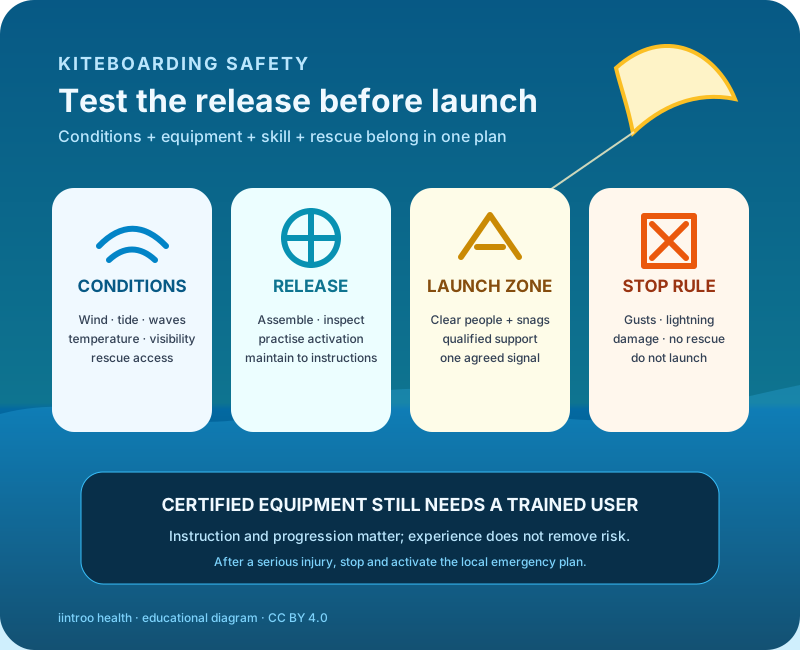
Key points
- ISO 21853 specifies safety requirements and test methods for kiteboarding release systems, but a compliant device still needs correct assembly, maintenance and practised operation.
- Recent injury studies are mostly surveys and reviews; they repeatedly identify lower-limb trauma while also recording rib, head and concussion injuries.
- Beginner status is associated with more reported injury in several studies, supporting qualified instruction and condition-specific progression—not a claim that experience removes risk.
Build the decision before the kite is powered
This guide is for recreational and competitive kiteboarders, families, instructors, clubs and event teams. Wind direction and gusts, tide, current, waves, water and air temperature, visibility, obstacles, other users, launch width and reliable help all change the consequence of a mistake. A forecast alone cannot show the conditions at one beach or moment.
Use current local rules and qualified instruction, and choose conditions, kite, board and task that match the rider's demonstrated skill. Keep spectators and uninvolved beach users outside the launch and landing area. Offshore or turbulent wind, lightning, poor visibility, damaged equipment, an overcrowded site or no workable rescue route can be reasons not to launch.
Inspect and rehearse the release system
ISO 21853 defines minimum safety requirements and testing for a system designed to reduce kite pull and disconnect the user. Certification is not self-maintenance. Assemble the bar, lines, leash and harness according to the current manufacturer instructions; inspect wear, sand, corrosion, tangles and incorrect connections before use.
Practise locating and operating each release in a controlled training setting with qualified supervision, including how the kite flags and how final separation works. A 66-person prospective study did not find lower injury frequency among release-system users, but it was small and observational. It cannot show the device is useless; it shows that equipment ownership alone is not evidence of correct activation, maintenance or safe judgement.
Treat injury surveys as signals, not forecasts
A 2025 review of 25 papers found lower-limb injuries prominent and stressed the shortage of prospective evidence. A 2026 online survey of 3,138 athletes recorded 3,720 qualifying injuries and reported much higher rates among beginners than professionals, with cuts, rib injuries, knee-ligament injury, foot or ankle fractures and concussion among the patterns.
Those data rely on self-selected reporting, recall and different definitions across disciplines such as big air, freestyle, foil and freeride. The apparent experience gradient may reflect exposure, reporting and risk selection as well as skill. It supports instruction and progressive conditions but does not prove that an expert, helmet or release system is immune from serious injury.
Match protection and rescue to the site
Follow the current class, event and local rules for helmet, flotation or impact protection, leash, line-cutting tool and other equipment. Competition requirements may not cover every recreational hazard, and a product made for another sport should not be assumed suitable. Protection must fit, remain accessible and avoid interfering with the release sequence.
Ride with an agreed communication and rescue plan and within a system that can actually recover a person and depower equipment in the prevailing conditions. Severe bleeding, breathing difficulty, loss of consciousness, neck or back pain, deformity, neurological symptoms or suspected drowning requires the local emergency response. Do not relaunch to test a significant injury.
Return by diagnosis and kiteboarding task
Return depends on the injury. It may rebuild ordinary movement, strength, balance and impact tolerance before controlled board handling, body drag, riding, transitions, jumps or discipline-specific competition. Wind strength, water state and equipment load are part of progression; a quiet-water session is not equivalent to a powered jump in gusts.
This article provides general education. It does not select a kite, wind limit, protective device, rehabilitation programme or return date. After serious injury or repeated symptoms, qualified medical assessment and instruction are more appropriate than copying another rider's setup or timeline.