
Mallet finger in ball sport: protect the tendon and plan the return
A drooping fingertip after ball impact may be mallet finger. Early assessment, uninterrupted splinting and sport-specific protection help preserve hand function.
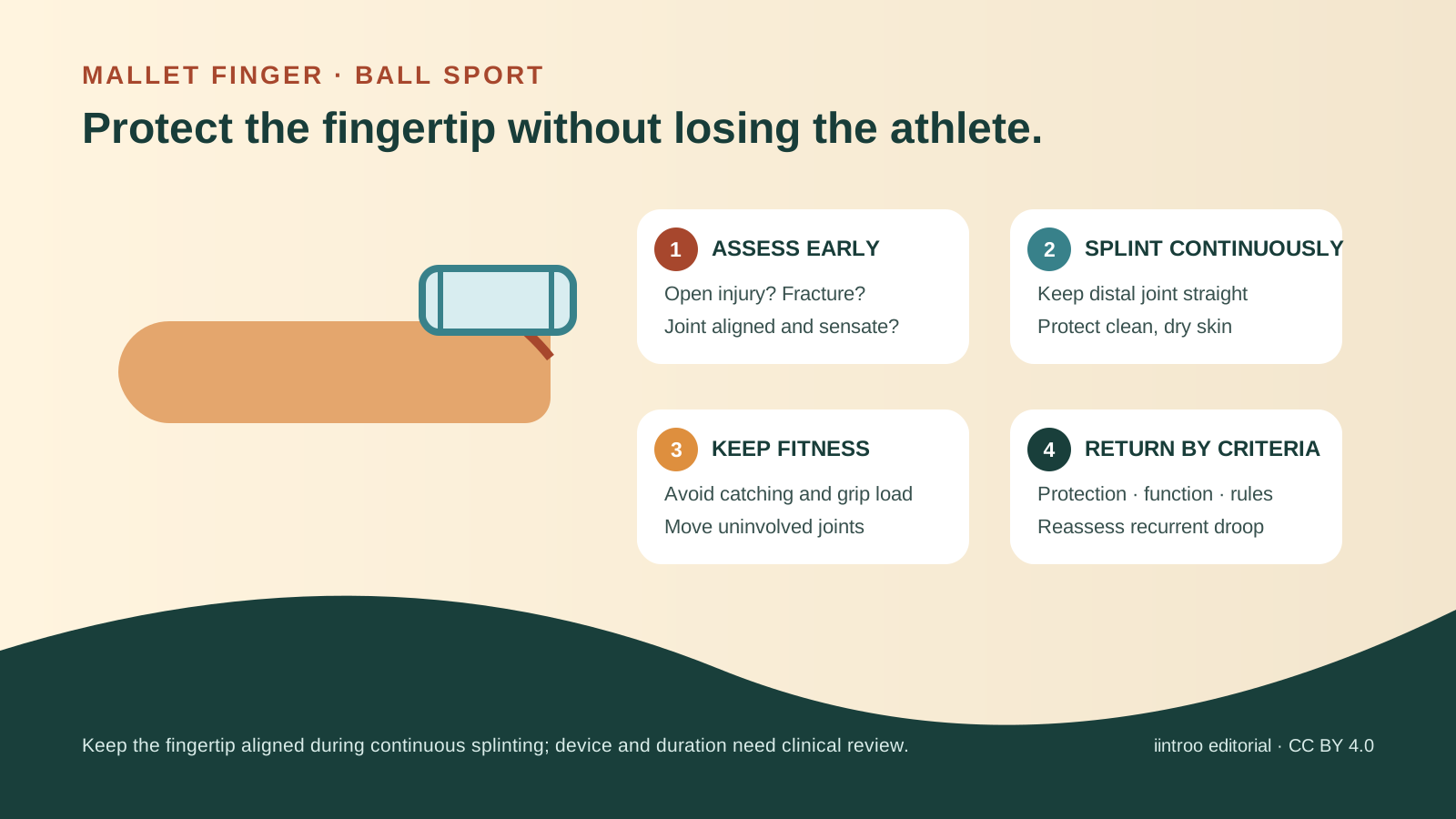
Key points
- Mallet finger follows disruption of the terminal extensor tendon, sometimes with an avulsion fracture, and typically leaves the fingertip unable to straighten actively.
- Most closed injuries are treated with continuous distal-joint extension splinting, but the exact device and duration should follow clinical assessment.
- Sport return depends on stable protection, skin health, hand demands and league rules; a generic week count cannot replace review of the injury.
Recognize the pattern and rule out injuries that need escalation
Mallet finger often follows a ball striking the end of an extended finger. The terminal extensor tendon is disrupted at the distal interphalangeal joint, with or without a small avulsion fracture, so the fingertip droops and cannot be actively straightened. Pain may be modest and athletes sometimes continue playing. A photograph cannot show fracture size, joint alignment, tendon continuity or an open injury. Early assessment is useful, particularly when the finger is deformed, very swollen, numb, cut or trapped beneath the nail.
Urgent hand or emergency review is important for an open wound, exposed bone or tendon, loss of circulation or sensation, severe displacement, a joint that cannot be passively straightened, or suspected dislocation. Imaging is commonly used to assess an avulsion fracture and joint alignment. Children and adolescents need age-appropriate evaluation because growth-plate and other injuries can mimic the pattern. Do not repeatedly test the fingertip by bending it; that can disrupt the position needed for healing.
Make uninterrupted splinting genuinely uninterrupted
Most closed, well-aligned mallet injuries are managed without surgery by holding the distal joint straight or slightly extended while allowing the middle joint to move. Public and clinical guidance commonly describes full-time splinting for about six to eight weeks, followed by a graded reduction or night protection when healing is satisfactory. That range is not a personal prescription. Fracture pattern, delay to treatment, skin tolerance, occupation, age and the clinician's examination can change the plan.
The critical point is maintaining the fingertip position during cleaning and splint changes. If the distal joint bends during the continuous phase, the treating team may need to restart the timing. The splint should not be so tight that it causes numbness, colour change or pressure injury. Keep the skin clean and dry, check it regularly and seek help for wounds, persistent maceration or worsening pain. A hand therapist can fit alternatives and teach safe hygiene without sacrificing tendon protection.
Keep fitness while shielding the healing finger
Cardiovascular and lower-body training may often continue if the splint remains secure and the activity does not create collision, catching or contamination risk. Exercise selection should avoid gripping, weight bearing through the injured hand, ball handling or equipment tasks that can bend the distal joint unless the treating team has approved them. Sweat and repeated taping can damage skin, so inspect the finger and replace wet materials correctly. Contact rules may prohibit hard or exposed splints even when medically appropriate.
Strength and motion work should follow the staged rehabilitation plan. Starting fingertip flexion too early can recreate the droop, while immobilizing uninvolved joints unnecessarily can add stiffness. Once the clinician confirms readiness, motion is usually restored gradually and monitored for recurrent extensor lag. Mild residual prominence or a small lag can persist even after appropriate care; appearance alone does not measure grip, dexterity or sport function. Surgery is reserved for selected open, unstable, subluxed or failed cases and has its own risks.
Return by protection, function and sport demands
A recent athlete hand-injury review notes that some athletes may compete in a splint, but this depends on whether the device can remain protective throughout play and whether rules permit it. Basketball, volleyball, cricket catching, goalkeeping and handball expose the fingertip differently from running or field positions with little hand use. Hand dominance, position, competition level, pain, swelling, skin integrity and the ability to execute sport tasks without losing alignment should all inform the decision.
Return should be coordinated with the hand clinician, therapist, athletic trainer and competition officials where relevant. Recurrent droop, a loose or damaged splint, new numbness, increasing pain or skin breakdown means stop and reassess. This article cannot select a splint, determine whether a fracture needs surgery or give one return date. The useful sequence is early diagnosis, continuous protection, skin-safe rehabilitation, maintenance of unaffected fitness and a criteria-led return that preserves both healing and the athlete's role.