
Climbing finger pulley injuries: diagnose the structure before loading it
A painful pop while crimping can be a pulley injury, but finger pain has several causes. Assessment, selective imaging and graded loading should guide return.
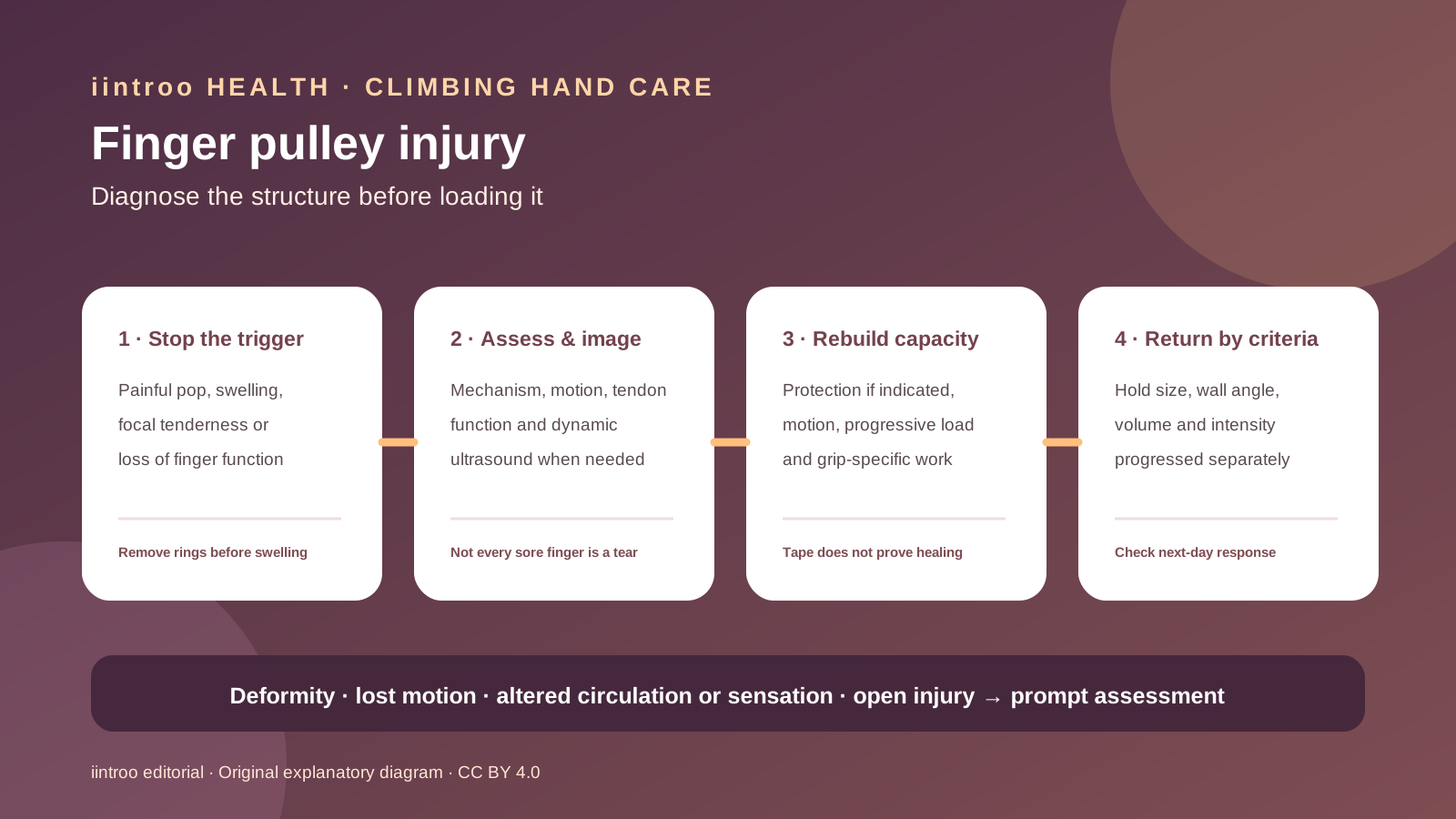
Key points
- Pulley injury is a climbing-specific possibility after a painful pop, swelling or focal tenderness, but not every sore finger is a pulley rupture.
- Dynamic ultrasound is commonly recommended when imaging is needed; grading and associated injuries influence protection, rehabilitation and surgical referral.
- Tape may change local mechanics but does not prove that a finger is healed or make painful climbing safe.
Treat the mechanism as a clue, not a self-diagnosis
This guide is for sport climbers, boulderers, paraclimbers, coaches and clinicians. Flexor pulley injuries are associated with high finger loads, especially an unexpected eccentric load in a crimp position. A climber may feel or hear a pop and develop focal palm-side pain, swelling, bruising or difficulty loading the finger. Those features raise suspicion; they do not distinguish a strain, partial tear, single rupture, multiple rupture, tendon problem, joint sprain, lumbrical injury or growth-plate injury without assessment.
Stop the problem grip and reduce further loading after an acute event. Remove rings before swelling increases. Marked deformity, an open wound, loss of active motion, altered circulation or sensation, an unreduced dislocation, severe swelling or a high-energy fall needs prompt clinical assessment. A teenager with persistent finger pain deserves particular care because epiphyseal stress injury can resemble an adult overuse problem. Do not repeatedly pull on the finger to demonstrate bowstringing for a video.
Use examination and imaging to grade what actually happened
A clinician should connect the mechanism and exact tender site with active motion, joint stability, tendon function and neurovascular status. Visible or palpable bowstringing can support a major pulley injury, but systematic review evidence does not support using its absence to rule an injury out. When characterization will change management, dynamic high-resolution ultrasound is commonly used first because it can show tendon-to-bone separation during movement. MRI may help when ultrasound is inconclusive or another structure is suspected.
Published ultrasound thresholds and measurement positions vary, and a 2020 systematic review found only seven eligible studies with substantial differences in cut-offs. The scan therefore needs appropriate technique and clinical interpretation. Grading systems can guide whether protection, functional rehabilitation or surgical review is considered, but they are not a do-it-yourself return calendar. Multiple pulley ruptures, associated tendon injury or persistent major bowstringing may need hand-surgery expertise.
Rebuild finger capacity through progressive, specific loading
Most isolated lower-grade pulley injuries are described as non-operative, but non-operative does not mean no plan. Early protection is followed by carefully progressed motion and loading selected for the injured structure and stage. Rehabilitation commentary emphasizes gradual tissue loading, movement quality and restoration of climbing-specific capacity. A protective splint or tape may be used in some grades under professional guidance. Tape is not a substitute for diagnosis, and the amount or direction of support should not be guessed from a generic tutorial.
Progress from pain-limited daily use to controlled isometrics or other clinician-selected exercises, then larger holds, open-hand positions, easy terrain and later more demanding grips. Change hold size, wall angle, volume, intensity and dynamic movement separately. Record symptoms during the session and the next day. Recurrent swelling, loss of motion, worsening focal pain or falling capacity means the plan needs review, not more tape or pain medicine to complete a project.
Return by repeatable function, not a fixed week number
Return should reflect the diagnosis, healing stage, full-finger function, tolerance of progressively harder climbing and recovery after exposure. The 2026 climbing-injury literature still highlights limited return-to-performance criteria, so a calendar alone is not enough. Begin below previous difficulty, avoid surprise dynamic loads and full crimping until the planned stage, and rebuild consecutive-session tolerance before projecting maximal routes. Youth, para and masters climbers may need different equipment, holds, communication or recovery windows.
Prevention evidence is less certain than social media suggests. A progressive warm-up, sensible exposure to high-intensity fingerboard or campus work, rest when technique deteriorates and age-appropriate training are reasonable load controls, but no routine eliminates injury. There is no universal tape pattern, ultrasound distance, pain score or number of weeks that clears every climber. This page provides education, not diagnosis, imaging selection, splint or exercise prescription, injection advice, surgery advice or personal return-to-climbing clearance.