
Massage guns for athletes: short-term mobility is not tissue repair
Percussive devices may change short-term movement or selected recovery measures, but soreness and performance findings are inconsistent. Use them cautiously.
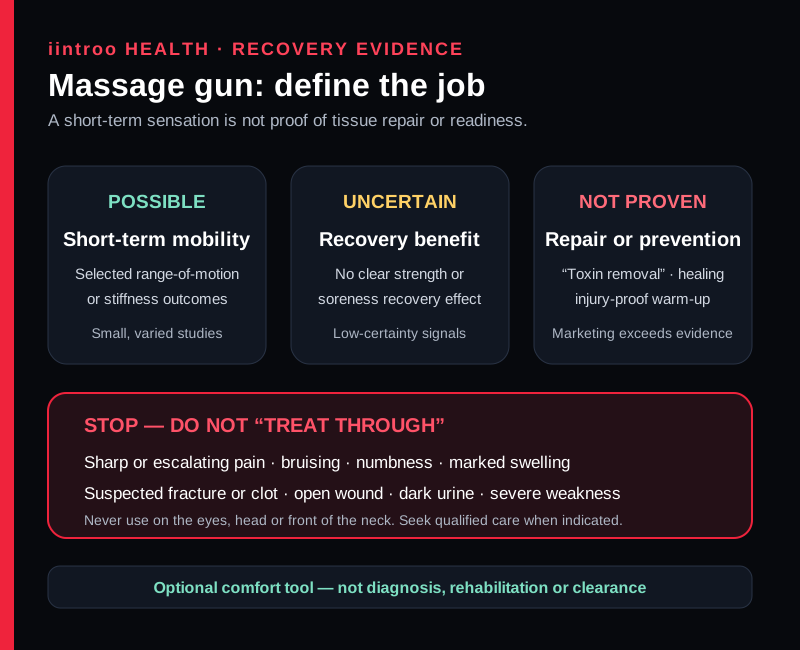
Key points
- Massage-gun studies are small and varied; short-term range-of-motion changes do not prove faster healing, better circulation or injury prevention.
- A 2026 meta-analysis found no clear benefit for maximum-strength recovery or delayed-onset muscle soreness, and rated several findings low or very low certainty.
- Do not use a percussion device to diagnose or treat an acute injury, over the head or front of the neck, or through sharp pain, bruising, numbness or worsening swelling.
Define the job before switching the device on
This guide is for athletes, coaches and support teams considering a handheld percussive massage device. Start with the goal: a brief change in perceived stiffness or range of motion is different from restoring strength after hard exercise, treating pain or healing an injury. Marketing often combines those separate outcomes into one recovery promise.
The 2023 systematic review found only 11 eligible studies, most with moderate risk of bias. A 2026 meta-analysis included 12 randomised trials after exercise-induced muscle damage. Protocols, muscles, devices and comparison groups differed, so one result cannot establish an ideal speed, pressure or duration for every athlete.
Mobility can change without proving repair
Some studies report short-term improvements in flexibility or range of motion. That may be useful when an athlete wants a comfortable movement option, but it does not show that muscle, tendon or fascia has been realigned, toxins have been removed or an injury has healed. Do not use a larger range immediately afterward as clearance for maximal load.
The 2026 review found a signal for countermovement-jump recovery and a change in creatine kinase, but certainty was low or very low. Maximum voluntary contraction and delayed-onset soreness did not clearly improve. Creatine kinase is a laboratory marker affected by many factors; lowering it is not itself proof of better health or readiness.
Do not assume it improves the warm-up
A small 2025 crossover study in 16 trained athletes found that massage-gun and foam-roller conditions did not outperform a dynamic warm-up and were associated with worse selected jump or sprint outcomes. The sample was too small to settle the question, but it challenges the idea that more pre-session treatment automatically improves performance.
If an athlete uses the device for comfort, keep it separate from the core warm-up: progressive movement, sport-specific skill and exposure to the speeds and forces of the session. Test the routine in training rather than first using it before competition. Stop if the athlete feels weaker, more sore or less coordinated.
Respect the safety boundary
Use only on areas permitted by the product instructions, with light pressure first, and never on the eyes, head or front of the neck. Avoid open wounds, acute bruising, obvious swelling, suspected fracture or dislocation and an area with reduced sensation. People with bleeding risk, vascular disease, recent surgery, pregnancy or another relevant condition should seek individual clinical advice before use.
A published rhabdomyolysis report after cycling and percussion massage shows that serious harm is possible, but one case cannot estimate incidence or prove that normal use carries the same risk. Its value is a warning against aggressive treatment of already damaged tissue. Severe or escalating pain, marked weakness, extensive swelling or dark urine needs urgent medical assessment, not more massage.
Put optional recovery tools in their place
Recovery still depends mainly on appropriate training load, sleep opportunity, adequate food and fluid, and assessment of persistent symptoms. A massage gun can be an optional comfort tool; it should not become a team requirement, a treatment delivered by an unqualified person or proof that an athlete is ready to play.
Persistent night pain, loss of strength, numbness, repeated swelling or symptoms that alter sport technique deserve qualified evaluation. Record what was used and how the athlete responded rather than increasing intensity because a device feels less noticeable over time. This page does not prescribe a device setting or treatment plan.