
Meniscal root tears in sport: restore knee function before pivoting return
A meniscal root tear can alter knee loading. Accurate diagnosis, treatment choice and criteria-based rehabilitation should guide return to pivoting sport.
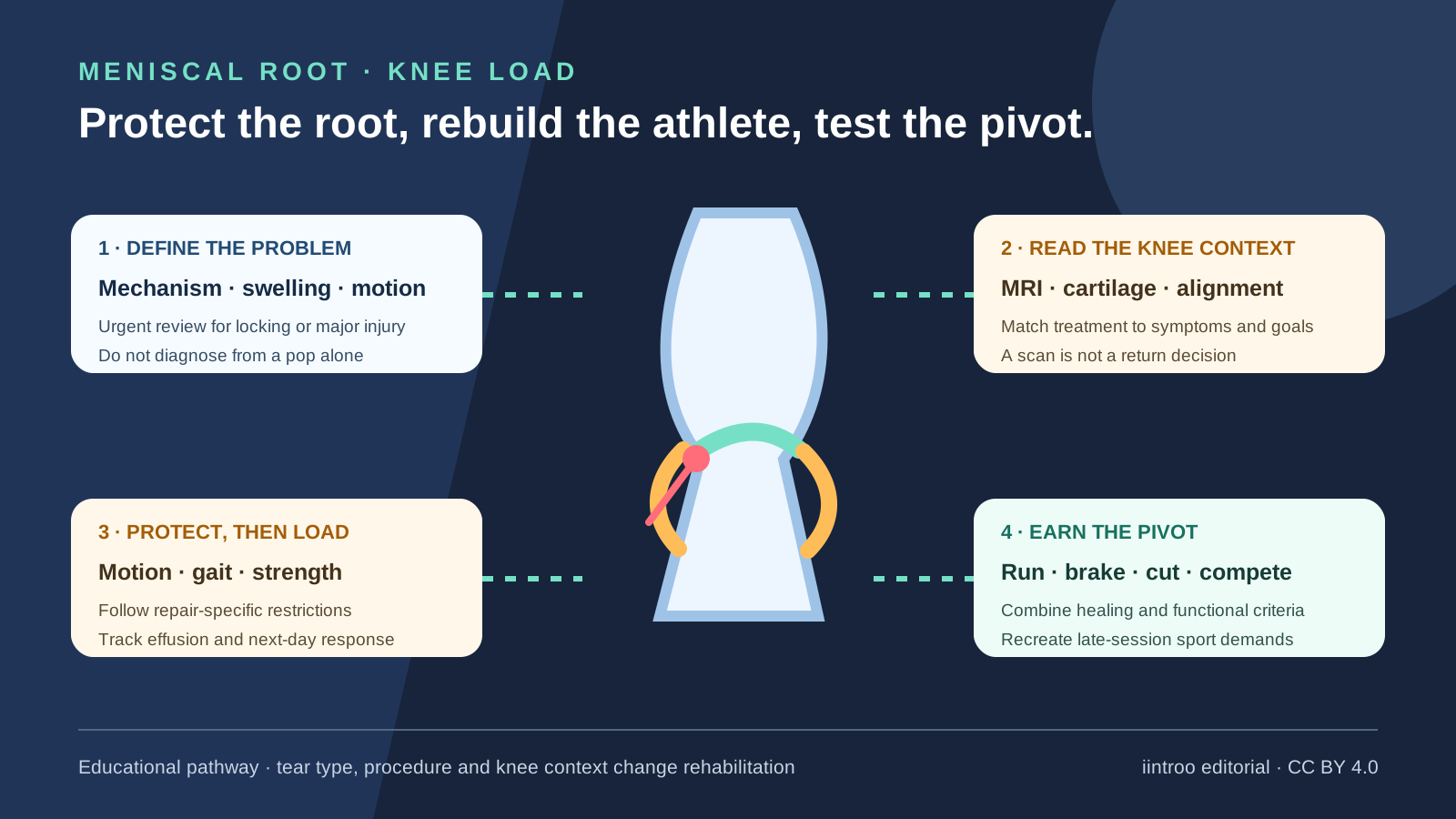
Key points
- A meniscal root tear disrupts the attachment that helps the meniscus transmit load; pain or a pop does not establish the diagnosis or the treatment.
- MRI, examination, osteoarthritis status, alignment, symptoms and activity goals are interpreted together when choosing repair, nonoperative care or another pathway.
- After repair, early protection and later return should match the tear and procedure, with effusion, motion, strength, control and sport tasks assessed before pivoting competition.
Recognize a load-transmission injury without diagnosing from the pop
This guide is for athletes, coaches and clinical teams dealing with pain at the back or inside of the knee, swelling, catching or a pop during a squat, pivot, landing or lower-load movement. The meniscal roots anchor the fibrocartilage that helps spread load across the knee. A complete root tear can reduce that function and allow extrusion, but the same symptoms can arise from other meniscal tears, ligament injury, cartilage disease, bone stress, arthritis or a Baker cyst. One painful manoeuvre or an online MRI screenshot cannot identify the problem.
Stop and arrange timely assessment when the knee becomes markedly swollen, locks, cannot take weight, loses motion or follows a significant twisting injury. Urgent care is needed for deformity, loss of circulation, progressive numbness, a hot red joint with fever or concern for fracture or dislocation. Record the mechanism, swelling timeline, joint-line location, previous knee injury and the tasks that reproduce symptoms. An older runner with gradual pain and an acute pivoting athlete may have different tissue and joint contexts even when the scan uses the same term.
Combine MRI with cartilage, alignment and the athlete's goals
A 2025 international Delphi process involving 56 experts reached broad agreement that MRI is central to diagnosing medial meniscal root tears, while treatment also depends on symptoms, cartilage status, limb alignment and the wider knee. The panel supported early anatomic repair for selected symptomatic tears without advanced osteoarthritis and nonoperative management when advanced osteoarthritis changes the expected benefit. This is expert consensus, not proof that every tear requires surgery or that an asymptomatic scan finding must be repaired.
The clinician interprets tear location, chronicity, extrusion, bone and cartilage findings, previous surgery, instability and alignment alongside age, health, occupation and desired sport. Lateral root tears often occur with ligament injury and are not interchangeable with degenerative medial-root patterns. Injections, a brace or temporary symptom relief do not show that load transmission has recovered. Shared decision-making should explain the uncertainty, possible progression, rehabilitation burden and alternatives rather than using fear of arthritis as a sales claim.
Protect the repair, then rebuild capacity in stages
The 2024 EU-US meniscus consensus recommends that rehabilitation reflect tear pattern, repair stability, tissue quality, associated procedures and patient factors. Root and complex radial repairs commonly require early limits on weight bearing and knee motion, followed by time- and criterion-based progression. Exact restrictions belong to the operating team because fixation method and associated ligament, cartilage or alignment procedures can change them. Copying a teammate's protocol or accelerating because pain is low can expose healing tissue to loads it has not been cleared to accept.
A 2026 review of 31 studies found substantial average improvement after transtibial medial-root repair but wide variation in bracing, motion and loading protocols; study-level analysis could not identify one superior schedule. Most evidence was observational and heterogeneous. Rehabilitation therefore tracks swelling, extension and flexion, gait, quadriceps activation, strength, single-leg control and response to increasing load. Persistent joint-line tenderness, recurrent effusion, loss of motion or a new mechanical block deserves review rather than a harder training test.
Return through running, braking and pivoting milestones
Return is both biological and functional. The formal consensus recommends assessing symptoms, effusion, motion, quadriceps and hamstring strength, neuromuscular control, coordination and psychological readiness, then completing sport-specific field or court progression. Restore repeatable walking and strength before straight-line running, then add acceleration, braking, lateral movement, reactive change of direction, jumping, contact and competition density. A hop score alone cannot represent repeated pivots, late-session fatigue or the demands of a skier, goalkeeper or wheelchair transfer.
Published return ranges are broad and root repairs generally require a longer protected course than partial meniscectomy, but a calendar is not clearance. Associated ACL injury, cartilage damage, alignment surgery or delayed recovery can change the path. This article cannot diagnose a tear, interpret MRI, select surgery, prescribe weight-bearing or clear competition. It supports accurate classification, honest discussion of evidence limits, repair-specific protection and a return decision based on healing plus the knee function required by the athlete's actual sport.