
Menstrual migraine in athletes: use a headache diary before changing training
Headaches around menstruation need prospective pattern tracking, red-flag assessment and an individual plan—not automatic cycle-based training restrictions.
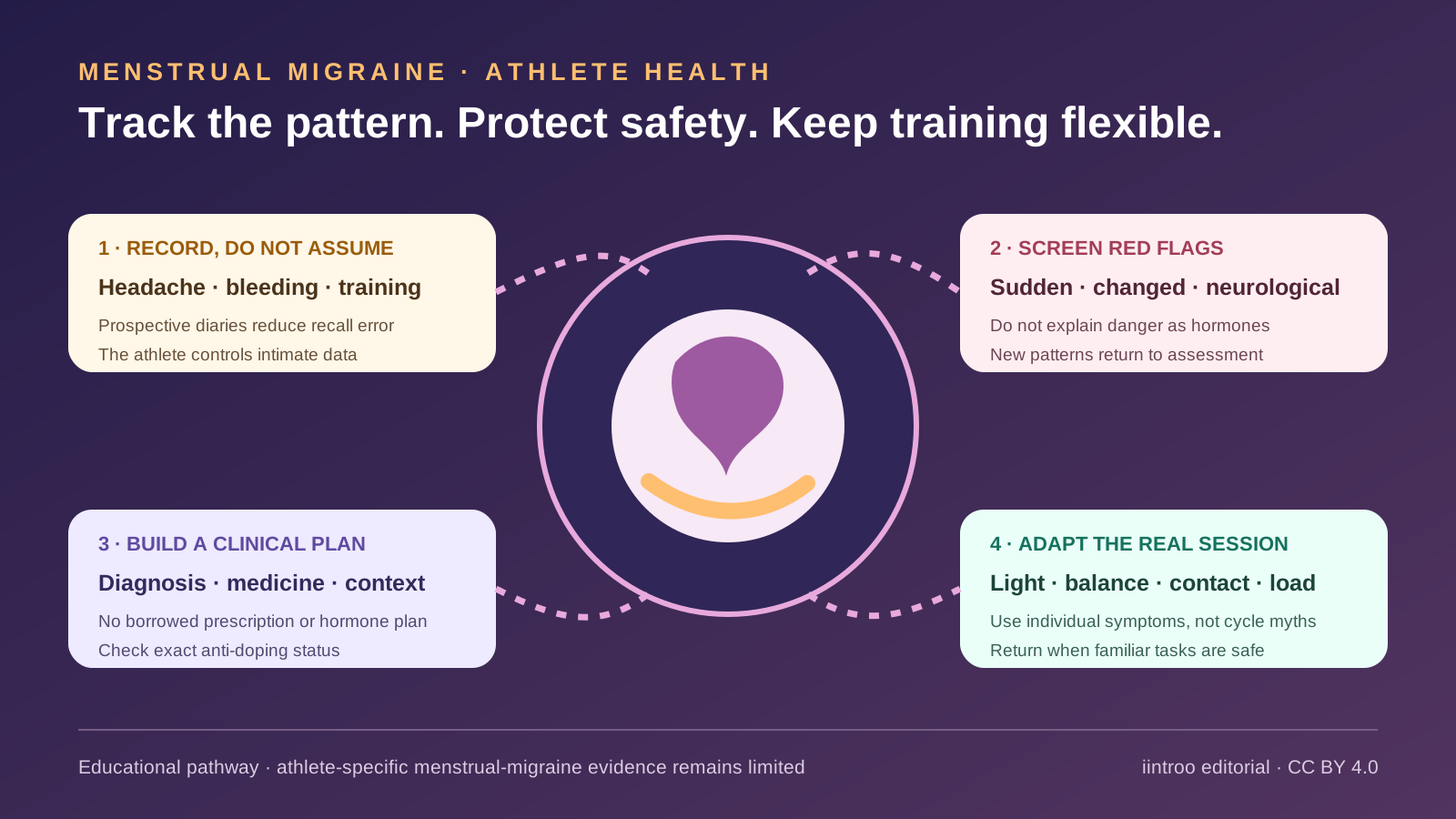
Key points
- Menstrual migraine is defined by a repeated timing pattern around menstruation; memory alone can overestimate or miss the association, so prospective diaries are useful.
- A first, sudden, changed or neurologically unusual headache needs assessment before it is attributed to hormones, dehydration or training.
- Exercise may support migraine health overall, but athlete-specific and menstrual-migraine intervention evidence is limited and does not justify a universal cycle-based programme.
Track the pattern without turning every headache into a hormone diagnosis
This guide is for menstruating athletes, coaches and health teams dealing with headaches that appear near a period. International Headache Society classification describes pure menstrual migraine and menstrually related migraine by attacks occurring from two days before to three days after menstruation begins in at least two of three cycles; the latter also occurs at other times. These categories sit in the ICHD-3 appendix and mostly concern migraine without aura. The label cannot be assigned from one difficult competition or a teammate's pattern.
Use a prospective diary to record headache timing, features, aura or other neurological symptoms, bleeding, sleep, meals, hydration, medicines, travel and training exposure. A longitudinal diary study of 607 women found poor agreement between self-reported menstrual migraine and diary-based criteria, illustrating recall limits rather than proving that symptoms are unimportant. The athlete controls who sees intimate health data. A coach needs agreed training information, not unrestricted access to cycle records.
Keep headache red flags separate from routine cycle planning
Seek urgent assessment for a sudden severe or thunderclap headache, collapse, seizure, new weakness or numbness, confusion, persistent double vision, fever with neck stiffness, a major head injury or a headache during pregnancy with concerning symptoms. A first exertional headache, a major change in a familiar pattern, persistent vomiting, progressive worsening or new aura also deserves clinical review. Menstruation, heat, altitude, dehydration and stress can coincide with serious conditions and should not become automatic explanations.
Migraine assessment reviews attack features, frequency, disability, medication use, aura, cardiovascular and pregnancy context and other possible causes. Low energy availability, iron deficiency, infection, concussion, sleep disruption and medication effects can overlap with headache and poor performance but require their own evaluation. This article cannot decide whether an athlete has migraine, whether contraception is appropriate or whether a symptom is safe to train through.
Build treatment with a clinician, not from a teammate's prescription
The 2024 IHS acute-treatment recommendations discuss standard migraine-specific and non-specific options and, for predictable menstrual migraine, short-term prevention in selected patients. Choice depends on diagnosis, contraindications, pregnancy plans, other medicines and local availability. Hormonal strategies require particular care because migraine with aura changes vascular risk discussions. Athletes should not borrow triptans, repeatedly exceed pain-medicine limits or start hormonal treatment solely to protect a competition date.
The plan should also consider anti-doping rules without implying that every migraine medicine is prohibited. Verify the current status of each exact medicine and route through an official anti-doping resource and the prescribing professional. Frequent acute medicine use can contribute to medication-overuse headache. Worsening frequency, poor control, new neurological symptoms or increasing medicine use deserves review rather than another self-directed dose or harder training session.
Make training flexible without promising cycle-based performance gains
A 2024 scoping review found very wide estimates of menstrual-cycle symptoms and perceived performance effects across athlete studies, with methodological differences and recall bias. A 2026 systematic review of menstrual-health interventions in athletes included only five heterogeneous studies and could not support firm performance recommendations. These limitations argue for individual symptom-led adjustment, not a rule that all athletes should deload, avoid competition or expect impairment during one phase.
Exercise trials in general migraine populations suggest possible benefit from aerobic, resistance, yoga or combined programmes, but certainty is low and they do not establish an athlete-specific menstrual-migraine prescription. Maintain tolerable activity when safe, protect regular meals, hydration and sleep, and adjust light, heat, contact or technical risk when an attack affects vision, balance or concentration. Agree in advance who can stop a session, where rescue medication is stored and how the athlete can leave water, road or combat training safely without delay or avoidable public disclosure. Return to full load when the familiar episode is controlled and sport tasks are safe; a new or changed pattern returns to assessment.