
Motorsport heat stress: plan cooling, hydration and a safe stop
Fire-resistant clothing, a confined cockpit and race workload can raise thermal strain. Use event heat plans, individual preparation and symptom-led stopping rather than a one-size-fits-all fluid target.
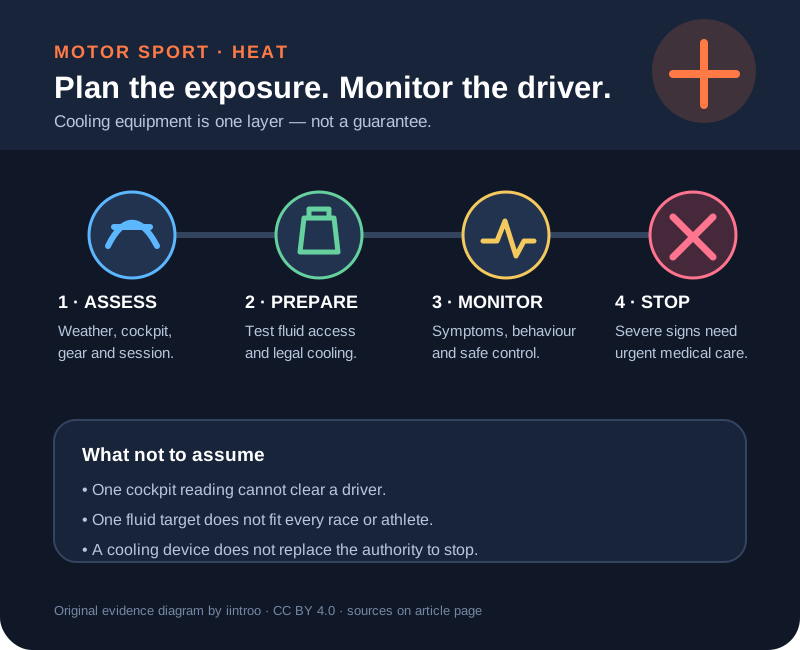
Key points
- Cockpit temperature alone does not reliably describe a driver's physiological strain; direct symptoms and appropriate monitoring still matter.
- Hydration and cooling should be planned around the driver, vehicle, protective equipment and event rules rather than copied from another competitor.
- Confusion, collapse, loss of coordination or other severe heat-illness signs require an immediate stop and emergency medical action.
Treat heat as an event risk, not a test of toughness
This guide is for racing drivers, teams, event organisers and medical staff across circuit, karting, rally and endurance settings. Drivers can combine metabolic work, psychological load, fire-resistant clothing, a helmet and limited airflow in a hot environment. The exposure differs by vehicle, session length, weather, ventilation and equipment, so an elite Formula 1 rule or study cannot be copied unchanged into every category.
The FIA introduced formal heat-risk measures and its 2026 Formula 1 regulations allow a Heat Hazard declaration when specified conditions are met. That is an event-level control, not a personal diagnosis. Club and national events need their own weather monitoring, communication, cooling access, medical cover and stop procedures under the applicable rules.
Assess the driver as well as the cockpit
A four-driver endurance-racing study found that cockpit temperature did not track heart rate, core temperature, skin temperature or a physiological-strain index closely enough to stand alone. Thermal strain rose during driving even as cockpit temperature fell. The sample was very small, but it illustrates why one dashboard or garage temperature should not be used as proof that a driver is safe.
Before the session, consider illness, recent heat exposure, sleep, medication, protective equipment and access to drink or cooling. During and after driving, monitor symptoms, behaviour and function. A driver who is unusually confused, unsteady, faint, vomiting repeatedly or unable to operate controls safely needs removal and urgent medical assessment according to the event emergency plan.
Plan fluid access without prescribing one number
In a study of nine male stock-car drivers, mean sweat rate was about 0.63 litres per hour and body mass fell by about 0.77% during one hot race. That describes a small sample in one category; it is not a universal target. Sweat rate, sodium loss, session length and drinking opportunity vary, while overdrinking can also be harmful.
Use individual observations across representative sessions with qualified support when available. Confirm how and when a driver can drink safely, test equipment before competition and include post-session recovery. Do not turn a body-mass change, urine colour or thirst alone into a medical clearance decision or a fixed prescription for every driver.
Cooling equipment needs testing and rules compliance
A 2026 heat-chamber study compared several cooling devices while participants exercised in full protective racing gear. Cold-air suit and helmet systems reduced thermal strain more than the control condition, but the study was not a race, used a small laboratory sample and did not establish one best system for every cockpit. A cool shirt was not uniformly superior.
Select equipment that is permitted, correctly installed, compatible with fire and electrical safety, and tested for comfort, visibility, movement and failure modes. Cooling should add to — not replace — acclimatisation, weather monitoring, rest, fluid access and the authority to stop. A device that leaks, restricts movement or distracts the driver can create a different hazard.
Build a clear stop-and-care pathway
Teams should agree who monitors conditions, who checks the driver, how symptoms are communicated and who has authority to stop a session. The driver must be able to report heat symptoms without selection pressure. After a concerning episode, return depends on clinical assessment, recovery and the demands of the next session; feeling cooler is not automatic clearance.
Current motorsport evidence is limited by small samples, mixed categories and substantial reliance on applied practice. The 2026 Formula 1 review explicitly notes data gaps. A defensible plan therefore combines current governing-body requirements, event-specific controls and individual medical advice rather than promising that a fluid volume, cooling device or heat threshold will prevent illness.