
Netball ACL prevention: make landing and cutting part of the warm-up
How to build a netball-specific movement warm-up, and what landing and cutting studies can tell players and coaches about ACL risk.
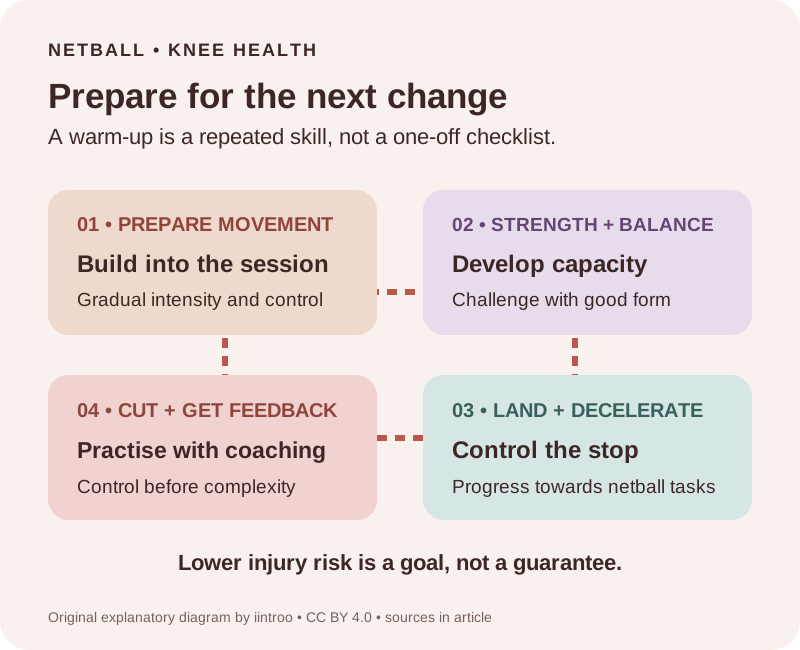
Key points
- Netball Australia's KNEE coach manual recommends repeating the programme two to three times weekly.
- Small netball trials measured movement and knee loading, rather than ACL injury rates.
- No warm-up can guarantee that an ACL injury will be prevented.
Train the moment after the catch
This guide is for netball players, parents and coaches. Receiving an overhead pass can involve landing on one foot, stopping quickly and then finding the next option. These demands make landing, braking and changing direction useful skills to practise. The anterior cruciate ligament, or ACL, helps stabilise the knee. Netball Australia’s KNEE programme connects sport-specific movement practice with strength and balance.
The aim is to improve how players coordinate these actions. It is sensible preparation for the sport, without a promise of injury-free play. The netball trials discussed here involved female players; they do not establish identical effects for men, mixed teams or every age group.
Use the complete routine and coach the quality
KNEE has four blocks: warm-up/footwork, strength, balance/landing and agility. Choose the appropriate junior, recreational or elite version and follow its exercise instructions. The coach manual recommends two to three sessions weekly, sustained over time. Introduce unfamiliar tasks gradually, demonstrate them and give feedback; completing a drill with poor control is not the goal.
Start landing practice slowly. Watch for hips and knees bending, the knee following the foot's direction and a steady trunk. For braking, rehearse several short steps rather than one large, stiff stop. Bring catches and changes of direction into the selected programme as control improves. These cues need observation and practice, rather than a checklist hurried through before the whistle.
Sources: 1
Youth results support movement practice, with limits
A 2017 randomized study included 23 female netball players aged 11–13. Thirteen completed six weeks of neuromuscular training and ten continued regular netball training. The intervention combined strength and jumping exercises in three supervised, 60-minute sessions each week. Laboratory tests found improvements in several landing measures, including lower peak landing forces and changes in knee positioning.
That is encouraging evidence that young netballers can change how they land. It was a small, short study of movement outcomes, rather than a season-long test of ACL injuries. Its substantial supervised training also differs from a brief court warm-up. Coaches should therefore use it to support teaching and progressive training, without claiming that six weeks of KNEE has been proved to prevent tears. A laboratory improvement does not show how long the change lasts or how consistently it appears during a contested match.
Sources: 2
A cutting study does not settle the minimum dose
A further randomized trial studied 17 elite female netballers over six weeks. It compared a targeted, 30-minute programme performed once weekly with the same programme performed three times weekly, alongside regular netball training. First published online in October 2024 and included in a 2025 journal issue, it examined single-leg jump-landings and unexpected sidestep cuts.
The once-weekly group improved one measure of rotational knee loading during right-leg cutting relative to the three-times-weekly group. Other between-group comparisons did not show significant differences. There was no group doing regular training alone and no ACL injury-rate outcome. These results cannot establish that once weekly prevents ACL injuries, that more practice is harmful, or that either schedule is optimal for community teams. They are a reason to investigate manageable training doses, rather than to reduce an established team routine on the strength of one finding.
Sources: 3
Keep injury evidence separate from technique evidence
A 2022 systematic review pooled nine cluster-randomized trials involving 14,394 sporting participants. Programmes containing plyometric exercises were associated with a lower ACL injury rate than usual warm-ups without them: an injury-rate ratio of 0.40, with a 95% confidence interval of 0.26–0.63. That concerns injuries per exposure, unlike the netball laboratory studies. It supports structured prevention programmes, but the pooled estimate is not a measured KNEE effect or a personal prediction for a netball player.
For a team, the useful response is to make the chosen programme a regular, coached part of preparation and revisit technique as the season develops. Avoid attaching a guaranteed percentage reduction to an individual's warm-up. Prevention training also cannot assess an injured knee or clear a player for competition. An existing injury or rehabilitation programme needs advice from the treating clinician before adding demanding landing and cutting tasks.