
Volleyball knee pain: diagnose before copying a jumper’s-knee plan
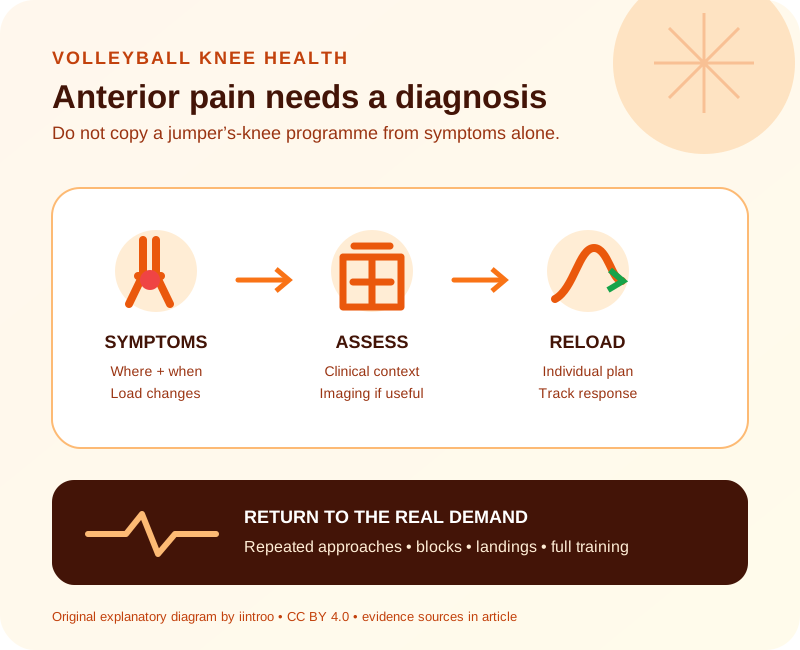
Pain below the kneecap can have more than one cause. Assessment, load review and individual progression should come before a borrowed exercise programme.
Key points
- Anterior knee pain is not a diagnosis by itself.
- Imaging findings and symptoms do not always move together.
- No single exercise programme has proved best for every patellar tendon problem.
Who this guide is for
This guide is for volleyball players, coaches and parents responding to pain at the front of the knee during jumping, landing or stairs. The FIVB manual identifies patellar tendinopathy and patellofemoral pain among important overuse causes in volleyball. Their management is not interchangeable, and pain location alone cannot establish which structure is responsible.
Reduce the provoking activity and arrange assessment by a qualified sports-medicine professional rather than testing repeated maximal jumps. A traumatic injury with rapid swelling, inability to bear weight, a locked knee, obvious deformity or severe worsening pain needs prompt medical evaluation.
Diagnosis is clinical, not an image label
The 2024 Dutch multidisciplinary guideline treats patellar tendinopathy as a clinical diagnosis based on history and examination and describes limited additional value from imaging. Tendon changes can appear in athletes without matching symptoms, while a painful knee can have another explanation.
An ultrasound or magnetic-resonance report should therefore be interpreted in context. It cannot specify a return date, prove that one jump caused the problem or replace examination. Age, recent load, previous symptoms and the demands of the player’s role all affect the clinical question.
Sources: 3
Loading is supported, but certainty is limited
The guideline recommends exercise therapy after diagnosis, but rates the supporting evidence low. A 2025 Cochrane review found the evidence very uncertain for pain benefits compared with no treatment and uncertain for return to sport. The review also noted small trials and gaps in adverse-event reporting.
A 2026 network meta-analysis included 17 randomised trials in its qualitative synthesis; its cleaner primary network contained 10 studies and 313 participants. No exercise approach was statistically superior to heavy slow resistance, and the network was sparse. Rankings are not a reason to copy the highest-looking protocol without individual assessment.
Rebuild the volleyball demand
A rehabilitation plan can review total jumps across practice, strength work and matches, plus changes in surface, role, schedule and recovery. Progression may move from tolerable strength work towards faster energy-storage tasks and volleyball-specific jumping, but the exercise choice, dose and acceptable symptom response belong to the treating team.
Return should reflect repeated approach jumps, blocks, landings and full training rather than one pain-free test. Track the response during the session and afterwards. This article does not prescribe sets, pain thresholds, injections, straps or a universal timeline.
Make reporting easier than hiding
Players often try to train through gradually increasing symptoms. Coaches can create an early-reporting route, adjust jump exposure and share an accurate load history without diagnosing. Parents and clubs should avoid presenting rest, imaging, injections or one exercise as a guaranteed fix.
Recovery can be slow and variable. If symptoms persist, function declines or the diagnosis remains uncertain, reassessment is more useful than escalating an online programme. The evidence supports a reasoned clinical process, not a promise that every case will respond in the same way.