October 2026 · athlete health

HEALTH QUESTIONS
BEHIND THE RESULTS.

Recovery, mental health, anti-doping, heat, concussion, energy availability, Para athlete care and youth pathways—connected to the demands visible in October’s global calendar.

iintroo editorial

01

Anti-doping · preparation for 1 January 2027

Prepare for the 2027 Prohibited List without confusing the effective date.

WADA published the 2027 List on 21 September 2026 after approval on 10 September. It takes effect on 1 January 2027; the 2026 rules still apply during October. Athletes should plan medication checks with qualified clinicians and their anti-doping organisation. Do not stop prescribed treatment based on a headline or assume that an unnamed substance is permitted.

Who should read this

Athletes · Doctors · Pharmacists · Coaches · Team managers · All sports

  • Athletes: which medications and supplements need a documented review before January?
  • Coaches: who coordinates education and protects confidential medical information?
  • Clinicians: are TUE requirements, administration routes and competition timing checked?
  • Support personnel: is the exact list edition recorded for each decision?
Primary guidance · WADA · 2027 Prohibited List
02

Medication · supplements · sport-specific restrictions

Read the changes alongside the complete rulebook.

The explanatory notes clarify non-approved peptides and add examples in several classes. They also address cannabinoid terminology, glucocorticoid administration routes and beta-blocker wording. Cannabidiol is not prohibited, but cannabis-derived products can contain THC. A monitoring-program change does not by itself determine whether another class prohibits a substance. Check the full list and obtain individual medical and anti-doping advice.

Who should read this

Doctors · Pharmacists · Dietitians · Athletes · Anti-doping officers

  • Does the medicine's ingredient, route and timing match the applicable restriction?
  • Could an unlisted peptide fall within a prohibited class?
  • Has supplement contamination risk been considered independently of the label?
Primary guidance · WADA · 2027 Summary of Major Modifications
03

Sleep · travel · recovery

Sleep planning is part of training design.

Competition times, late finishes, early travel, altitude and time-zone changes can all reduce sleep opportunity. Monitoring should begin with the athlete's normal pattern and lead to an individual plan rather than a single universal target.

Who should read this

All sports · Athletes · Coaches · Doctors · Physiotherapists · Psychologists

  • How much sleep opportunity does the schedule actually protect?
  • Which travel days or late finishes create the highest risk?
  • Is persistent sleep difficulty being assessed by a qualified clinician?
Primary guidance · Sleep and the athlete · BJSM expert consensus
04

Mental health · recognition · access to care

Performance change can be a reason to ask, not to diagnose.

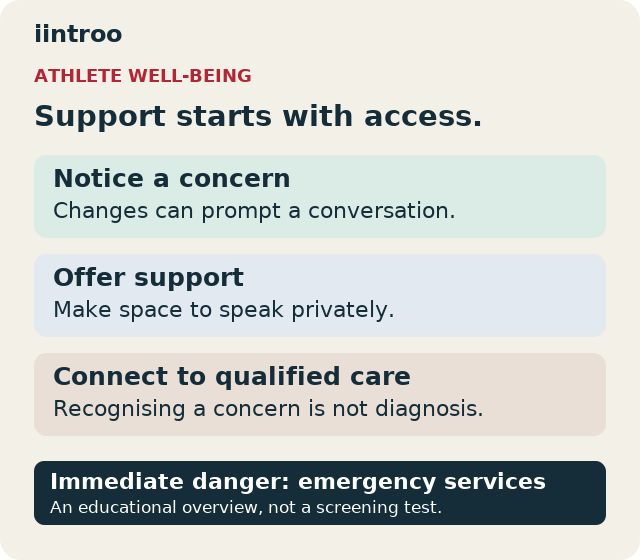
Support pathway: notice a concern, offer a private conversation and connect to qualified care. Immediate danger requires emergency services. This is not a diagnostic tool.
Original explanatory diagram by iintroo · CC BY 4.0 · evidence sources below

A change in mood, sleep, concentration or social participation can be a reason to check in. It cannot establish a diagnosis. The IPC encourages early support when concerns persist and highlights the additional effects of accessibility barriers, discrimination and isolation for Para athletes.

The 2026 IOC consensus updates the 2019 statement. It recommends planned screening with validated instruments and care that considers the training and competition environment. Screening belongs within a professional care pathway; a coach should not use a score to diagnose an athlete or decide treatment.

Ask where an athlete can speak privately with a qualified professional and how support continues during travel. Teams should rehearse a mental health emergency plan with clear responsibilities. Immediate danger requires urgent help through local emergency services, without waiting for a routine appointment.

Evidence: the 2026 consensus combines a literature review and Delphi process, not a treatment trial. High-income settings dominate the evidence and panel; coaches were not represented. Recommendations need local clinical and cultural interpretation. This educational summary has not received an independent clinician review.

Who should read this

All sports · Athletes · Coaches · Doctors · Psychologists · Clubs · Federations

  • Does the athlete know where confidential support is available?
  • Who responds when there is an immediate safety concern?
  • Are selection and confidentiality boundaries explained in advance?
Primary guidance · IOC mental health consensus (2026) · DOI 10.1136/bjsports-2025-111514

IPC · mental health and accessible support

05

Supplements · anti-doping · informed decisions

A supplement label is not an anti-doping guarantee.

Contamination, adulteration and supply-chain gaps can expose athletes to prohibited substances even when a product label looks acceptable. Need, evidence, batch testing, documentation and professional review should be considered before use.

Who should read this

All sports · Athletes · Doctors · Dietitians · Pharmacists · Coaches · Team managers

  • Is there a demonstrated performance or health need?
  • Has the exact batch been independently tested where a programme exists?
  • Are the decision, product and batch details documented?
Primary guidance · WADA · systemic risk assessment of inadvertent doping through supplements
06

Heat · endurance · event operations

Heat risk belongs to the event plan, not only the athlete.

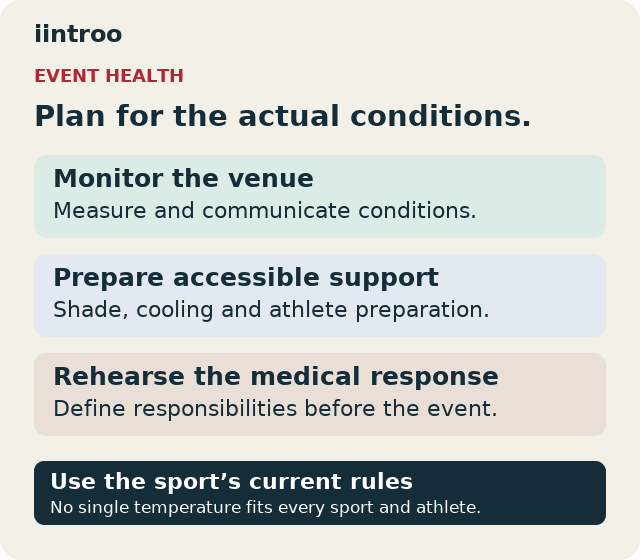
Three parts of event heat planning: monitor conditions at the venue, prepare accessible shade and cooling, and rehearse medical response. Apply sport-specific rules and individual assessment.
Original explanatory diagram by iintroo · CC BY 4.0 · evidence sources below

Heat planning starts with the conditions athletes actually experience. A calendar month or a city forecast cannot establish the risk at the field of play. The IOC consensus connects event monitoring, athlete preparation and medical response rather than treating hydration as the entire solution.

Organisers should measure and communicate conditions, provide shade and cooling access, and agree who can modify the event under the sport's rules. Athletes and clinicians should discuss preparation, clothing and individual needs. Impairments can affect thermoregulation, so access and support must be planned individually.

World Athletics' Tokyo 2025 guidance provides a practical event example: it directed visitors to local WBGT information and described heat countermeasures. Those arrangements were specific to that championship. For another venue, use its current official instructions and medical plan rather than copying a past event's timetable.

Evidence: the IOC statement was published online in September 2022 and in the January 2023 issue. It combines literature, field experience and expert consensus; its heat-policy development framework is expert-informed. No universal cancellation temperature or personal fluid prescription follows from it.

Who should read this

Endurance · Motor sport · Tennis · Para sport · Event medicine · Officials

  • What environmental measurements trigger a change?
  • Are cooling and fluids accessible to every athlete?
  • Does the plan account for impairment-specific thermoregulation?
Primary guidance · IOC heat consensus · DOI 10.1136/bjsports-2022-105942

World Athletics · Tokyo 2025 heat countermeasures

07

Contact · speed · combat

Delayed symptoms still change the return-to-sport decision.

A normal-looking finish to a match or stage does not close a concussion assessment. Recognition, removal, serial review and graduated return must reflect the sport, the athlete and the available clinical resources.

Who should read this

Football · Handball · Hockey · Ice sport · Cycling · Motor sport · Combat

  • Was the athlete removed and assessed without competitive pressure?
  • Who monitors delayed symptoms after the venue?
  • Are school, work and travel demands part of the return plan?
Primary guidance · Amsterdam 2022 concussion consensus · BJSM
08

REDs · women · weight-category sport

A performance drop can be a whole-system health signal.

Low energy availability can affect bone, endocrine, immune, cardiovascular and psychological health. Screening should not be reduced to body size, menstrual status or one laboratory value.

Who should read this

Women athletes · Endurance · Gymnastics · Diving · Combat · Weightlifting

  • Has recent training, fuelling, sleep and weight change been reviewed together?
  • Are bone stress and endocrine symptoms being missed?
  • Is the athlete protected from blame and unsafe weight-making pressure?
Primary guidance · 2023 IOC REDs consensus · PubMed
09

Para sport · individual context

The impairment, equipment and environment form one health system.

Skin integrity, autonomic function, thermoregulation, transfer demands, pain, medication and the athlete–equipment interface can alter both performance and risk. Generic able-bodied assumptions are not enough.

Who should read this

All Para disciplines · Classifiers · Clinicians · Engineers · Coaches

  • Which risks are impairment-specific and which are sport-specific?
  • Has equipment fit and skin pressure been checked?
  • Can the athlete access cooling, toilets, transport and clinical care independently?
Primary guidance · International Paralympic Committee · Medicine & Science
10

Youth · growth · safeguarding

The calendar must fit the developing athlete.

January's junior and under-age championships make growth, maturation, school demands, sleep, travel and safeguarding part of the performance conversation. Adult load models should not simply be scaled down.

Who should read this

U19 · U20 · U23 · Junior pathways · Families · Coaches · Clinicians

  • Is load interpreted against growth and maturation?
  • Who can the athlete contact outside the performance chain?
  • Are sleep, education and travel recovery protected?
Primary guidance · IOC harassment and abuse consensus
11

Diving · wrestling · gymnastics · cycling · rugby league

Match the clinical question to the sport's demands.

October's championship calendar includes sports with different exposures: diving and gymnastics combine technical precision with repeated loading; wrestling includes contact and weight-category pressures; track cycling combines high speed with training load; rugby league involves repeated collisions. These exposures are starting points for a clinical conversation, not diagnoses. Injury history, impairment, age, nutrition and competition schedule matter alongside the discipline.

Who should read this

Athletes · Clinicians · Physiotherapists · Coaches · Event organisers

  • Diving and gymnastics: how are pain, recovery and landing or entry loads monitored?
  • Wrestling: is weight management reviewed by qualified medical and nutrition staff?
  • Rugby league and cycling: are concussion recognition and emergency response procedures rehearsed?
  • Para sport: are access, equipment fit and impairment-specific needs considered?
Primary guidance · IOC · prevention of injury and illness in sport

Medical notice: This page supports education and multidisciplinary discussion. It is not diagnosis, treatment, medication clearance or emergency advice. Use a qualified clinician and the rules of the relevant federation for personal decisions.