
Starting pickleball later in life: build court movement before chasing every ball
Use the injury evidence without treating age as a diagnosis, prepare for stopping and direction changes, and make a gradual, individual plan for safer pickleball participation.
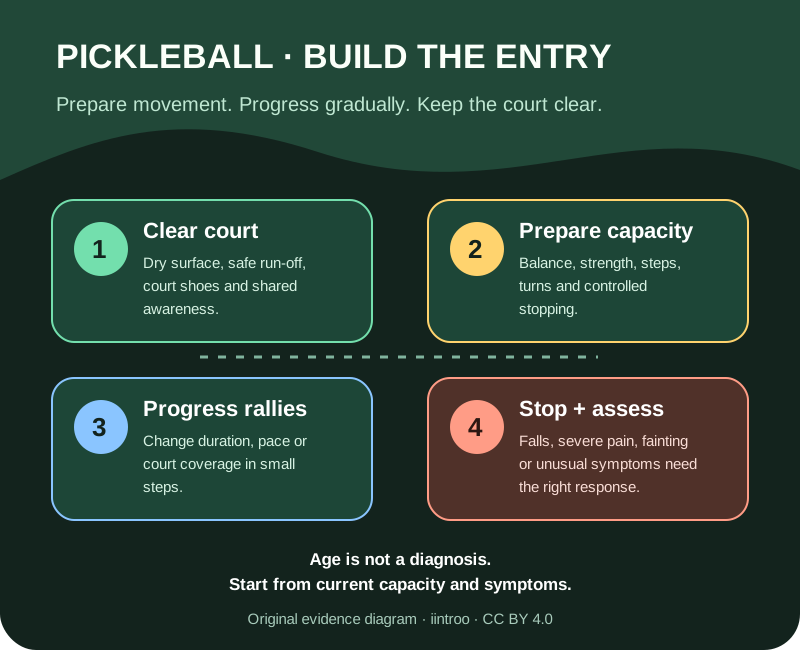
Key points
- Emergency-department data show that falls and fractures feature prominently in older pickleball patients, but they do not measure the risk per hour of play.
- Strength, balance and court-movement practice can be prepared away from match pressure before rally duration increases.
- Age alone does not determine readiness; symptoms, health conditions, recent activity and individual capacity matter.
Read the injury data without turning age into a warning label
This guide is for adults beginning or returning to pickleball later in life, and for coaches and clubs supporting them. A 2026 US emergency-department study found that most identified injuries involved people aged 60–79; falls, hand and wrist injuries and fractures were more prominent in older groups. That describes the patients who reached an emergency department, not the injury probability for one player or one hour on court.
A 2026 lower-limb systematic review also found that the pickleball evidence base was dominated by retrospective surveillance, case series and reviews. Participation may offer physical and social benefits, while injury surveillance cannot identify who should or should not play. Chronological age alone is not a clearance test.
Prepare the movements that the small court still demands
Pickleball includes repeated starts, stops, lateral steps, reaches and turns. Before competitive rallies, practise court positioning and controlled deceleration at a pace that preserves balance. USA Pickleball's safety material highlights court awareness, balance, appropriate court shoes and pre-game preparation. These are practical organisational recommendations, not proof that one warm-up prevents every injury.
CDC guidance for adults 65 and older combines aerobic, muscle-strengthening and balance activity across the week. That broader preparation can support day-to-day function and participation, but it is not a pickleball-specific treatment prescription. A physiotherapist or qualified exercise professional can adapt tasks for pain, previous falls, joint replacement, osteoporosis, neurological conditions or other individual needs.
Make the first sessions easier to leave than to survive
Begin with a clear, dry court, a cooperative partner and enough space around the playing area. Short skill blocks and rallies allow movement quality and symptoms to guide the next session. Increase only one or two demands at a time—such as rally duration, pace, court coverage or weekly frequency—instead of entering a long tournament after a period of inactivity.
There is no validated number of minutes, games or weekly increases that makes a new player safe. The available studies rarely measured exposure hours, prior fitness, coaching or court conditions well enough to prescribe one progression. Record session duration, effort, pain and near-falls if they help a clinician or coach understand the pattern; do not treat the log as a guarantee.
Use a health check for the person, not a blanket ban
Most adults can benefit from becoming more active, including people with stable long-term conditions, but the route into sport may need adjusting. Someone with unexplained chest discomfort, fainting, unusual breathlessness, a recent serious illness or surgery, uncontrolled symptoms or repeated falls should seek appropriate clinical advice before pushing intensity. Medication effects, vision, hearing and footwear can also influence the plan.
This is not a request for every older player to obtain medical clearance or a battery of screening tests. It is a reminder to match the starting point to current function and known conditions. A clinician who knows the person can advise on symptoms and restrictions; a coach should not diagnose from age, appearance or playing style.
Respond to a fall or sudden symptom before restarting
After a fall, stop play and check for head impact, new confusion, severe pain, inability to bear weight, visible deformity, new weakness or numbness. Use local emergency services for serious or rapidly worsening symptoms. Do not move someone with a possible neck or spine injury unless the environment is unsafe, and do not ask a player to finish the game as a self-test.
Persistent swelling, pain, loss of function or a new fear of falling deserves assessment even when emergency care is not required. Return depends on the injury, health history and court demands rather than a universal waiting period. The aim is sustained participation with an individual plan—not proving toughness or avoiding activity altogether.