
Orienteering ankle sprains: rebuild control for uneven terrain, not just flat running
Foot orienteering adds roots, rocks, slopes and navigation decisions to running. Prevention and return should prepare for that changing terrain without promising immunity from a sprain.
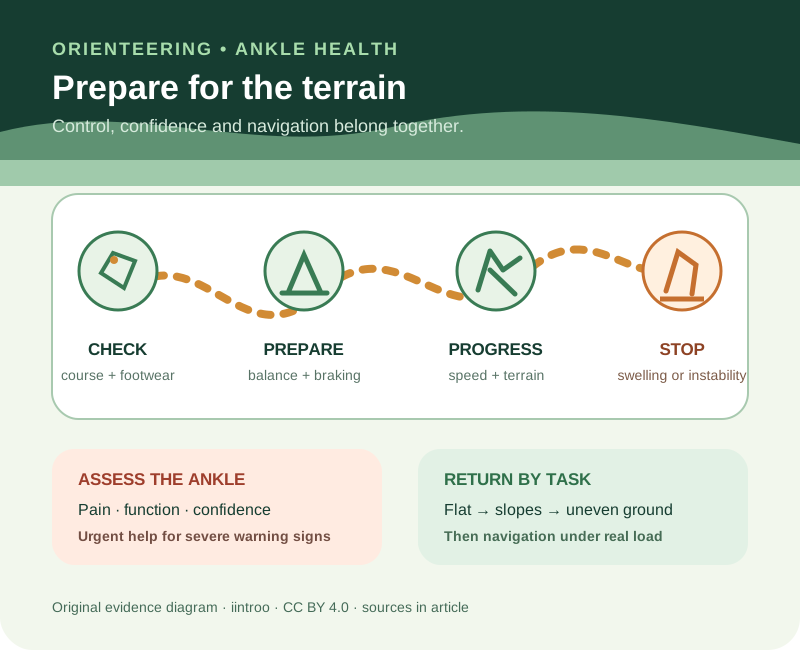
Key points
- Older surveillance and newer reviews consistently identify the ankle and lower leg as important injury sites in orienteering, but study methods and populations differ.
- A small elite-orienteer trial did not show a clear benefit in its main analysis; a compliant subgroup signal should be treated as hypothesis-supporting, not proof of a universal programme.
- Return after an ankle sprain should consider pain, ankle function, confidence, balance and sport-specific performance—including navigation on uneven terrain.
Treat orienteering as more than road running with a map
This guide is for foot orienteers, coaches, families, clubs and event teams. Forest and park courses can combine continuous running with abrupt direction changes, slopes, vegetation, rocks, roots, wet ground and divided attention while reading the map. Injury evidence repeatedly points toward the ankle, lower leg and knee, but old event surveillance, adolescent cohorts and modern running reviews do not measure exposure in the same way.
A 2024 running meta-analysis estimated a substantial ankle-sprain proportion in orienteering, yet heterogeneity across its broader analysis was high. A 26-week study followed only 64 adolescent elite orienteers from two Swedish schools and found overuse problems dominated. These findings justify sport-specific surveillance and preparation; they cannot predict one athlete's risk or prove that terrain alone caused an injury.
Prepare balance, braking and route choices together
Preparation can combine ordinary running capacity with single-leg control, changes of direction, braking, stepping over obstacles and gradual exposure to representative surfaces. Add terrain complexity, speed, fatigue and navigation demand progressively instead of changing all four at once. Course setters and coaches should also use the applicable IOF rules, local weather information and event risk plan rather than treating physical preparation as the only control.
In a 14-week randomised trial of 62 elite orienteers, a balance-and-jump programme performed four times weekly did not significantly reduce substantial injuries or ankle sprains in the main analysis. A per-protocol comparison favoured athletes who completed at least two sessions weekly, but adherence-based subgroup results can be biased. The study supports further testing and a practical conditioning option, not a guaranteed preventive dose.
Use footwear and support as context-dependent tools
Choose footwear for the course surface, local rules, weather and the athlete's experience, then check fit, lacing, sole condition and traction before the start. A shoe that grips one surface may behave differently on wet rock, mud or hard paths. New studs, orthoses, taping or braces should be trialled in training; none can compensate for pain, fatigue, poor visibility or a route choice beyond current ability.
Athletes with a previous lateral ankle sprain may discuss bracing or taping and balance-focused rehabilitation with a qualified clinician. Evidence from mixed sports cannot identify the best device for every orienteer, and external support should not become a stand-alone treatment for persistent instability. Record recurrent giving-way, swelling and terrain-specific difficulty so the decision is based on function rather than habit.
Stop for more than a momentary roll
Stop and obtain appropriate assessment after a severe twist, inability to take several steps, marked swelling, visible deformity, focal bone tenderness, numbness, colour change or a joint that feels grossly unstable. Follow the event's communication and rescue plan when the athlete is remote from the finish. Do not keep running because the direct route back appears short or because an ankle briefly warms up.
Minor symptoms that settle still deserve follow-up when swelling, pain or giving-way returns on later runs. Fracture, high ankle sprain, tendon injury and ordinary lateral sprain cannot be separated reliably by an online checklist. New head, neck or neurological symptoms after a fall require their own urgent response and must not be reduced to an ankle problem.
Return through the PAASS domains and the forest task
The PAASS consensus asks clinicians to consider pain, ankle impairments, athlete perception, sensorimotor control and sport or functional performance. For an orienteer, functional work may progress from walking and straight running to controlled direction changes, slopes, uneven surfaces, route decisions and a complete training session. The sequence and support depend on diagnosis, age, previous injury, course demands and response after each stage.
Flat treadmill speed or one pain-free hop does not establish readiness for a technical forest race. Confidence, navigation quality under movement, recurrent instability and next-day symptoms belong in the discussion. This article does not diagnose an injury, prescribe a brace or exercise programme, or supply a universal return date.