
Thoracic outlet symptoms in overhead sport: swollen, pale or weak arms need the right pathway
Arm pain or tingling in overhead sport is not one diagnosis. Sudden swelling, colour change or weakness needs prompt neurovascular assessment.
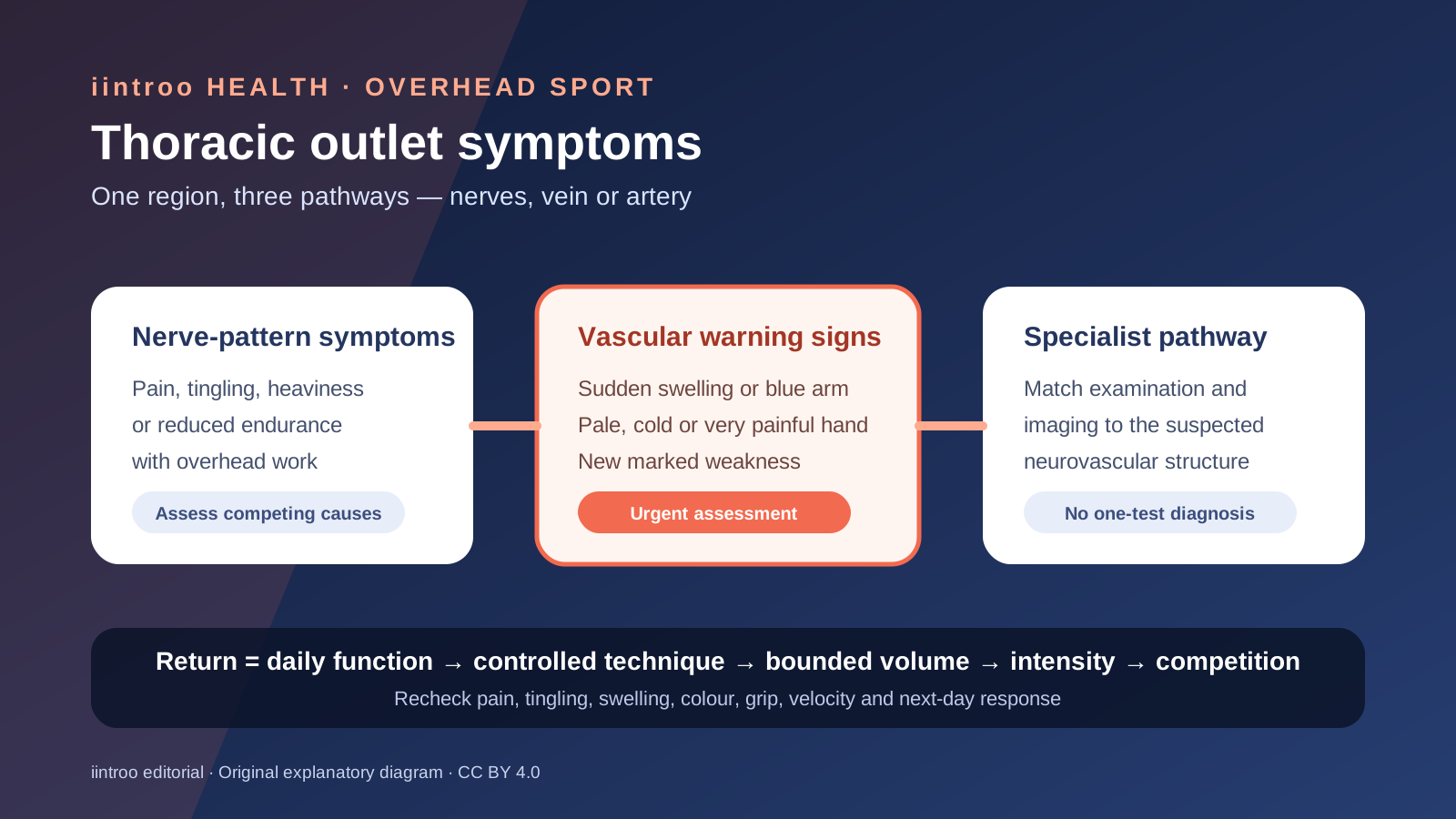
Key points
- Thoracic outlet syndrome can involve nerves, a vein or an artery; those are different pathways, not interchangeable labels.
- A suddenly swollen, blue, pale, cold or very painful arm, or new marked weakness, needs urgent assessment rather than stretching or massage.
- Return to throwing, swimming or lifting should rebuild symptom-free function and sport load after the correct diagnosis, not follow a universal calendar.
Do not make thoracic outlet syndrome a catch-all label
This guide is for overhead athletes and the teams supporting them. The thoracic outlet is the region where the brachial plexus and subclavian vessels pass between the neck, first rib and shoulder. Compression can produce neurogenic, venous or arterial thoracic outlet syndrome, and symptoms can overlap. Pain, heaviness, tingling or reduced endurance during overhead work may also come from the cervical spine, shoulder, elbow or another nerve site. A provocative test or social-media posture image cannot settle the diagnosis.
Society for Vascular Surgery standards and the European neurosurgical consensus emphasise a structured history, examination and exclusion of competing explanations. Sport details matter: throwing volume, swimming stroke, lifting position, recent trauma, a central line or pacemaker lead, symptom timing and whether the arm changes colour or size. The 2024 athlete review identifies baseball, football, swimming, diving and weightlifting as relevant overhead contexts, but sport participation alone does not prove compression.
Recognise vascular signs that should not wait for routine rehab
Venous thoracic outlet syndrome can present with sudden arm swelling, heaviness, blue discoloration or prominent veins, sometimes after intense overhead effort. Arterial involvement can produce a pale or cold hand, severe pain, weak or absent pulse, colour change or signs of reduced blood flow. These patterns can involve thrombosis, embolisation or limb-threatening ischaemia. Stop activity and seek urgent medical assessment; do not massage a swollen arm, repeatedly test it overhead or assume it is delayed-onset soreness.
Chest pain, unexplained breathlessness, fainting, coughing blood or neurological collapse requires emergency care. The ACR criteria separate imaging pathways for neurogenic, venous and arterial presentations because the appropriate tests differ. That is why a generic scan list is not useful here. Coaches should record the onset and visible changes, remove restrictive equipment and activate the local emergency plan without trying to diagnose the vessel or start treatment.
Use rehabilitation for the diagnosed problem, not the internet label
For neurogenic thoracic outlet syndrome, specialist consensus generally places conservative management first when there is no significant muscle atrophy or weakness requiring another pathway. Rehabilitation may address breathing, thoracic and shoulder movement, nerve irritability, training load and task mechanics. It is not simply stretching the neck or forcing the shoulder blades down. Symptoms that worsen, objective weakness, muscle wasting or a changing neurological examination should trigger reassessment rather than more aggressive exercise.
The sports systematic review found encouraging return-to-sport reports, but much of the literature consists of case reports, retrospective cohorts and selected surgical populations. It does not provide a universal probability of recovery or prove that one operation, injection or exercise programme is right for every athlete. Venous or arterial TOS often follows a different specialist pathway from neurogenic TOS. Medication, anticoagulation, injections and surgery belong to qualified clinicians, not a performance plan.
Rebuild overhead exposure through observable criteria
Return should restore comfortable daily use, range, strength, endurance and control before high-velocity or prolonged overhead work. Then reintroduce the sport in stages: low-load technique, bounded volume, greater intensity, unpredictable play and competition consequence. Track pain, tingling, swelling, colour, grip, velocity, stroke quality and next-day response. A symptom-free gym test does not automatically clear repeated pitching, long swim sets, blocking or maximal lifts.
There is no single number of weeks, first-rib result, pulse test, imaging finding or strength ratio that clears every athlete. Recurrence or a new vascular sign needs review even after successful treatment. This page provides general education, not a diagnosis, self-test, imaging order, rehabilitation prescription, anticoagulation advice, surgical recommendation or personal return-to-sport clearance.