
Para ice hockey concussion: adapt the assessment, not the safety threshold
Para ice hockey concussion care must distinguish new symptoms from baseline impairments, remove suspected cases and build an individual return-to-ice plan.
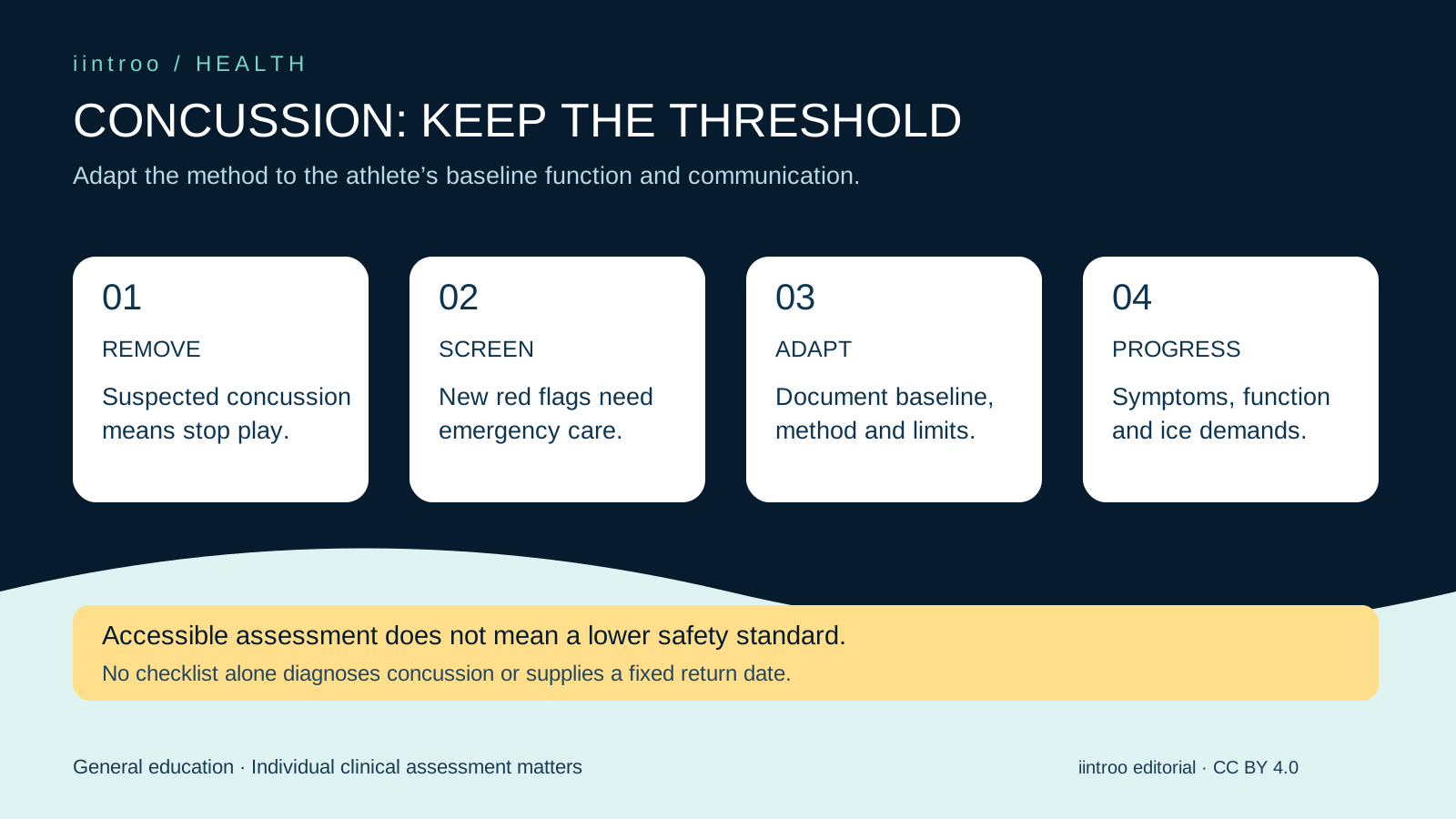
Key points
- Suspected concussion means immediate removal from play and clinical assessment.
- Baseline impairment can change how standard tests are performed and interpreted.
- A progressive return is individual; a fixed calendar cannot provide clearance.
Treat the suspicion first
This guide is for Para ice hockey players, coaches, officials and event medical teams. A fast collision, fall, puck impact or contact with the boards can transmit force to the head, neck or body. Concussion cannot be ruled out because there was no loss of consciousness, because the helmet looks undamaged or because a player wants to continue. If concussion is suspected, remove the player from play and arrange an appropriate clinical assessment.
Emergency warning signs take priority over the sports pathway. Worsening headache, repeated vomiting, a seizure, deteriorating consciousness, unusual behaviour, increasing confusion, unequal pupils, neck pain, weakness or new loss of sensation require urgent emergency evaluation. The athlete's usual movement, speech, sensation and communication should be known where possible, because a genuinely new change may otherwise be mistaken for a pre-existing impairment.
Standard tools may need an accessible method
The Concussion in Para Sport position statement explains why an unmodified assessment can mislead. Visual impairment may affect eye tests; upper-limb impairment may affect coordination tasks; spinal cord injury can alter autonomic symptoms; intellectual or communication disability may change how questions are understood. These differences do not lower the safety threshold. They mean the clinician should document which components were not applicable, which were adapted and how the athlete's current presentation differs from their usual function.
A pre-participation description of baseline symptoms, communication preferences and functional ability can help, but a baseline score is not a passport back to play. Assessment may require a quiet accessible space, a support person chosen by the athlete, transfer assistance or equipment positioning. The purpose is to make the clinical encounter usable, not to coach the athlete toward a particular score. No sideline checklist independently diagnoses or excludes concussion.
Look beyond the visible impairment
The 2024 systematic review found only 13 studies across Paralympic sports and judged the evidence sparse and heterogeneous. Para ice hockey was among the sports studied, but estimates and methods varied. That uncertainty is a reason for careful surveillance and individual assessment, not for assuming that a player's impairment explains every symptom. Headache, dizziness, nausea, light or noise sensitivity, slowed thinking, sleep disturbance and emotional change can all matter when they are new or worse than usual.
Some athletes may have altered sensation or autonomic function, so the medical team should consider the athlete's underlying condition as well as concussion and cervical injury. Event plans need accessible emergency routes, suitable transfer procedures and staff who know the athlete's equipment. The International Paralympic Committee identifies Para ice hockey as a higher-risk winter sport in its surveillance programme, but surveillance data describe groups; they cannot predict an individual's injury or recovery.
Return through symptoms, function and ice demands
After an initial period of relative rest, modern concussion guidance favours a gradual increase in daily and aerobic activity that does not substantially worsen symptoms, followed by sport-specific progression under clinical direction. For a sledge player, that discussion can include transfers, pushing, turning, visual tracking, puck handling, decision-making and tolerance of the cold rink environment. The sequence must be adapted to the athlete and the diagnosed injury; it is not a self-prescribed workout plan.
Contact risk should return only after earlier stages are tolerated and a qualified clinician has approved progression according to the applicable rules and local policy. A training drill can expose teammates as well as the recovering player, so the environment matters. Symptoms that recur with harder exercise, school, work or travel should be reported rather than hidden. Published protocols do not justify a universal number of days away from ice.
Build a team plan before the next hit
Teams should agree who can stop play, who performs the initial check, where the accessible assessment area is and how emergency transport will accommodate the athlete and essential equipment. Record the mechanism, observed signs and changes from baseline. Give the athlete information in a format they can use, and include the person they want involved without removing the athlete from decision-making.
A well-fitted helmet, rule enforcement and respectful reporting culture are important, but no helmet prevents every concussion. Persistent symptoms, repeated concussion, uncertainty about baseline function or concern about another neurological problem warrants specialist review. This article offers education and planning prompts; it does not diagnose concussion, replace emergency services or provide individual clearance to return.