
Patellar instability in sport: rebuild control before returning to cuts and landings
A kneecap dislocation needs injury assessment, recurrence-risk review and criteria-led rehabilitation before an athlete returns to cutting and landing.
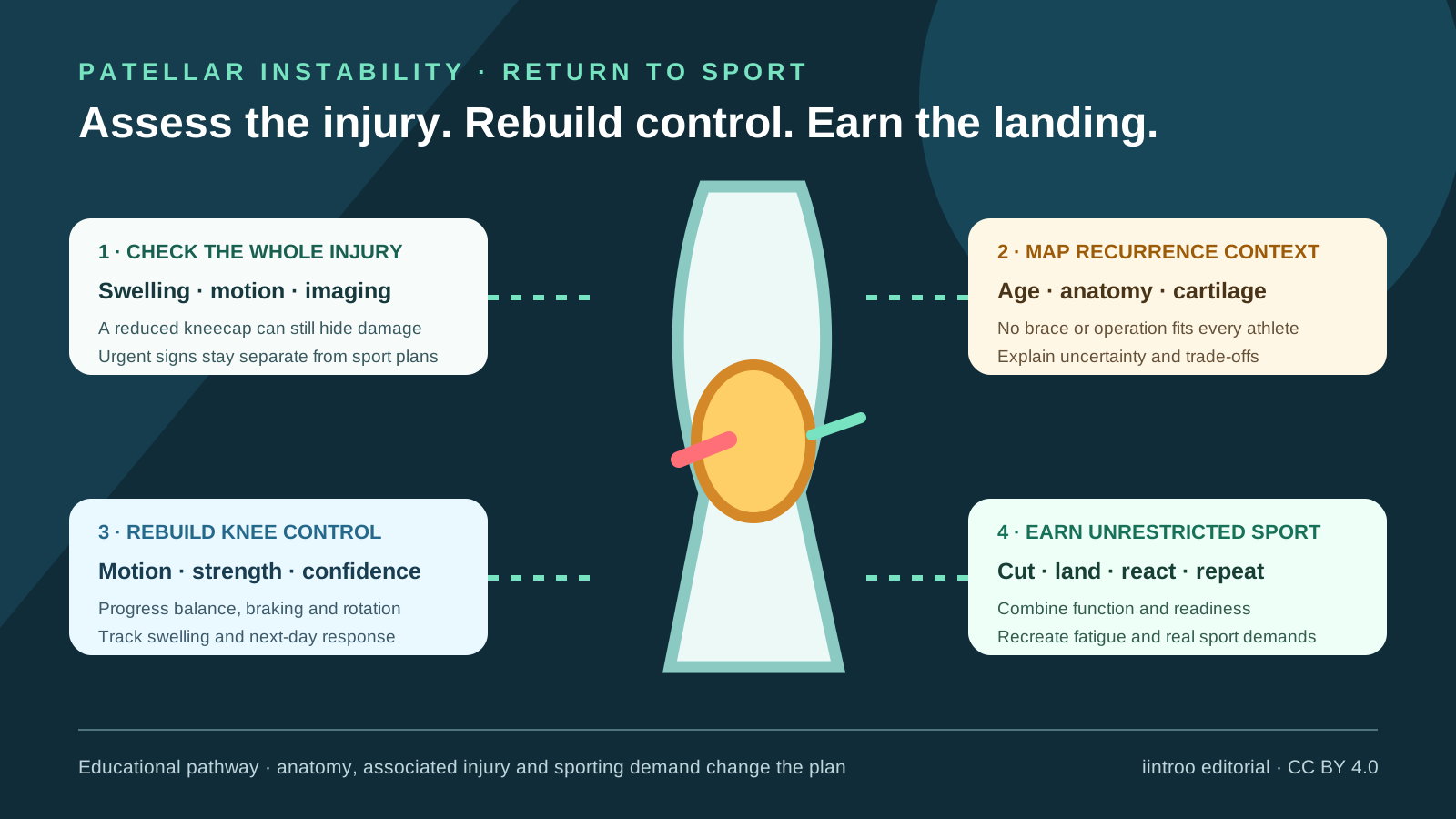
Key points
- A first-time patellar dislocation can include cartilage or bone injury, and a kneecap that appears to have reduced still needs timely clinical assessment.
- Treatment is individualized around age, anatomy, associated injury, recurrence risk and sporting demand; neither a brace nor surgery is the automatic answer for every athlete.
- Return should assess swelling, motion, strength, movement control, confidence and repeatable sport tasks rather than rely on a fixed week or one hop score.
Treat the first episode as more than a kneecap that moved
This guide is for athletes, families, coaches and clinical teams after a patellar subluxation or dislocation. The patella can move out of the trochlear groove during a twist, cut, landing or direct contact and may reduce before medical review. Pain, rapid swelling, inability to straighten the knee, a locked joint, deformity, altered foot sensation or loss of circulation requires urgent assessment. A visible reduction does not exclude an osteochondral fragment, fracture, ligament injury or another diagnosis.
Record the mechanism, whether the patella reduced spontaneously, the swelling timeline and any previous instability. A trained clinician examines the knee and decides which radiographs, MRI or other imaging answer the injury question. The 2024 ESSKA consensus emphasizes imaging and individualized evaluation because a first-time event can arise from different anatomy and damage patterns. A sideline apprehension test, social-media video or normal walking later that day cannot establish tissue safety.
Match treatment to the injury, anatomy and recurrence context
Treatment decisions combine age and skeletal maturity, osteochondral injury, trochlear shape, patellar height and alignment, prior instability, activity goals and the consequences of recurrence. Many first events can be managed without surgery when there is no repairable fragment or major high-risk pattern, while selected athletes may be offered stabilization or correction of relevant anatomy. The consensus reports stronger agreement for some principles than for exact thresholds; expert agreement is not proof that every young athlete benefits from an operation.
Bracing can provide short-term comfort or confidence, but current evidence does not show one brace that prevents long-term recurrence for everyone. Surgery also carries infection, stiffness, hardware, pain and revision risks and does not guarantee a return at the same level. Shared decisions should explain what is known, what is uncertain and how the chosen plan fits school, work, Para-sport transfers, competition timing and the athlete's own risk tolerance rather than treating the season as the only outcome.
Rebuild the whole movement system, not only the quadriceps
Rehabilitation first settles effusion, restores extension and progressive flexion, normalizes gait or mobility and recovers quadriceps activation. It then develops hip and trunk strength, lower-limb control, balance, deceleration and confidence under increasing load. The exact range, loading and brace instructions depend on associated injury and whether surgery was performed. Pain-free walking is useful progress but does not represent repeated jumps, deep landings, lateral pushes or unplanned contact.
A 2025 clinical review supports early active motion and progressive strength after suitable first-time events, yet it also notes that no single rehabilitation protocol is established. The 2025 return-to-sport review after medial patellofemoral ligament reconstruction found wide ranges in reported return and identified fear of reinjury as a frequent barrier. Those mostly lower-level studies cannot supply a universal deadline. Track swelling, motion, strength quality, movement strategy, symptoms during load and the next-day response.
Earn unrestricted sport through repeatable cutting and landing
Return testing can combine clinical stability, absent or minimal effusion, full useful motion, quadriceps and hip strength, step-down quality, balance, jumping, lateral movement, acceleration, braking and sport-specific reactions. Limb-symmetry numbers can help but may hide weakness in both legs or poor technique. Progress from controlled drills to unpredictable tasks, contact where relevant and normal practice density before unrestricted competition. Psychological readiness and trust in the knee belong in the decision.
Recurrent giving way, renewed swelling, locking, persistent apprehension or failure to progress deserves reassessment. Reassess after changes in surface, footwear, training density or contact exposure rather than assuming every flare is harmless deconditioning or normal soreness. This article cannot diagnose instability, interpret imaging, choose surgery, prescribe a brace or clear competition. It supports timely recognition of associated injury, an individualized treatment discussion and a return process that demonstrates the knee can tolerate the athlete's actual cuts, landings, rotations and fatigue—not simply that enough calendar days have passed.