
Pelvic organ prolapse in sport: adapt symptoms without banning impact or lifting
Pelvic heaviness or a vaginal bulge deserves assessment and individual load planning; current evidence does not support a blanket ban on impact or lifting.
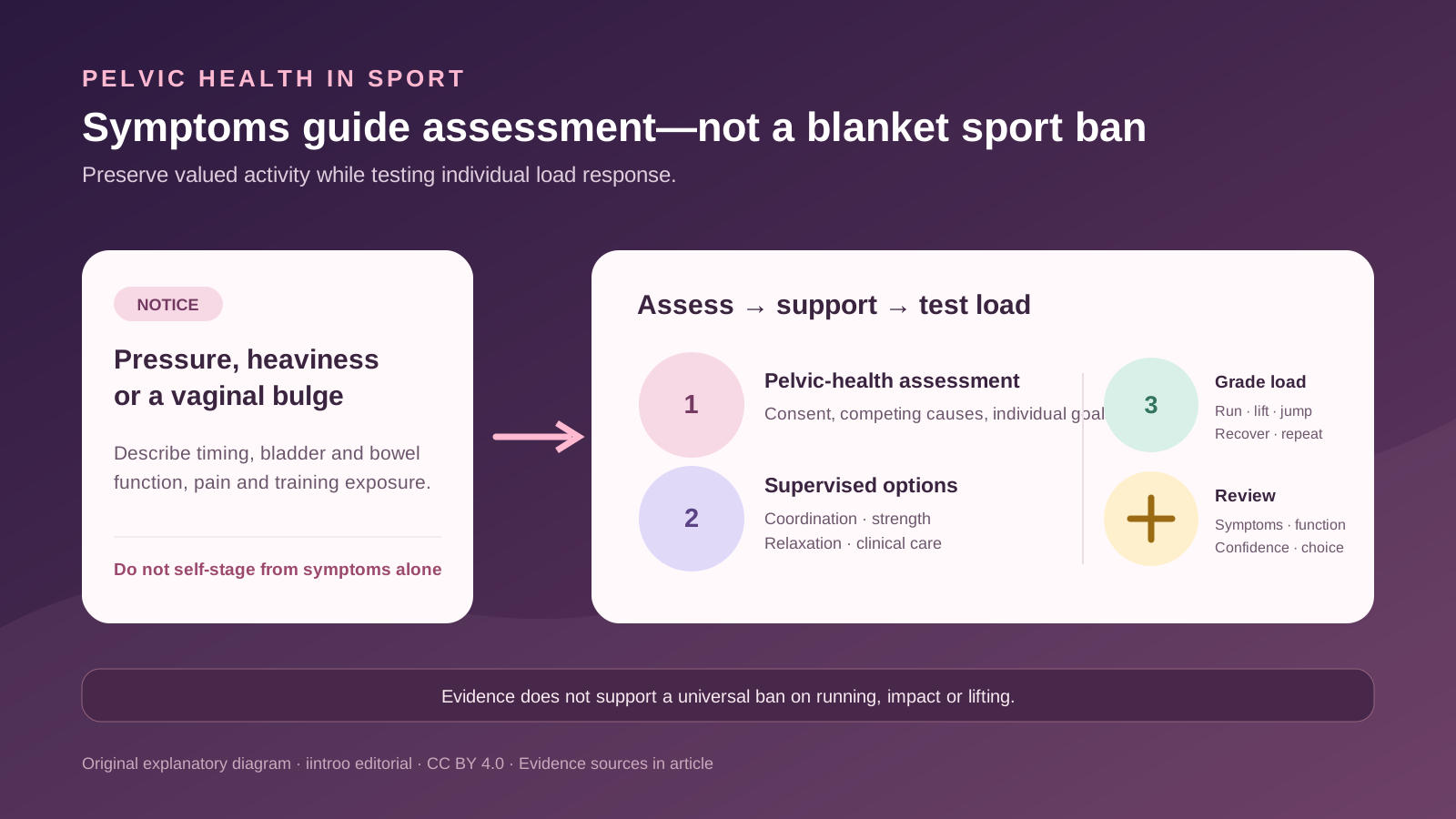
Key points
- Pelvic pressure, heaviness or a vaginal bulge can have several causes, and symptoms do not establish prolapse type or stage without clinical assessment.
- Research linking strenuous sport to prolapse onset or progression is limited and inconsistent; a universal ban on running, jumping or lifting is not evidence based.
- Supervised pelvic-floor muscle training is a recommended first-line option for selected symptomatic prolapse, while sport exposure is adjusted around the person's symptoms and goals.
Recognize symptoms without self-staging prolapse
This guide is for athletes with pelvic heaviness, dragging, pressure, a feeling or sight of a vaginal bulge, urinary or bowel symptoms, or discomfort that changes with training. These symptoms can reflect pelvic organ prolapse but can also overlap with infection, pelvic pain disorders, constipation, postpartum healing and other conditions. A pelvic-health clinician can take a history and, with consent, examine at rest and with strain to describe what is present. A mirror check, tampon test or online stage chart cannot replace that assessment.
Seek timely medical review for new bleeding, difficulty emptying the bladder, repeated urinary infection, significant bowel obstruction, a new mass, persistent pain or symptoms that disrupt daily function. Sudden severe pelvic or abdominal pain, heavy bleeding, fainting, fever or symptoms during pregnancy or early postpartum may require urgent care. Training history should include pregnancy and birth, surgery, menopause, bowel habits, respiratory symptoms, energy availability, lifting technique, impact volume and when symptoms appear—not to assign blame, but to identify modifiable load and health factors.
Read the exercise evidence without turning uncertainty into prohibition
A 2023 scoping review found limited and inconsistent evidence about strenuous activity, pelvic-floor support and prolapse. Studies use different definitions, small samples and cross-sectional designs, so an association between a sport and symptoms cannot prove that training caused anatomical progression. The 2025 BJSM discussion likewise describes uncertainty around physical activity and prolapse. Elite selection, pregnancy history, age, connective tissue and symptom reporting can all distort comparisons between athletes and non-athletes.
NICE states there is no evidence that unsupervised activities such as walking or swimming improve or worsen pelvic-floor dysfunction symptoms. That absence is not proof that every load is harmless, but it also does not justify telling every symptomatic athlete to stop impact or lifting indefinitely. A useful plan observes symptom response during and after specific tasks, then changes volume, intensity, breathing, rest, surface, implement position or exercise selection while preserving valued activity where possible.
Use supervised rehabilitation and graded load experiments
NICE recommends considering supervised pelvic-floor muscle training for at least four months for selected symptomatic prolapse that does not extend more than one centimetre beyond the hymen on straining. The clinician first checks whether the person can contract and relax the pelvic floor and adapts training to ability, symptoms and access. Pelvic-floor exercises are not simply constant squeezing during sport; relaxation, breathing, trunk pressure management and coordination with the task matter, and an overactive or painful pelvic floor may need a different approach.
Build from tolerable daily activity and technique practice to higher forces, repeated efforts and competition density. For a runner this may involve testing pace, hills and duration separately; for a lifter, load, repetitions, stance and belt or breath strategy; for a gymnast, landing volume and sequence density. Symptoms are useful information, not a moral failure. Pessaries or specialist treatments may be discussed clinically, but equipment or surgery should never be presented as mandatory for sport or as a guaranteed performance solution.
Judge progress by function, symptoms and informed choice
Track bulge or pressure, bladder and bowel function, pain, confidence, task tolerance and next-day response. Progress is not defined only by an anatomical stage, and anatomy alone does not describe the burden on an athlete. Review after a meaningful training change, pregnancy, birth, surgery or a new symptom pattern. A plan may include unrestricted participation, temporary modification, equipment, rehabilitation, medical treatment or surgery depending on clinical findings and the person's priorities.
Coaches should provide bathroom access, privacy, flexible training and referral without requesting intimate examination details. Do not use symptoms to question an athlete's toughness or automatically exclude them from a team. This article cannot diagnose or stage prolapse, prescribe pelvic-floor exercises, select a pessary, advise surgery or clear postpartum return. It supports evidence-aware assessment and graded sport decisions that respect both symptoms and the uncertainty in current research, rather than replacing one-size-fits-all restriction with one-size-fits-all reassurance.