
Red-light therapy for recovery: promising signals are not a return-to-play shortcut
Photobiomodulation studies report some short-term signals, but protocols vary and athlete evidence does not show reliably faster return from injury.
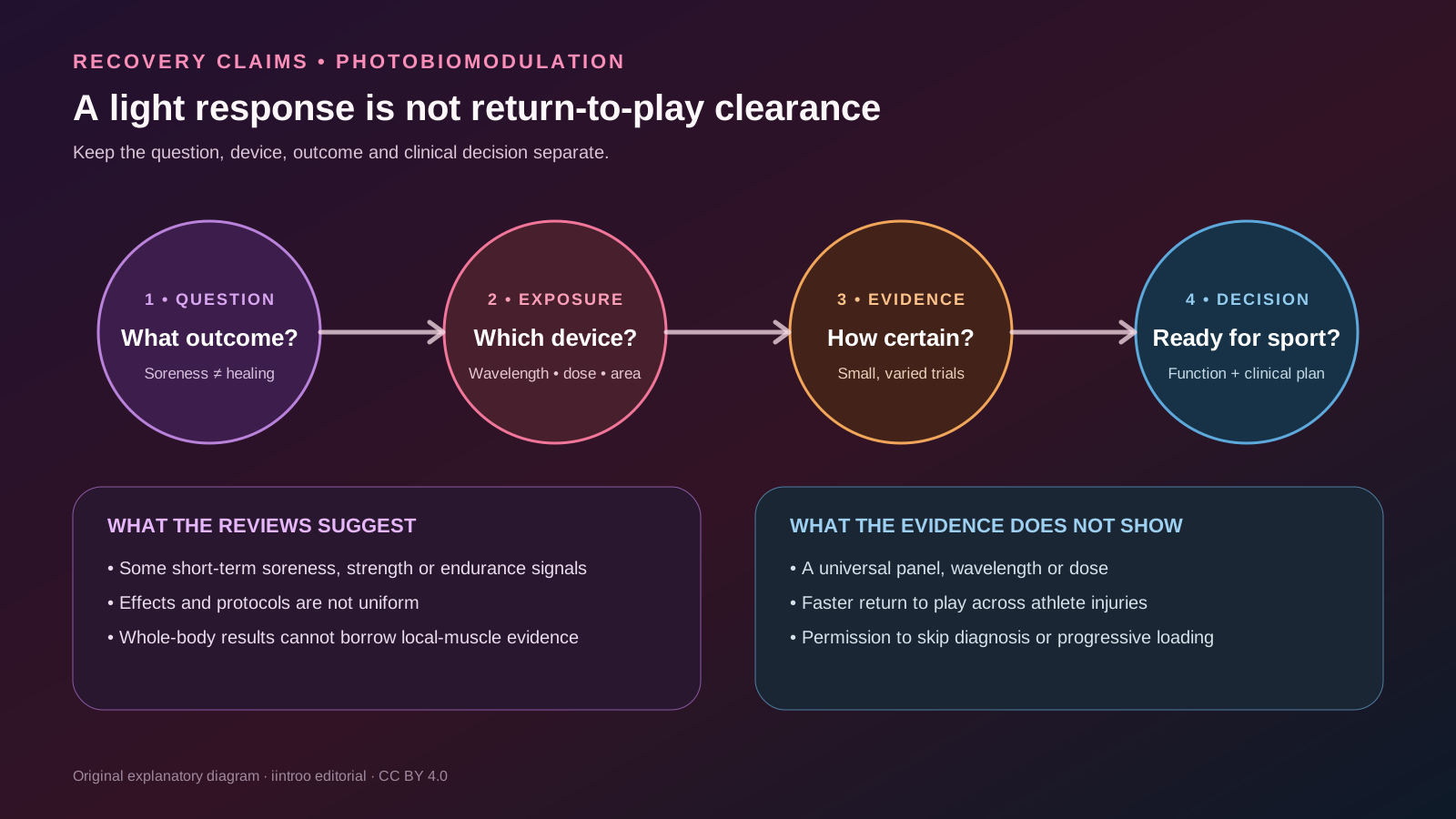
Key points
- Photobiomodulation devices differ in wavelength, power, energy, treatment area and timing, so a study result cannot be transferred to every red-light panel.
- Recent reviews report selected small or low-certainty effects on soreness, strength or endurance, while whole-body evidence and sport outcomes remain inconsistent.
- Six injury trials involving 205 athletes did not show a shorter return-to-play time; light should not replace diagnosis or progressive rehabilitation.
Define the light and the question before reading the result
This guide is for athletes, coaches and support teams considering a red or near-infrared light device for soreness, performance or injury recovery. Photobiomodulation is a non-thermal light intervention delivered by lasers or LEDs, but the label covers very different wavelengths, irradiance, energy, treatment areas, distances and timing. Local treatment of a muscle before exercise is not the same exposure as lying in a whole-body light bed after training. Colour alone does not reveal the delivered dose.
Start with one outcome: perceived soreness, force, repetitions, a time trial, pain from a diagnosed injury or time to sport are not interchangeable. A change in creatine kinase or another laboratory marker does not automatically mean tissue has healed or the athlete is ready. Check who was studied, whether the comparison was credible sham treatment, how long follow-up lasted and whether the device parameters can actually be matched. Marketing that combines several outcomes into ‘recovery’ hides those distinctions.
Keep the size and certainty of recovery effects visible
A 2025 systematic review of photobiomodulation, electrical stimulation and pneumatic compression included 19 trials with 672 healthy adults across all three modalities. It judged the evidence that pre-exercise photobiomodulation reduced soreness to be low certainty. A 2026 review of 23 randomised trials found small pooled effects for muscle endurance and strength, but most protocol subgroups did not differ and the authors considered dose findings exploratory. These results do not define an optimal commercial protocol.
Whole-body photobiomodulation deserves its own reading. A 2025 systematic review found no evidence of benefit for exercise recovery or performance, despite a possible sleep-quality signal. That conclusion came from a young and inconsistent evidence base, not proof that every whole-body device is ineffective. The honest summary is narrower: selected local protocols may affect some short-term outcomes, average effects are not uniform, and a whole-body claim cannot be borrowed from a small-muscle trial.
Do not convert pain change into a return-to-play date
A 2024 review found six randomised trials with 205 competitive or recreational athletes receiving photobiomodulation for injuries. The pooled pain outcome favoured treatment, but only two trials assessed time to return and did not support a faster return to play. Small samples, different injuries, treatment protocols and comparators limit confidence. Less pain can help movement, yet it can also remove a warning without restoring capacity or reducing reinjury risk.
A 2026 sham-controlled trial in 103 military trainees with MRI-confirmed tibial or metatarsal bone-stress injuries found no statistically clear difference in graduation time, MRI healing, pain or function; 97 participants were analysed. Military graduation is not a sport-specific return test, and broad confidence intervals do not prove exact equivalence. The result directly challenges a claim that light reliably accelerates bone-stress recovery and should be read alongside—not replaced by—the broader reviews.
Place any device inside a governed recovery plan
If a qualified team elects to test photobiomodulation, document the device, wavelength, treatment area, energy, timing, comparison period and outcome that matters. Follow manufacturer eye and skin precautions and do not stare into an active source. A clinical PBM consensus addresses specific medical applications and general safety, but it is not a universal sports-performance endorsement. Young athletes, pregnancy, photosensitising medicines, skin disease, cancer treatment and other medical contexts require individual professional advice rather than a copied protocol.
Focal pain, swelling, weakness, night pain, neurological change or loss of function requires assessment of the cause. Return to training should follow diagnosis, tissue loading, sport-specific function and clinical decision-making—not an immediate post-light feeling. A club should compare cost and staff time with sleep, nutrition, load planning and a credible rehabilitation programme. This page does not prescribe a wavelength or dose, endorse a device, treat an injury or clear an athlete to return.