
Whole-body cryotherapy for athletes: a colder chamber is not proven recovery
Whole-body cryotherapy can change soreness or laboratory markers in some studies, but recovery benefits are inconsistent and safety still requires screening.
Key points
- Whole-body and partial-body cryotherapy, cold-water immersion and local ice are different exposures; findings from one cannot be transferred automatically to another.
- Recent reviews report selected short-term changes, but results depend on outcome and time point, athlete studies remain heterogeneous and biomarker change does not prove faster tissue repair or better performance.
- Cold injury and medical adverse events are possible; current expert guidance calls for screening, trained supervision and exclusion of important temporary or medical contraindications.
Define the exposure before reading the claim
This guide is for adult athletes and support teams considering a commercial whole-body cryotherapy or cryostimulation chamber after training. True whole-body cryostimulation exposes the entire body, including the head, to very cold dry air in a walk-in chamber; partial-body units leave the head outside, and local cold devices or cold-water immersion transfer heat differently. Chamber temperature, duration, clothing and whether nitrogen gas is used also vary. A claim about an ice bath, local cooling or one chamber design should not be relabelled as evidence for every cold exposure.
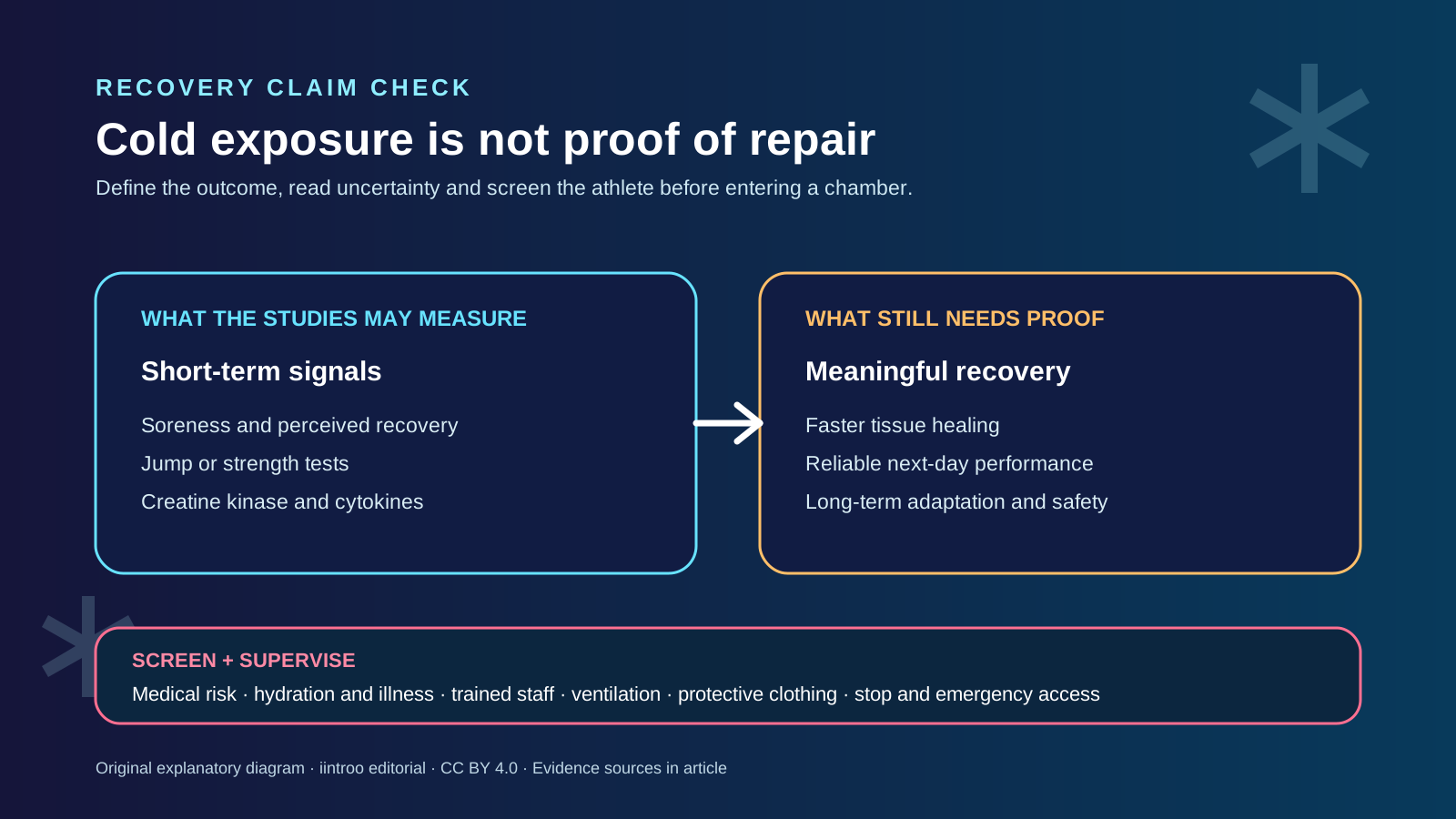
Start with the recovery problem: soreness, a perception of readiness, restoration of sport performance or management of a diagnosed injury are different outcomes. Feeling less sore can be valuable, but it is not evidence that muscle, tendon or bone has repaired faster. Creatine kinase, cytokines and skin temperature are intermediate measurements rather than automatic proof of competition readiness. A club should ask whether the selected outcome was measured, against what comparison, in athletes like its own and at a time that matters for the next session.
Read positive and null findings together
The Cochrane review found four small studies and judged the evidence for preventing or treating post-exercise muscle soreness very uncertain, with poor adverse-event monitoring. Newer reviews include more trials and report selected time-dependent changes. A 2026 network meta-analysis of 51 trials found different modalities leading at different time points and reported whole-body cryotherapy effects for selected jump and creatine-kinase outcomes. Network ranks, however, can be driven by indirect comparisons, small nodes, differing protocols and outcomes that are not equivalent to real sport performance.
A separate 2026 network review restricted to competitive and elite endurance athletes found no recovery modality significantly better than passive recovery for sport-specific performance, and noted that its whole-body cryotherapy estimate came from a single trial. These results do not prove that the chamber never helps any athlete; they show why a marketing promise of faster recovery is stronger than the evidence. Compare effect size and confidence interval with cost, travel, time, athlete preference and a credible passive-recovery routine rather than treating novelty or an extreme temperature as efficacy.
Screen the person and protect the session
A 2023 safety review found only 16 documented adverse events across five case reports and two randomised trials, but under-reporting and inconsistent surveillance mean rarity cannot be calculated from that number. Reported concerns include cold injury, skin reactions and medical events. Nitrogen-based partial-body cabins add an asphyxiation hazard if oxygen is displaced or ventilation fails. The athlete should never be locked in, use a chamber alone, remain after feeling unwell or rely on a waiver as medical screening.
A 2025 expert consensus lists temporary and medical contraindications that require qualified screening, including fever, dehydration, open wounds, pregnancy, cold intolerance, unstable cardiovascular disease, uncontrolled blood pressure, important vascular or respiratory disease and other conditions. The panel was small and European, and consensus is not proof of benefit. Facilities still need trained staff, equipment maintenance, ventilation and oxygen monitoring where relevant, emergency access, dry protective clothing, exposure controls and a stop procedure. Do not copy a temperature or duration from a study into unsupervised use.
Keep recovery decisions connected to training
If an adult athlete and qualified team choose the modality after screening, record the exact device, exposure, training session and outcome that matters. Review soreness, sleep, symptoms and subsequent performance rather than a single laboratory value. Avoid introducing a new chamber before a key competition, and do not use reduced pain to train through focal injury, swelling, weakness, neurological change or systemic illness. Evidence on repeated use, female athletes, Para athletes, adolescents and long-term adaptation is thinner than the popularity of the service suggests.
Frostbite signs, persistent numbness, blistering, severe skin pain, chest symptoms, fainting, confusion, marked breathing difficulty or another acute reaction needs prompt medical care. This page cannot screen an individual, prescribe a chamber protocol or treat an injury. It supports a narrower, honest decision: define the recovery goal, compare uncertain short-term evidence with passive recovery, exclude relevant risk and keep the cold exposure supervised rather than treating discomfort or biochemical change as proof of repair.