
Pickleball eye injuries: ordinary glasses are not court protection
Emergency-department data show serious pickleball eye trauma. Use sport-rated wraparound protection and know which post-impact symptoms need urgent care.
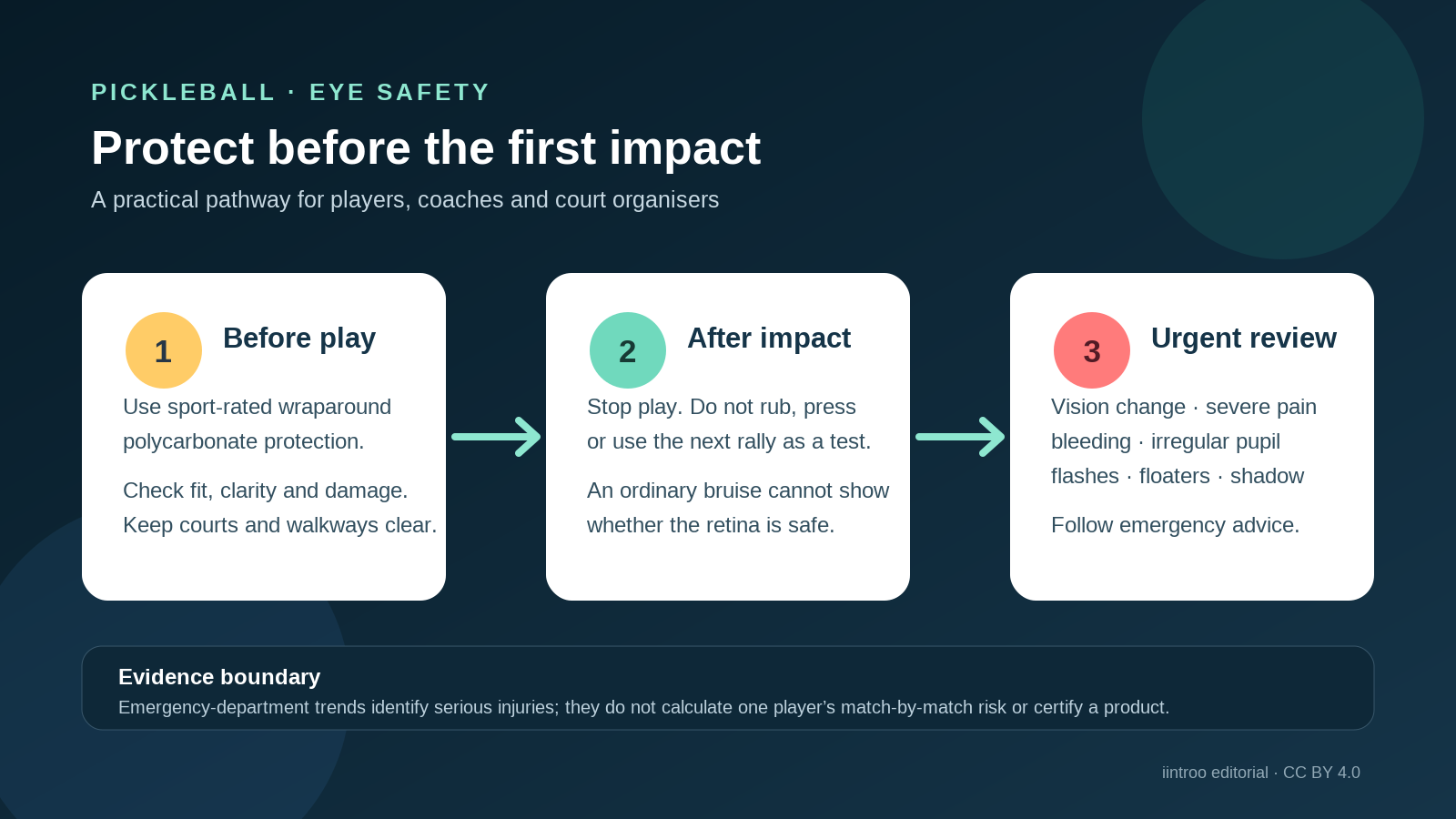
Key points
- US emergency-department studies estimate a rising burden of pickleball-related ocular and periocular injuries, but they do not measure every injury or prove an individual player's risk.
- A fast ball, paddle and fall can injure the eye or surrounding bones; ordinary spectacles are not designed or certified as sports impact protection.
- Vision change, marked pain, bleeding, an irregular pupil, flashes, new floaters or a curtain-like shadow after impact needs urgent eye assessment.
Understand what the injury counts can and cannot show
This guide is for adult pickleball players, coaches, clubs and event organisers. Two recent studies used the US Consumer Product Safety Commission's National Electronic Injury Surveillance System. One estimated 3,112 pickleball-related ocular injuries treated in emergency departments from 2005 through 2024 from 73 sampled cases. A separate analysis estimated 6,015 eye-region injuries from 2010 through 2023 from 117 sampled cases. The studies used different case definitions and periods, so their totals should not be added together.
Both studies are useful for identifying mechanisms and who reached emergency care, not for calculating a player's chance of injury per match. They miss injuries treated elsewhere or not treated, and weighted national estimates come from small underlying case numbers. Reported mechanisms included direct ball and paddle impact, along with falls causing facial trauma. Severe diagnoses in the ocular study included retinal detachment, hyphema, orbital fracture and globe trauma.
Choose protection for the hazard, not for appearance
The American Academy of Ophthalmology recommends polycarbonate safety goggles with front and side coverage for pickleball. A close net exchange can leave too little time to avoid a ball, while doubles adds another paddle and player in a confined space. Protection should fit securely, preserve peripheral vision and remain clear during sweat and movement. A club can make sport-rated eyewear normal at beginner sessions instead of waiting for a serious incident.
Prescription spectacles, fashion sunglasses and open-sided frames may improve vision or reduce glare but are not automatically impact protectors. Players who need prescription correction can ask an optometrist or ophthalmologist about compatible sports frames or inserts. This page does not certify a product or reproduce a testing standard; check the current marking, manufacturer documentation and rules that apply to the competition. Replace damaged frames or lenses according to the maker's instructions.
Treat an eye impact as more than a bruise check
Stop play after a direct eye or orbital impact. Do not rub or press the eye, attempt to remove an embedded object, or use the next rally as a vision test. Vision loss or change, severe or increasing pain, bleeding, an irregular pupil, double vision, flashes, new floaters, a curtain-like shadow, marked light sensitivity, nausea after eye trauma or difficulty moving the eye warrants urgent assessment. A visible black eye does not indicate whether the retina or globe is safe.
Call local emergency services for penetrating injury, major vision loss, collapse or other serious trauma. Even when symptoms seem modest, an ophthalmologist should advise on concerning change after impact, especially after previous eye surgery, retinal disease or in a person with only one reliably seeing eye. The decision to resume play belongs to the treating professional; symptom improvement on the sideline is not clearance.
Build eye safety into the court plan
Organisers can separate courts from walkways, provide enough run-off space, manage stray balls and paddles, match beginners with appropriate instruction and include eye trauma in the emergency action plan. Players should call loose balls clearly and avoid entering another active court. Those measures address collisions and falls as well as direct hits; eyewear is one layer, not the whole prevention programme.
Keep the message proportionate: pickleball offers physical and social benefits, and emergency-department trends do not mean the sport is inherently unsafe. They do show that eye injury can be serious and that preventable exposure deserves attention. This guide provides general education, not a personal equipment fitting, diagnosis, product endorsement or return-to-play decision.