
Badminton eye injuries: the shuttle is light, the impact can be serious
Learn why doubles play and shuttlecock strikes feature in the evidence, what ordinary spectacles cannot do, and how sport-specific protective eyewear fits into a badminton safety plan.
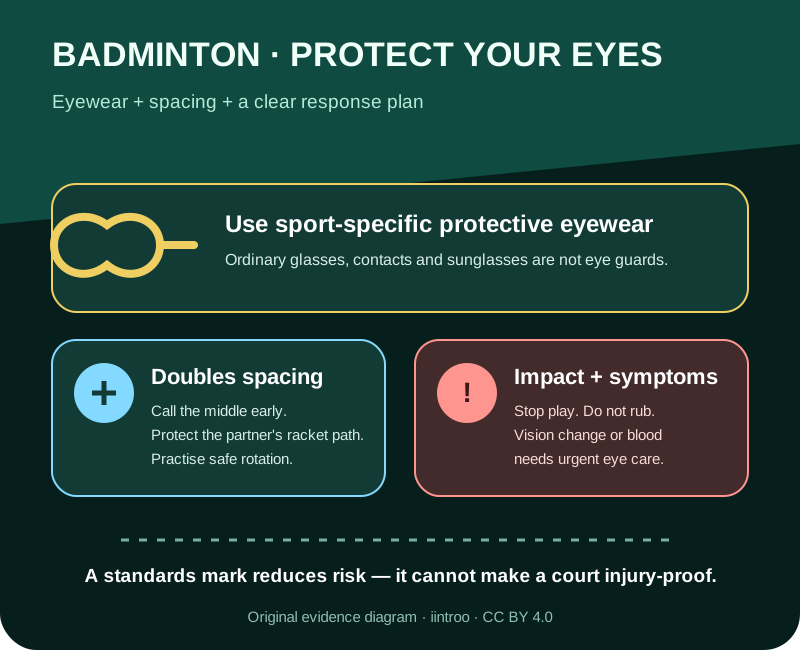
Key points
- Published badminton eye-injury reports most often identify the shuttlecock as the striking object.
- Ordinary prescription spectacles and contact lenses are not protective sports eyewear.
- Pain, blurred vision, light sensitivity, blood in the eye or a new visual disturbance after impact needs urgent eye assessment.
A small projectile can still injure the eye
This guide is for badminton players, parents, coaches and venue organisers. A shuttlecock can arrive quickly at close range and its cork base can fit within the eye socket. A 2023 systematic review identified 378 one-eye injuries reported across 19 studies from 12 countries; 85% involved a shuttlecock, and doubles play, the shuttle and lack of eye protection appeared repeatedly in the reports.
Those data come from case series and hospital populations spanning 1974–2020. They cannot calculate the chance of injury in one match or prove that every doubles rally is more dangerous than singles. They do show that badminton-related eye trauma is not limited to a harmless bruise and that prevention deserves a place in coaching and facility policy.
Hospital cases show why symptoms matter
A Melbourne eye-hospital review identified 88 badminton-related presentations from 2018–2023. Hyphaema, bleeding in the front chamber of the eye, was common; most patients required medical treatment and six required surgery. This is a referral-hospital sample, so it overrepresents injuries serious enough to seek specialist care and should not be used as a population incidence estimate.
After a strike, stop play. New blurred or reduced vision, severe pain, light sensitivity, visible blood, flashes, floaters, a curtain-like shadow, a misshapen pupil, nausea or an open wound requires urgent eye assessment. Do not press or rub the eye, remove an embedded object or return to play because the eyelid looks normal.
Sources: 3
Everyday glasses are not a substitute
The National Eye Institute states that ordinary prescription glasses, contacts and sunglasses do not protect against sports injury. A prescription can often be incorporated into appropriate protective eyewear. The racket-sport review also reported cases in which ordinary lenses or unsuitable eyewear worsened injury, while standards-compliant protectors were associated with the strongest protection in the available observational evidence.
Choose a protector made for the sport and an appropriate current standard in the athlete's jurisdiction; ASTM F803 is one example used in North American racket-sport policies. Fit, lens condition, retention and compatibility with vision needs matter. A standards mark is not a guarantee against every impact, and this article cannot select a product or certify a pair of goggles.
Doubles safety also depends on communication
Many published injuries occurred in doubles, including strikes from a partner. Agree who takes shuttles through the middle, call early and avoid a full swing when a partner occupies the racket path. Coaches can practise spacing and rotation at realistic speed before tournament pressure. These habits complement protective eyewear; they do not replace it.
Badminton Ontario requires ASTM F803 protective eyewear for juniors at sanctioned events when more than two players share a court. That is a provincial policy, not a worldwide BWF rule. Clubs should state their own requirement clearly, confirm the exact standard they accept and make sure rental or loan equipment can be fitted and cleaned safely.
Plan prevention before the first serve
Include eye protection in registration information, equipment checks and coach education rather than introducing it only after an injury. Replace scratched, cracked, warped or poorly fitting equipment according to the manufacturer's instructions. Athletes who rely on vision in one eye should seek individual advice from an eye-care professional about participation and protection.
If an eye injury occurs, document the object, side, symptoms and timing and activate the venue's emergency plan. Return to badminton depends on the diagnosis, treatment and an eye professional's advice; there is no safe universal waiting period. Prevention reduces risk but cannot make a court injury-proof.