
Pompe disease in sport: coordinate muscle, breathing and recovery
Pompe disease can affect skeletal and breathing muscles. Training should follow current function, respiratory findings and recovery rather than a fixed dose.
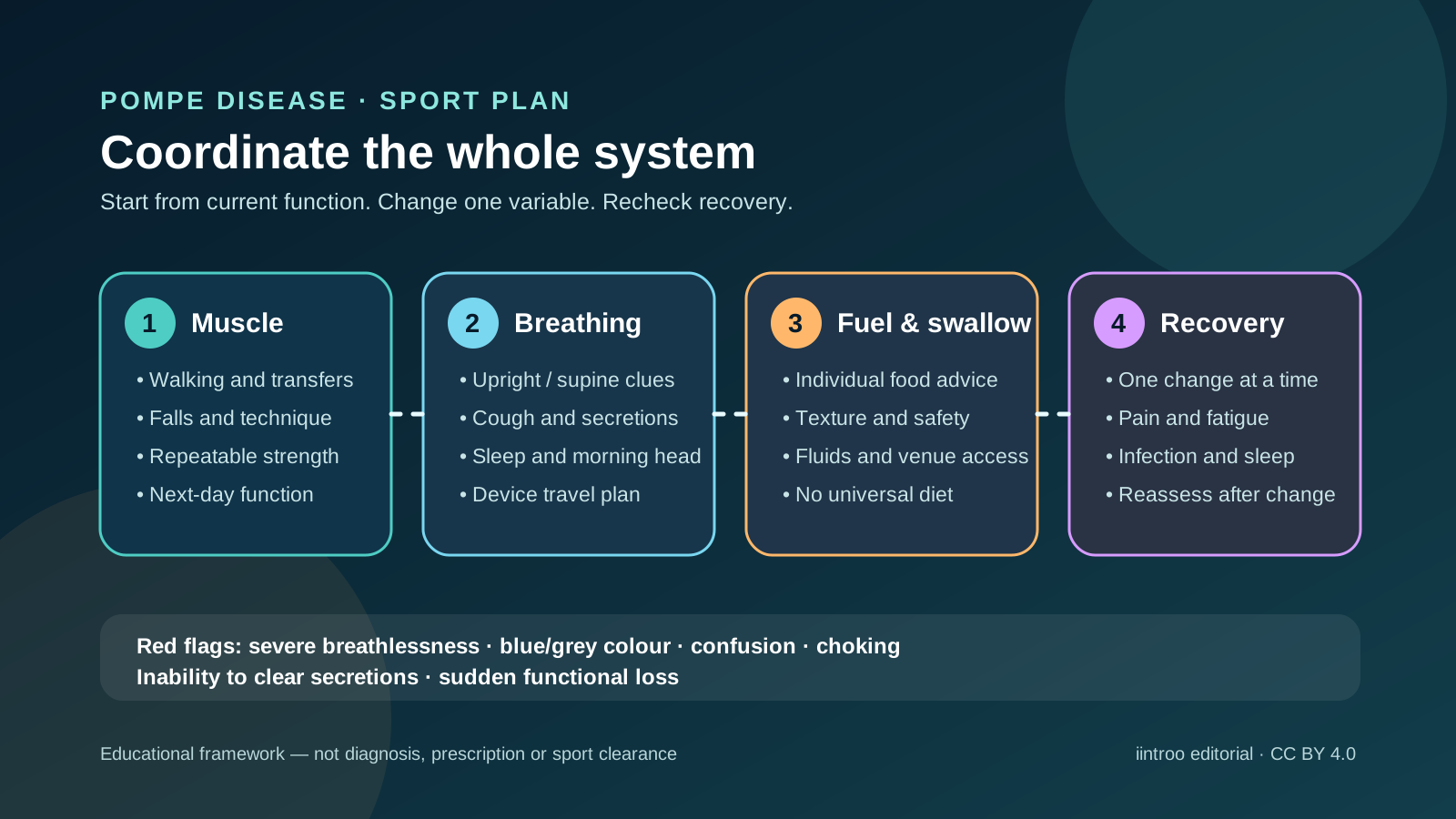
Key points
- Small studies suggest that individualized aerobic, resistance and respiratory-muscle training can be feasible, but samples are too limited to define one best programme.
- Diaphragm weakness, weak cough, sleep-related hypoventilation, swallowing difficulty, falls and bone health can change how activity is planned.
- Severe breathlessness, blue or grey colour, confusion, inability to clear secretions, choking, chest pain or sudden functional loss needs prompt assessment.
Begin with muscle and respiratory baselines
This guide is for people with infantile- or late-onset Pompe disease, families, coaches and clinical teams. Pompe disease is a lysosomal glycogen-storage disorder caused by deficient acid alpha-glucosidase. The pattern and rate of skeletal-muscle, respiratory and cardiac involvement vary. In later-onset disease, limb-girdle and diaphragm weakness may be prominent even when ordinary daytime breathing seems comfortable. Infantile-onset survivors can have additional cardiac, motor, feeding and developmental needs. A diagnosis therefore does not supply a safe training dose or predict an individual's current capacity.
Before a new season or material progression, establish the person's usual walking, transfers, falls, fatigue, pain, swallowing, cough, sleep and next-day recovery. Confirm whether respiratory testing has included both upright and supine measures when clinically indicated, because diaphragm weakness can be more apparent lying down. Ask about non-invasive ventilation, cough assistance, orthoses, mobility aids and feeding support, and follow the responsible team's instructions. A coach can record change and make sessions accessible; they cannot diagnose hypoventilation, adjust ventilation, prescribe airway-clearance equipment or infer respiratory safety from a pulse oximeter alone.
Read promising exercise findings in proportion
Current European and UK pathways support individualized aerobic and strength work with specialist physiotherapy input when the person's condition allows it. Trials and cohorts have reported gains in strength, walking performance or fitness after supervised mixed training. However, the early aerobic-and-resistance study enrolled five people, the later resistance pilot enrolled ten, and protocols often involved relatively stable adults receiving enzyme replacement therapy. A ten-year retrospective cohort found better function among people who stayed active, but activity was not randomly assigned and healthier participants may have been more able to remain active.
Respiratory-muscle training also needs measured language. A 2024 systematic review and meta-analysis pooled five single-arm studies with only 31 participants. Inspiratory and expiratory pressure improved, but six-minute walk distance did not, and larger controlled trials are still needed. A sham-controlled trial provides stronger design evidence but does not establish a universal device setting or long-term clinical outcome. Together these findings justify supervised, progressive experimentation with recorded outcomes. They do not prove that exercise slows disease progression, replaces disease-specific treatment, prevents respiratory failure or makes a high-protein diet necessary for every athlete.
Build a low-cost, recoverable session
Choose an activity that matches present function: supported cycling, walking, water-based exercise, balance practice, task-specific movement or resistance performed with stable technique. Use a repeatable starting point and change duration, load or complexity one variable at a time. Avoid routine maximal testing, forced repetitions after form breaks down and the assumption that soreness proves adaptation. Record breathlessness, perceived effort, falls, muscle pain, cramps, cough, voice or swallowing change and next-day function alongside distance or repetitions. The useful dose is one the athlete can recover from and repeat, not a generic percentage taken from a small research protocol.
Plan energy, food texture, fluids and recovery around the individual's swallowing and nutrition advice. Feeding difficulty and low intake can coexist with reduced activity, while indiscriminate diet claims can create harm. Water sessions require transfer, fatigue and rescue planning; floor work must account for the person's ability to rise; respiratory equipment needs an agreed travel and power plan. Infection, heat, poor sleep or a demanding school or work day may justify a shorter session. An athlete using ventilation or cough assistance should have an event plan written with the clinical team rather than improvising device use at the venue.
Escalate respiratory change and return by function
Stop activity and seek urgent assessment for severe or rapidly worsening breathlessness, blue or grey colour, confusion, collapse, chest pain, new neurological symptoms, choking with persistent breathing difficulty or inability to clear secretions. New morning headache, unrefreshing sleep, daytime sleepiness, a weaker cough, recurrent chest infections, declining voice, repeated falls or a sustained drop in ordinary mobility needs timely clinical review. A normal wearable reading does not exclude nocturnal hypoventilation, aspiration or respiratory-muscle weakness, and supplemental oxygen should not be added without an appropriate clinical plan.
After a respiratory infection, hospital admission, fall, fracture, treatment change or material loss of function, return through comfortable daily movement, controlled conditioning and then sport-specific tasks. The pace should reflect current breathing, strength, swallowing, bone and recovery findings rather than a fixed rest period. There is no universal forced-vital-capacity value, walking distance, heart-rate zone or symptom-free interval that clears every person. This article cannot diagnose Pompe disease, interpret pulmonary or swallowing tests, prescribe exercise, nutrition or devices, alter treatment, or clear competition; it is an educational framework for coordinated rehabilitation and sport.