
Retinal detachment and sport: urgent symptoms first, surgeon-led return after repair
New flashes, floaters or a curtain-like shadow need urgent eye assessment. After retinal repair, gas, healing, vision and impact risk shape return.
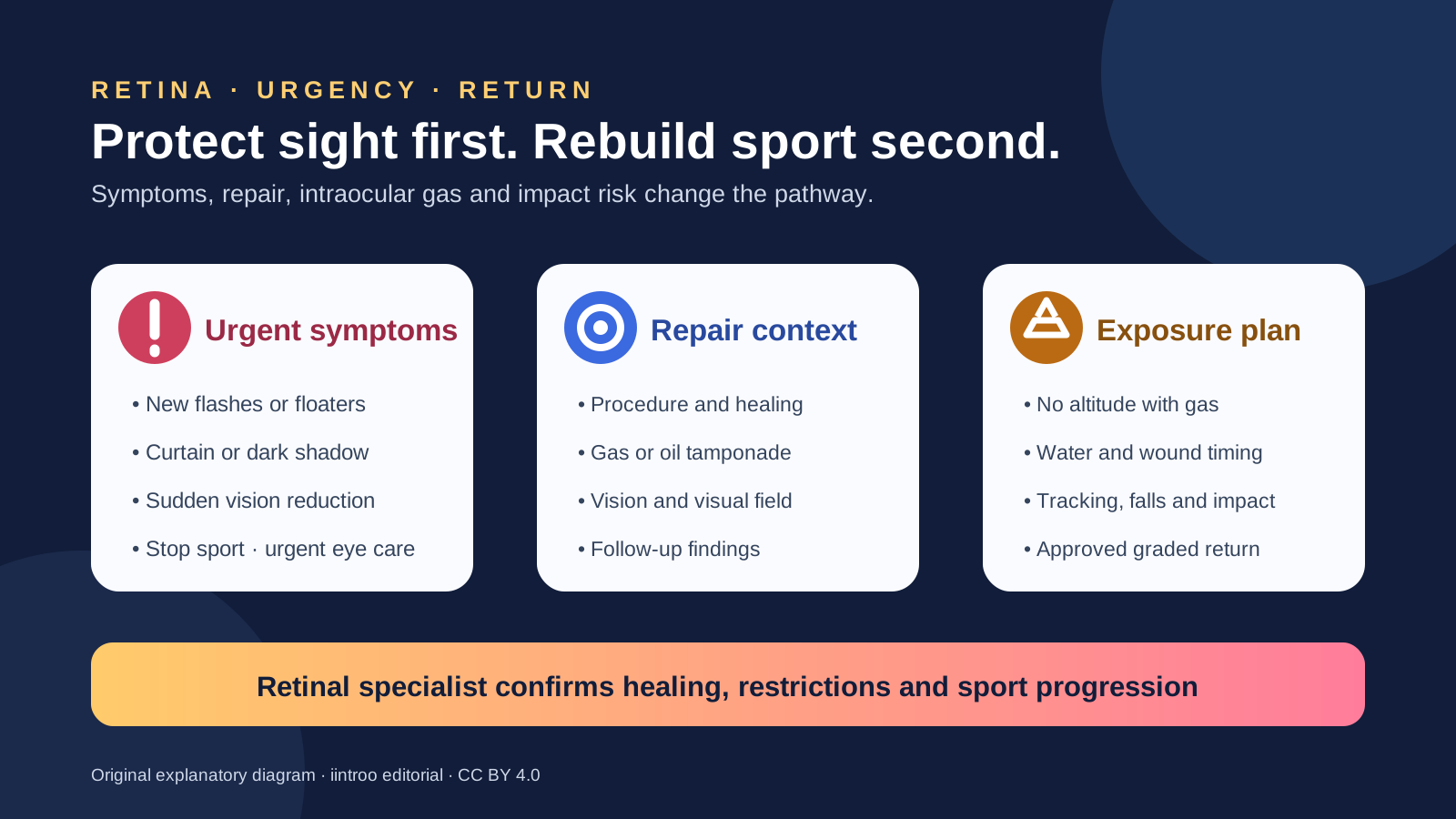
Key points
- A sudden shower of new floaters, flashes or a dark curtain or shadow in the visual field is an eye emergency, not a symptom to monitor through another training session.
- After retinal surgery, the exact restrictions depend on the repair, retinal findings, intraocular gas or oil, vision and the consequences of the proposed sport.
- An intraocular gas bubble makes flying, high altitude and scuba unsafe until an ophthalmologist confirms that the bubble has completely gone.
Treat new visual symptoms as time-critical
This guide is for athletes, coaches and families responding to new visual symptoms or planning sport after a repaired retinal detachment. The retina is the light-sensitive tissue at the back of the eye. A rhegmatogenous detachment occurs when fluid passes through a retinal tear and separates the retina from its supporting layer. It is not a diagnosis that can be ruled out by normal-looking eyelids, a sideline vision chart or the absence of pain. Early examination can protect sight, while delay can allow more retina to detach.
A sudden increase in floaters, flashes of light, a dark curtain or shadow, or rapidly reduced vision needs immediate ophthalmic or emergency assessment. Stop sport, protect the person from further impact and do not let them drive themselves. Similar symptoms after a blow to the eye are also urgent. Do not press, rub or patch an injured eye tightly, and do not ask the athlete to repeat heading, sparring, jumping or rapid head movement to see whether the disturbance returns.
The operation determines the early precautions
Retinal detachment can be treated with pneumatic retinopexy, scleral buckling, vitrectomy or a combination, sometimes with laser or freezing around a tear. Positioning and activity instructions therefore differ. The 2025 international surgical consensus emphasizes individualized procedure choice and postoperative positioning. National Eye Institute guidance likewise says to avoid intense exercise and heavy lifting while the eye heals and to attend follow-up. An athlete should use the written instructions from the operating team rather than copying another patient's schedule.
If gas was placed inside the eye, air travel, high altitude and scuba diving can make the bubble expand and raise eye pressure dangerously. Those exposures remain off limits until the ophthalmologist confirms complete gas resorption; vision alone cannot prove the bubble is gone. The surgeon may also prescribe a particular head position. Worsening vision, increasing pain, marked swelling, nausea with eye pain, new flashes or floaters, or a returning shadow after surgery requires prompt contact with the surgical service or emergency care.
Evidence does not provide one universal return date
The American Academy of Ophthalmology gives general advice that strenuous exercise and swimming are commonly paused for one to two weeks after many retinal operations, but explicitly states that this does not apply to everyone. A 2025 expert consensus describes a cautious gradual return and much longer avoidance of high-trauma activity. These are broad reference points, not clearance criteria. Technique, break location, macular involvement, pressure, wound healing, remaining tamponade, visual function and the fellow eye all change the decision.
An older randomized trial of 108 people after scleral-buckle surgery found no significant difference in reoperation, final attachment or vision between immediate full activity and six weeks of strict restriction. It studied one historical procedure and cannot be generalized to modern vitrectomy, intraocular gas or collision sport. A retrospective professional-hockey series found that many players returned after retinal injury, but public injury reports, small numbers and elite resources make its timelines unsuitable for predicting another athlete's recovery.
Rebuild vision, movement and protection together
Return planning should document the diagnosis, repair, gas or oil status, current visual acuity and field, protective-eyewear advice, follow-up findings and the real demands of the sport. Walking or stationary conditioning differs from ball tracking, inversion, water exposure, rapid acceleration or intentional head contact. Progress only with the retinal specialist's approval, then reintroduce environment and sport demands without symptoms. Any loss of depth judgement, peripheral awareness or confidence can create secondary collision and fall risk even when the retina is anatomically attached.
Impact-risk sports require an explicit conversation about recurrence consequences, protection standards and whether participation is appropriate. Ordinary spectacles are not sports eye protection, and no protector makes intentional eye trauma safe. This page cannot diagnose a retinal tear, interpret a postoperative image, select a procedure, change positioning, confirm that gas is gone or clear an athlete. The safest plan puts urgent symptoms first and makes return a surgeon-led decision based on healing and function, not a calendar promise.