
Rett syndrome and adaptive sport: support movement while planning for seizures and scoliosis
Rett syndrome affects movement, communication, breathing and bone health differently. Adaptive sport needs supported choice, seizure planning and safe progression.
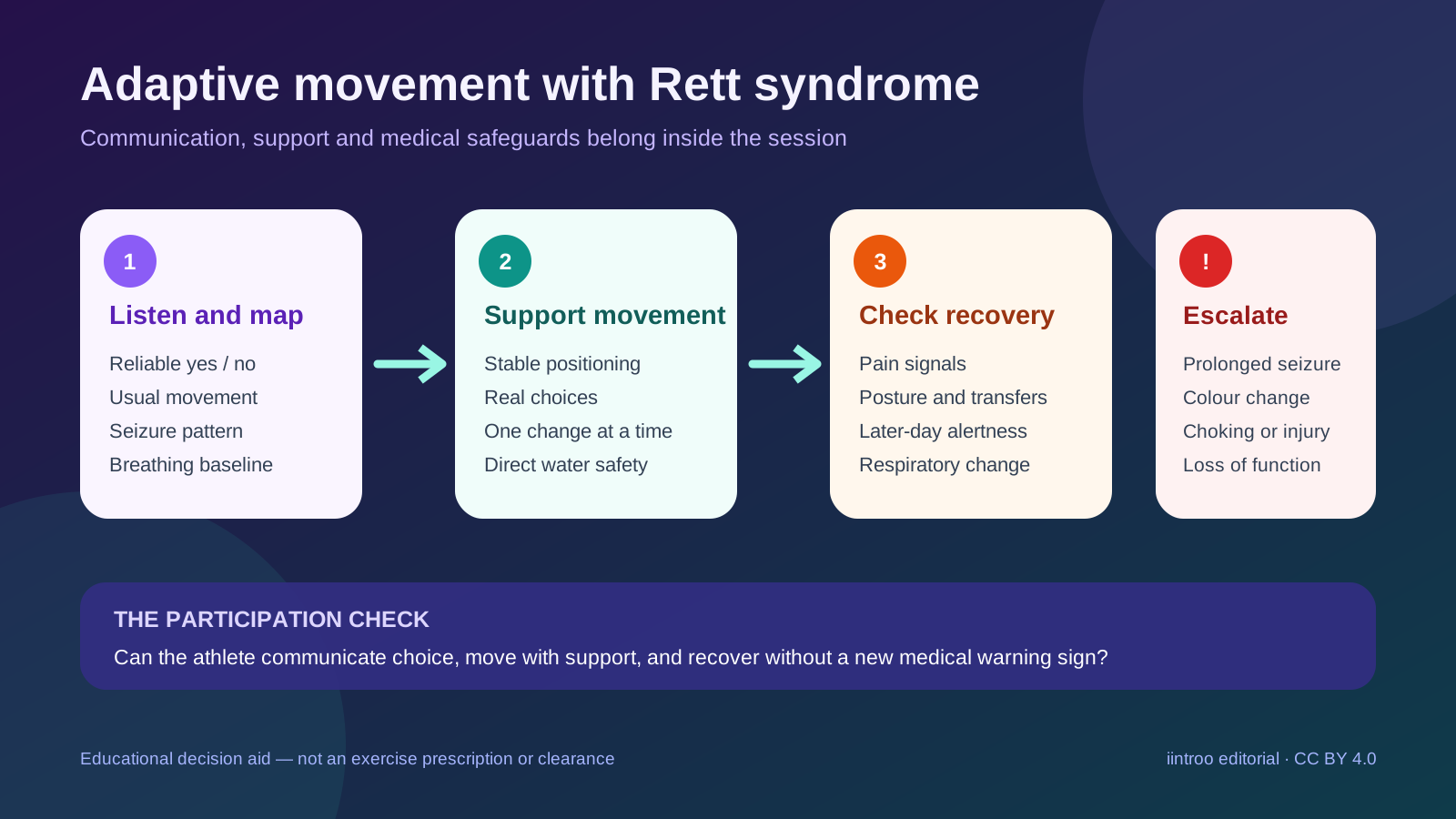
Key points
- Movement opportunities can support participation and function, but the evidence is mainly small, heterogeneous rehabilitation studies rather than sport trials.
- Communication access, seizure history, breathing pattern, mobility, scoliosis, bone health and swallowing can all change how a session is planned.
- A first or prolonged seizure, injury, marked breathing change, blue or grey colour, aspiration concern or sudden loss of function needs urgent assessment.
Begin with communication, function and medical context
This guide is for people with Rett syndrome, families, coaches, teachers and rehabilitation teams. Rett syndrome is a neurodevelopmental condition, usually associated with MECP2-related disease, that can affect hand use, speech, walking, breathing regulation, epilepsy, sleep, feeding, bone health and the spine. Abilities and health needs vary across age and disease stage. A person who does not use speech may still make meaningful choices through gaze, body movement, expression, symbols or an eye-gaze device. Sport planning should preserve that communication route rather than treating silence as lack of preference.
The lifespan consensus recommends coordinated surveillance across neurology, rehabilitation, orthopaedics, respiratory health, nutrition and communication. Before a new activity, record the athlete's usual mobility, transfers, breathing pattern, seizure presentation, rescue plan, scoliosis or hip concerns, pain signals, swallowing needs and reliable yes/no response. The coach's role is to make participation accessible and observe change. It is not to diagnose seizures, interpret spinal imaging, alter anti-seizure medicine or decide that a familiar breathing irregularity is harmless in a new context.
Use movement evidence with its limits visible
A systematic review identified approaches including conventional physiotherapy, treadmill work, aquatic exercise, music and technology-supported activity, but judged the underlying evidence weak. A small treadmill study included 12 females with Rett syndrome and found that individually paced walking was feasible for up to six minutes while autonomic and breathing responses differed from controls. A three-person aquatic programme and other case-based reports can generate useful ideas, not a universal dose or proof that exercise changes the underlying disorder.
More recent evidence remains cautious. A 2025 multiple-baseline study of 20 girls found gross-motor improvements during an individualized home programme but no significant reduction in scoliosis progression across the group. A 2026 systematic review of supportive care described continued reliance on therapy and assistive interventions while noting sparse evidence about utilization and outcomes. These findings support repeated, individualized assessment. They do not justify promising prevention of scoliosis, fewer seizures, restored speech or a particular number of minutes, steps or pool sessions.
Adapt the session around access and predictable risks
Use familiar communication partners and offer real choices about music, equipment, pace and stopping. Stable seating, supported standing, flotation, handholds or an adapted cycle may reduce barriers, but positioning and equipment should follow current physiotherapy or occupational-therapy advice. Build one element at a time and allow recovery before technique deteriorates. Repetitive hand movements, apraxia or delayed responses are not non-compliance. A wearable step count can describe some movement, but it cannot measure enjoyment, pain, seizure control, respiratory safety or the value of participation.
Keep the individual seizure action plan and prescribed rescue medication accessible, with trained responders and emergency routes known. Ask the clinical team about restrictions after a recent fracture, surgery, worsening scoliosis or changing seizures. In water, use direct supervision and a rescue plan matched to seizure and swallowing risk. Respiratory pauses, breath-holding or hyperventilation can occur in Rett syndrome, yet a new pattern, distress, colour change or reduced responsiveness should not be normalized. Avoid forced stretching, unsupported impact and competitive pressure to continue through distress.
Escalate change and return through familiar function
Stop and follow the emergency plan for a first seizure, a seizure lasting longer than the person's plan allows, repeated seizures without recovery, injury, breathing difficulty, blue or grey colour, choking, collapse or reduced consciousness. New persistent pain, loss of walking or transfers, a marked change in posture, repeated aspiration signs, fever with respiratory symptoms or a sustained decline in alertness needs clinical review. Do not give food, drink or medicine during impaired consciousness unless the written plan specifically directs trained responders.
After illness, seizure change, fracture or surgery, return from comfortable familiar movement to supported skill practice and then longer or more complex sessions, guided by the responsible clinicians when baseline function changed. There is no universal seizure-free interval, spinal angle, heart-rate target or walking test that clears everyone. This article cannot diagnose Rett syndrome, prescribe therapy or equipment, change medication, assess swallowing or clear participation. Its purpose is to help a team create dignified movement opportunities while treating communication and medical safeguards as part of the sport itself.