
Repeatable lower-leg tightness in runners: understanding chronic exertional compartment syndrome
Lower-leg tightness that returns at a similar workload can be chronic exertional compartment syndrome. Diagnosis must exclude bone, nerve and vascular causes.
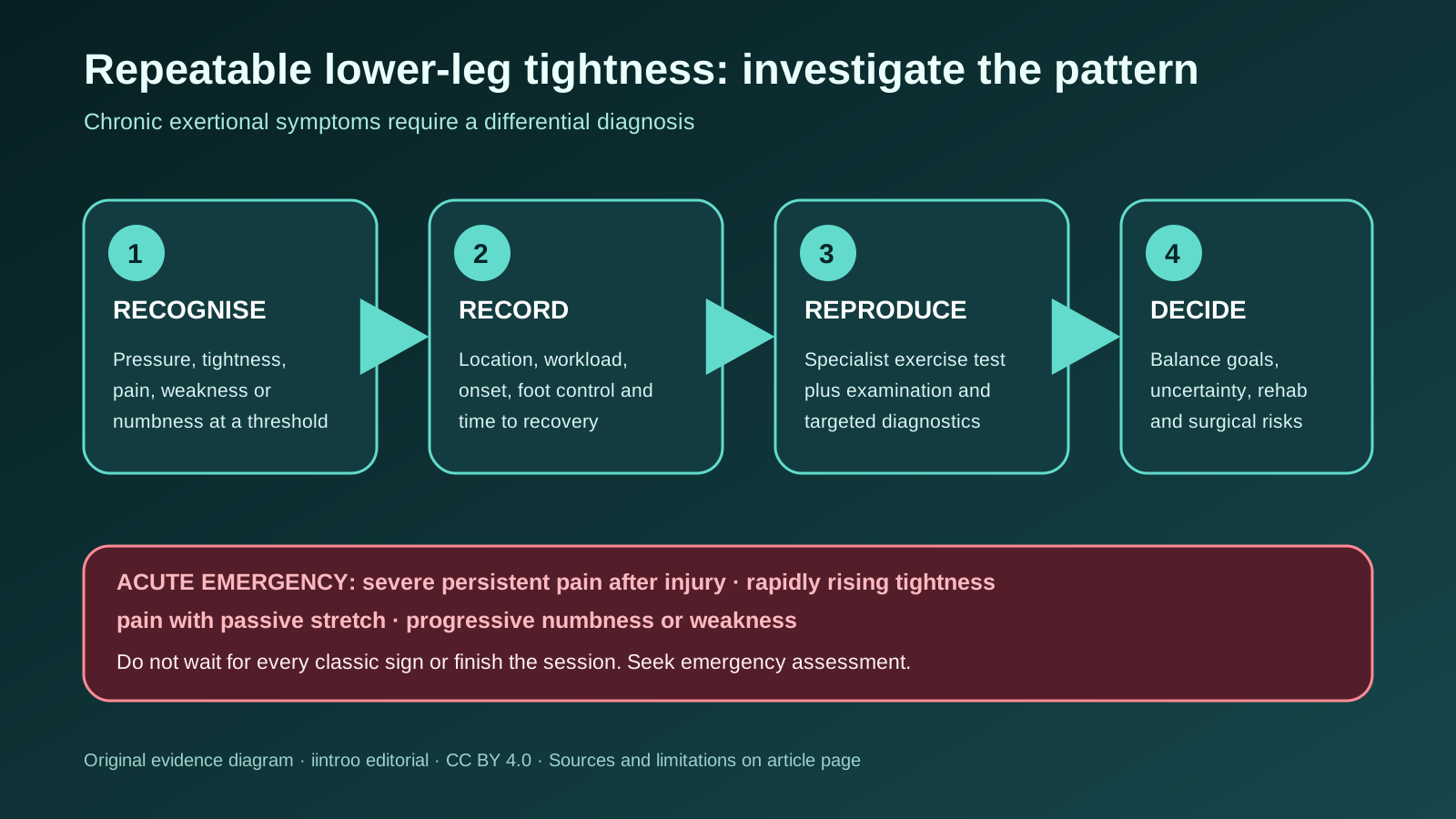
Key points
- Chronic exertional compartment syndrome can cause reproducible pressure, tightness, pain, weakness or altered sensation during exercise that eases after stopping.
- History and examination before and after a symptom-provoking test guide diagnosis; pressure thresholds and protocols vary, and no isolated number explains every case.
- Sudden severe persistent pain after injury, pain with passive stretch, increasing weakness or numbness is a different emergency pattern requiring immediate assessment.
A repeatable exercise threshold is an important clue
This guide is for runners and other athletes who develop a predictable pressure, aching, cramping or tight sensation in one or both lower legs during exercise. Weakness, foot slapping, numbness or tingling may occur. In chronic exertional compartment syndrome, symptoms often begin around a similar time, distance or intensity and improve after stopping. That pattern is useful, but it is not diagnostic and should not be reduced to the label ‘shin splints.’
Bone stress injury, medial tibial stress syndrome, tendon or muscle problems, nerve entrapment and vascular disorders such as popliteal artery entrapment can overlap. Training history, footwear, surface and technique matter, but they do not identify the cause alone. Localised bone tenderness, pain at rest or at night, swelling, persistent neurological change or symptoms that no longer settle deserve timely assessment. A clinician should compare both legs and examine the athlete before and, when appropriate, immediately after symptoms are reproduced.
Diagnosis combines the story with appropriately timed testing
An international Delphi consensus supports a characteristic history and physical examination around provocative exercise. Intracompartmental pressure testing is commonly used when diagnostic confirmation would change management, but protocols, timing and cut-off values vary. A static measurement without the athlete’s familiar symptoms may mislead. Imaging or vascular and nerve tests can be selected to examine alternatives rather than ordered as a universal battery for every painful lower leg.
Do not repeatedly run through escalating weakness or altered sensation to prove the pattern on an unsupervised route. Record location, onset time, effort, surface, recovery time and any foot control or sensory change. Video and training data can show reproducibility but cannot measure compartment pressure or exclude a stress fracture. The useful question is not only ‘does pressure rise?’ but whether the history, examination, test response and competing diagnoses form a coherent explanation.
Conservative care and surgery both carry uncertainty
Initial management may include temporary load modification, rehabilitation of relevant strength and mobility, running-technique work and review of equipment or training errors. Evidence for specific conservative programmes is limited and not every proposed gait change suits every athlete. A reduction in symptoms during a short modification period does not prove the diagnosis. The plan should preserve fitness where possible without repeatedly provoking severe symptoms and should be reviewed against the athlete’s goals and objective function.
Fasciotomy may be discussed for a well-supported diagnosis with substantial limitation that persists despite appropriate non-operative care. Systematic reviews report variable symptom relief, satisfaction, complications and return to previous activity, mostly from observational studies using inconsistent definitions. Surgery is therefore not a guaranteed route back to running. A surgeon should explain which compartments are involved, diagnostic confidence, alternatives, wound and nerve risks, recurrence or revision risk and how outcomes match the athlete’s sport.
Return by capacity, and recognise the acute emergency
After either conservative care or surgery, return should follow symptom behaviour, wound healing when relevant, strength, movement control, neurological status and progressively greater running demand. Walking and easy jogging do not test hills, speed, repeated intervals or competition fatigue. Rehabilitation protocols and return criteria after surgery are poorly standardised, so a calendar alone is insufficient. Increase one main demand at a time and reassess if the familiar pressure, weakness or numbness returns.
Acute compartment syndrome is different and can threaten muscle and nerve. Sudden severe pain that persists rather than settling, especially after trauma, rapidly increasing tightness, pain with passive stretch, progressive numbness or weakness requires emergency assessment. Do not wait for all classic signs or finish the session. This article does not diagnose CECS, recommend pressure testing or surgery, or provide individual return clearance.