
Scapholunate ligament injury in sport: protect wrist stability and function
Persistent central wrist pain after a fall or loaded extension can signal scapholunate injury. Early assessment matters because severity and treatment vary.
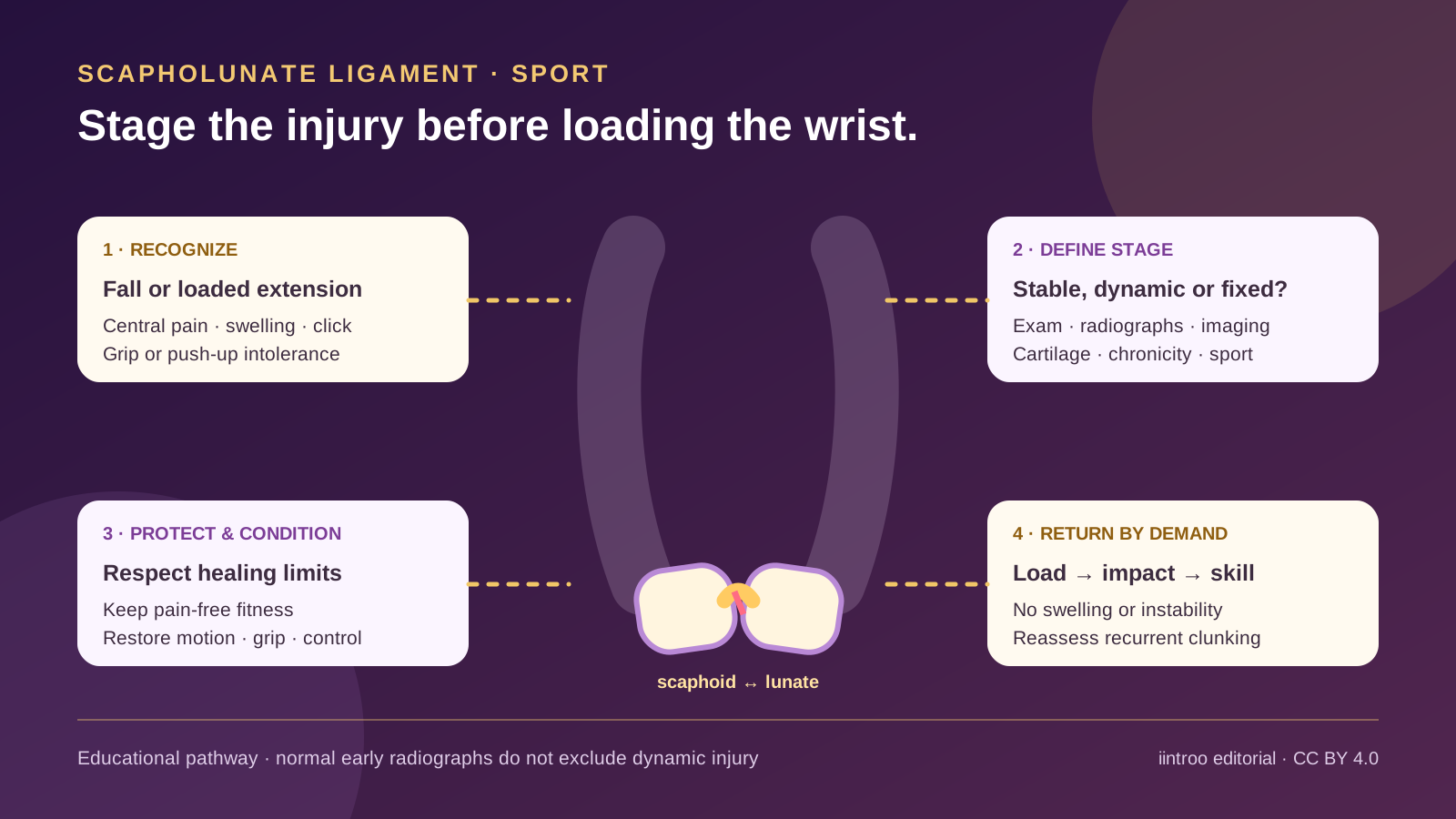
Key points
- The scapholunate ligament complex stabilizes two central wrist bones; injury ranges from a partial sprain to dynamic or fixed carpal instability.
- Initial radiographs can be normal, so persistent pain, clicking, weakness or load intolerance after trauma deserves reassessment rather than repeated provocation.
- Treatment and return depend on injury stage, reducibility, cartilage, chronicity and sport demands; published return evidence is heterogeneous.
Take central wrist pain seriously after trauma or loaded extension
The scapholunate interosseous ligament complex helps the scaphoid and lunate move as a coordinated unit. Injury may follow a fall onto an extended wrist, forceful impact or repeated high-load extension in gymnastics, boxing, weightlifting, racquet sport and snow sport. Pain is often on the central or thumb-side back of the wrist, with swelling, clicking, reduced grip or pain in push-up positions. Those features overlap with fractures, cartilage injury, tendinopathy and dorsal impingement and cannot confirm a ligament tear.
Visible deformity, an open wound, marked swelling, new numbness, a cold or pale hand or inability to move the wrist after significant trauma needs urgent assessment. Less dramatic symptoms still deserve timely review when pain persists, grip falls or loaded extension repeatedly fails. Early plain radiographs help detect fracture and static widening, but normal films do not exclude partial or dynamic injury. Repeated self-testing with painful push-ups or forceful wrist manoeuvres can add irritation without clarifying the diagnosis.
Define injury stage before choosing rehabilitation or surgery
Assessment combines mechanism, tenderness, stability tests and imaging. Clinicians may use comparison or stress radiographs, ultrasound, MRI, CT or wrist arthroscopy depending on the question. Each has limitations, and arthroscopy can define ligament and cartilage injury when results will change care. The clinically important spectrum includes partial injury, dynamic instability visible only under load, fixed widening, irreducible deformity and later arthritis. One measurement cannot represent the whole wrist.
Chronicity matters because ligament repair potential and carpal alignment change with time. Recent reviews describe many nonoperative and operative pathways, with no single technique consistently superior across all stages. Stable partial injuries may be managed with protection and progressive rehabilitation, while acute repairable tears or more advanced instability can require specialist surgery. The athlete's age, hand dominance and reliance on weight-bearing or impact also shape the decision. A brace bought online cannot determine whether the carpus is stable, and an athlete should not delay assessment simply to finish a season.
Maintain conditioning without repeatedly loading the injured carpus
While the diagnosis and protection plan are established, conditioning can emphasize lower-body and aerobic work that does not reproduce wrist pain or require risky catches. Gymnasts, boxers and lifters need explicit substitutions because bars, floor skills, punching, front-rack positions and pressing can load the scapholunate interval differently. Immobilization or postoperative restrictions may also limit safe grip, steering and fall protection. The treating clinician and therapist should approve equipment and positions rather than relying on pain alone.
Rehabilitation may restore finger and forearm function, wrist motion, grip, proprioception and load tolerance in stages, but the order changes with treatment. Forcing extension or heavy grip too early can threaten healing; excessive protection can add stiffness and weakness. Persistent clunking, recurrent swelling, loss of grip or increasing pain needs reassessment. This is not a condition for generic mobility drills or an automatic return once resting pain disappears.
Return through sport-specific load and honest evidence limits
A systematic review of surgical treatment found return to work or sport rates above 80% across included techniques, but the studies were small, heterogeneous and mixed occupations with athletes. The optimal operation and reliable sport-specific timeline remain uncertain. A 2026 state-of-the-art review likewise emphasizes stage, severity and chronicity rather than one procedure. Population averages should not be converted into a promise for a gymnast, goalkeeper, boxer or wheelchair athlete.
Return progression can move from daily activities and protected strength to closed-chain loading, catching or punching, heavy grip, impact and full technical sequences. Decisions consider pain, swelling, motion, grip, stability, imaging or surgical healing when relevant, and the consequences of another fall. Taping may support a plan but cannot stabilize every injury. This page cannot diagnose ligament grade, select imaging or surgery, or clear competition; it supports early assessment, stage-matched treatment and criteria-led reloading.